


by Fernanda Macedo
On September 25, I attended a meeting between President Luiz Inácio Lula da Silva and business leaders to discuss the outlook for Brazil. Among the economic topics discussed, one political reflection stayed with me: we’re living through a time when argument carries less weight, facts no longer settle debates, and opinions circulate as if they were sufficient on their own.
This shift isn’t just about how we argue on social media. It affects government decisions, international relations and societies’ ability to recognize when power is trying to replace justification with force. When the obligation to prove and explain weakens, whoever has more resources to repeat their own version of events also gains more freedom to act on it.
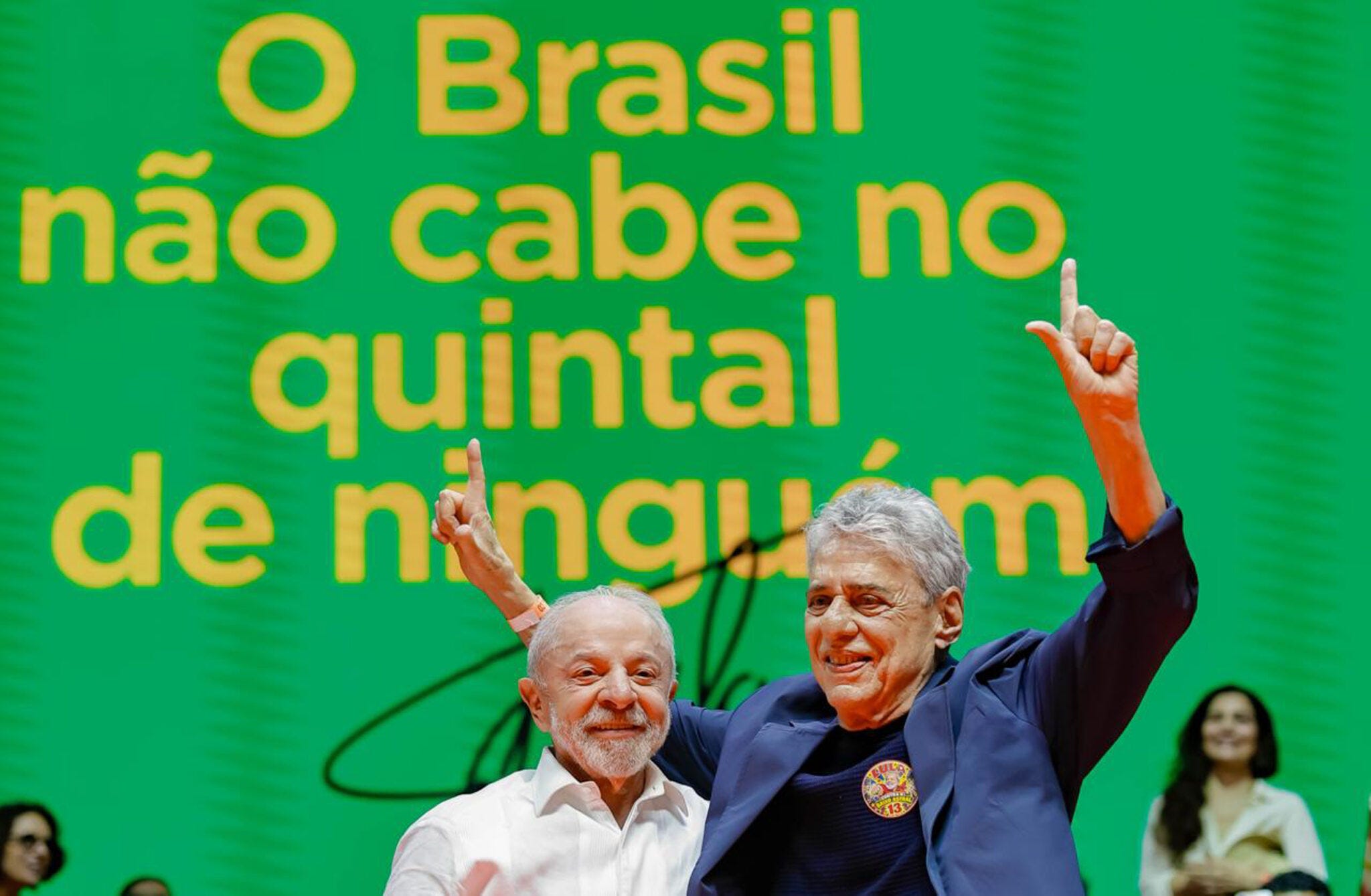
President Lula and Chico Buarque in front of screen which reads, “Brazil doesn’t fit in anyone’s back yard.” (Ricardo Stuckert)
This is the backdrop against which we should view Donald Trump’s policy toward Latin America. On that Friday’s meeting, Lula said, in essence, that Trump’s bet is to own the region. I agree with that reading. This isn’t about claiming there’s a declared plan for territorial annexation. It’s about recognizing a struggle for power: Washington is working to expand its ability to influence which governments receive support, which national decisions get tolerated, and how Latin America’s strategic resources get used.
That interpretation is backed up by language the U.S. government itself has chosen. In its National Security Strategy, the White House announces a “Trump corollary” to the Monroe Doctrine. Its stated goal is restoring U.S. preeminence in the Western Hemisphere. The document calls for strengthening aligned political partners, reviewing the U.S. military presence in the region, and identifying resources and locations considered strategic. This isn’t just a provocative line from a president. It’s a government policy, put in writing.
The reference to the Monroe Doctrine matters because it shows that an old question is still with us: who has the right to determine the future of the Americas? The promise to block the influence of outside powers might sound, at first, like a defense of regional autonomy. But Latin American countries’ autonomy is also diminished when a single country claims the authority to decide which economic and political relationships its neighbors should maintain. For us, trading one power’s tutelage for another’s isn’t independence.
The U.S. strategy doesn’t hide the fact that it considers the hemisphere important to its supply chains, trade, security and access to strategic resources. None of that is surprising. What demands pushback is the attempt to turn those interests into a right to take priority over everyone else’s. There’s a difference between proposing a partnership to develop resources and assuming that a sovereign decision about those resources can be treated as a threat.
Trump’s speech at the U.N. General Assembly made this logic even more explicit. Referring to U.S. actions in Venezuela, he said his administration wouldn’t allow threats to take hold anywhere in the Western Hemisphere, and that it would use military force if necessary to protect its “vital national interests.” The U.N. recorded the statement, and the White House itself highlighted it.
These words deserve scrutiny. Who decides what counts as a threat? Which interests are vital? What mechanisms let affected countries challenge that definition before it’s used to justify sanctions, pressure or the use of force? In Trump’s framing, U.S. national interest alone is treated as reason enough to announce the possibility of a military response in a region made up of sovereign states. The asymmetry is obvious: Washington claims a latitude for itself that it would hardly agree to extend to any of its neighbors.
The fight against organized crime offers an example of how this asymmetry can be presented as an unquestionable necessity. Drug trafficking causes real violence, erodes institutions and crosses borders. Confronting it requires international cooperation. But however serious the problem is, it doesn’t remove the need for proof of who’s actually being targeted in an operation, clear criteria for using force, and accountability for the results. When the label “narcoterrorist” seems sufficient to shut down those questions, the language of security stops clarifying a decision and starts shielding it from public scrutiny.
In Venezuela, the discussion extends to oil as well. The White House has announced measures affecting revenue from its sale. Venezuela’s political situation deserves critical scrutiny, including of its own authorities’ responsibility. Even so, criticizing one government doesn’t automatically give another country the right to determine what happens to its resources. Defending self determination doesn’t mean staying silent about internal abuses. It means refusing to let those abuses serve as a standing license for outside control.
Tools of influence aren’t limited to military force, though. Trade deals, tariffs, access to technology and financing can also set real limits on a country’s choices. An economic proposal doesn’t stop being political just because it comes wrapped in numbers and contracts. When one party has the power to restrict markets or make investment harder, it’s fair to ask how much real room the other side actually has to say no.
Brazil knows this tension firsthand. Facing U.S. tariffs, Lula recently said he would keep negotiating before resorting to reciprocal measures, while leaving that option open if talks failed. That position can be judged by its results and challenged on its merits. What matters is that Brazil’s own debate keeps the country’s own interests in view: who bears the cost of the tariffs, which sectors are affected, what concessions are on the table, and who benefits from any eventual deal. Negotiating means understanding the price of each decision, even when that price doesn’t show up as a tariff.
Brazil’s elections have made this issue even more sensitive. The first round took place on October 4. In his U.N. speech, Lula warned against foreign interests shaping Brazil’s national debate and said Brazilian democracy belongs to Brazilians. That claim should hold regardless of any individual voter’s party preference. Defending the idea that the choice belongs to the Brazilian people means defending the conditions that let candidates compete for votes, institutions remain accountable, and foreign interference be identified and discussed openly.
This is where the reflection I heard on September 25 takes on its most urgent dimension. Losing the argument doesn’t mean political conflicts disappear. It means we face them with fewer tools to hold power accountable. Economic pressure can be presented as cooperation. Military action can be presented as protection. One power’s interest can enter the debate as if it were a universal necessity. To push back on any of these framings, we need to separate what actually happened, what was claimed to justify it, and what goals the action actually serves.
Facts, of course, don’t speak for themselves. They need to be verified, put in context and interpreted. To argue is to commit to offering reasons other people can check and question. That’s why defending an argument itself isn’t a call for neutrality. It’s a demand for accountability, including for those of us who criticize U.S. power. Our criticism will be stronger if we can point to specific documents, decisions and consequences, rather than treating every diplomatic disagreement as proof of intervention, or every economic partnership as submission.
It’s also not enough to call for Latin American unity as if every country in the region shared identical interests. They don’t. Their societies disagree on development models, international alliances, security and the distribution of wealth. A democratic response to U.S. claims of preeminence starts by recognizing these differences and defending each country’s right to debate them. Regional integration only has value if it expands its members’ ability to choose, rather than creating a new obligation to obey.
Agreeing with Lula’s reading, then, means taking seriously the mechanisms through which one country can try to control other countries’ decisions without ever declaring ownership of their territory. It means paying attention to who controls the terms of negotiation, who defines the threats, who claims priority access to resources, and who reserves the right to use force. The vocabulary might be one of partnership. The actual power relationships need to be examined beyond it.
I left that meeting on September 25 thinking that losing the argument has very concrete consequences. When we stop distinguishing fact, interpretation and interest, we lose the ability to see clearly what’s being decided in our name. On the eve of a runoff election, recovering that capacity is part of defending Brazilian democracy. For Latin America, it’s also a condition for recognizing the pressures the region faces, negotiating without giving up its autonomy, and affirming that its future belongs to the people who live here.
Fernanda Macedo is a lawyer with a postgraduate degree in Criminal Sciences and Public Security from Uerj, a university professor, and the author of Racial Literacy in Security Forces.
This article originally ran in LeMonde Diplomatique Brasil, was reprinted and translated by Panamerican Dispatch with express permission of the editor-in-chief, and can be read in its original Portuguese here.