

by José Bernardes and Maria Teresa Cruz
Brasil de Fato
The two main speeches at the opening of the U.N. General Assembly were delivered by Brazilian President Luiz Inácio Lula da Silva and U.S. President Donald Trump. The leaders addressed many of the same issues, but their speeches offered sharply contrasting visions of the global order.
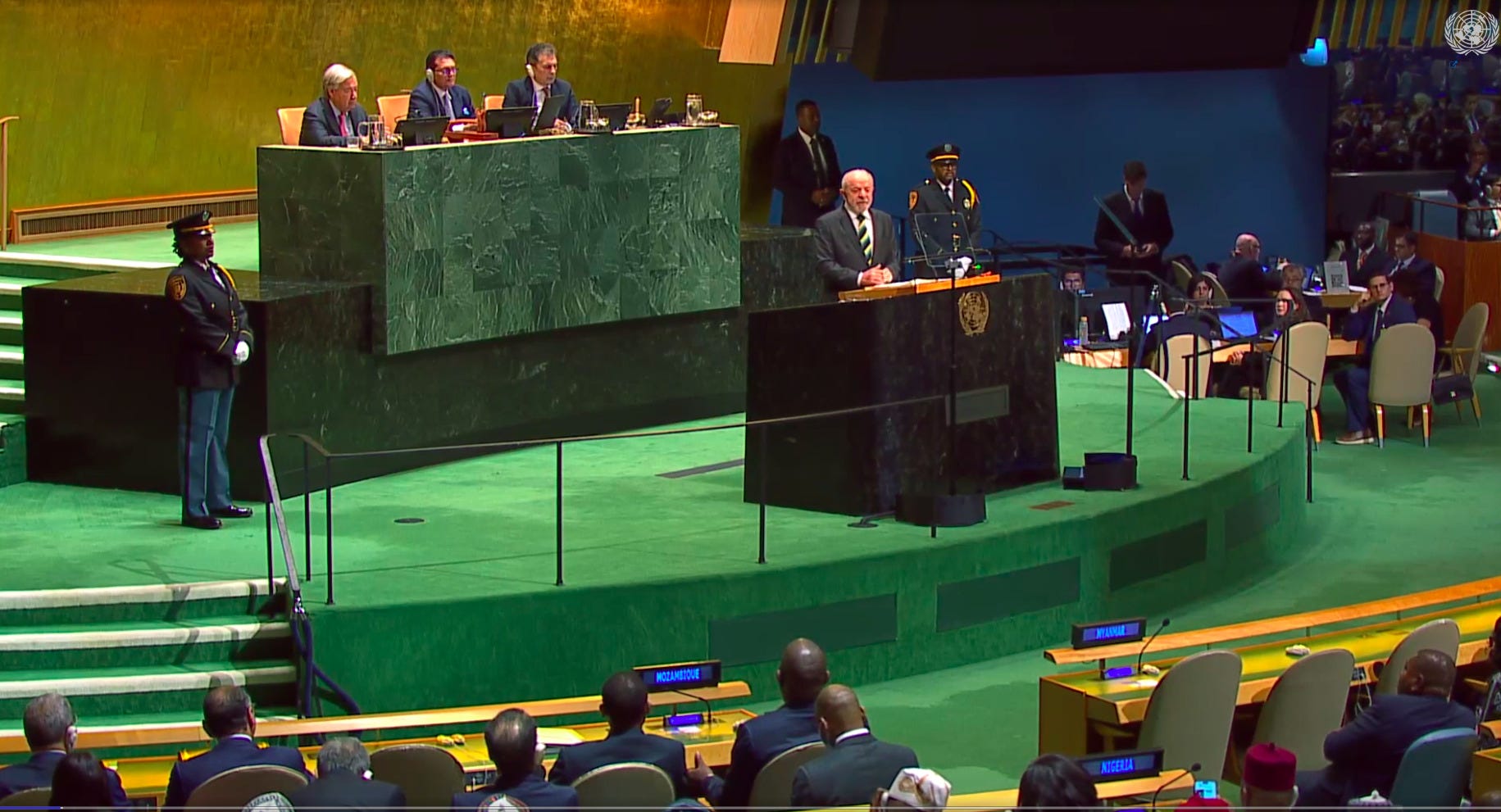
Brazilian president Luiz Inácio Lula da Silva speaks before the UN General Assembly on September 22, 2026 (United Nations)
Sérgio Costa, a sociology professor at the Free University of Berlin, described Lula’s speech as important and forceful, not only for its defense of multilateralism, but also for the statesmanship Lula displayed in his address.
“I think Lula made this very clear: multilateralism is essential to global health, for example. Without multilateralism, we face vaccine shortages and the return of diseases that had been eradicated. Climate and the environment are multilateral issues. So is preventing wars, especially as we are living in a world experiencing a record number of conflicts. These are wars of territorial expansion, something we thought had been left behind in the 20th century, but which have returned with tremendous force,” Costa said during an interview on Conexão BdF, a program on Rádio Brasil de Fato.
Trump, by contrast, offered few surprises as he defended U.S. interests and sought to place his country at the center of the world. “These are the imperialist interests of a power that has lost ground in the world and wants to regain it,” Costa said.
The professor pointed to the document that guides U.S. national security policy, released at the end of last year. He said it explicitly lays out the goal of turning Latin America into a U.S. sphere of influence, with Brazil emerging as an obstacle to that effort.
Trump adopted a belligerent tone. He spoke of annihilating Iran, made direct threats against Cuba and offered no mea culpa regarding Venezuela, acknowledging that the primary interest had always been the oil.
“If we did not have leaders in different Latin American countries willing to hand over their wealth and national sovereignty to the United States, the strategy adopted by the U.S. would not work. It relies on elites that align themselves with this discourse of American hegemony, selling out their countries to build more power at home,” Costa said.
For Costa, one possibility for changing this situation would be for Trump to suffer a defeat in the midterm elections. That could open the way for nations to strengthen the multipolar order on the world stage.
“I believe it is possible to build multilateralism on the foundations that exist today,” said Costa. “In other words, even though these international organizations have been weakened, they have not disappeared.”
Watch Lula’s full UN Speech here.
This article was published by Brasil de Fato. You can read it in its original Portuguese, here.