

by Ivan Longo
Brazilian President Luiz Inácio Lula da Silva used part of his opening speech at the United Nations General Assembly this Tuesday to respond to pressure from the Donald Trump administration over Brazil and to defend national sovereignty.
Without directly naming the U.S. president in his speech, Lula asserted that Brazil does not accept external interference in its democracy and will not submit to the influence of any power.
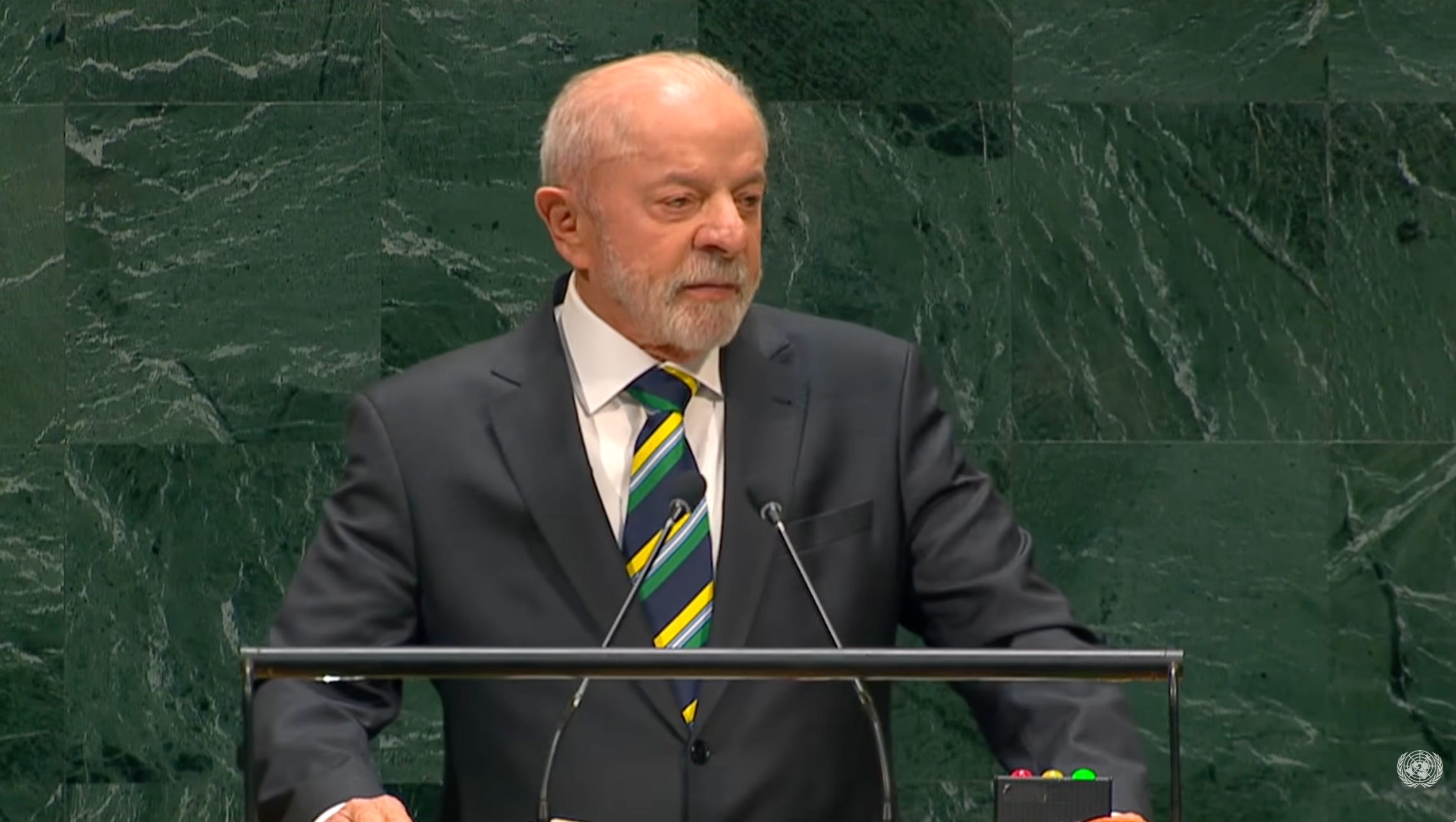
Brazilian president Luiz Inácio Lula da Silva speaks before the U.N. General Assembly on September 22, 2026. (United Nations)
The remarks came amid threats and statements from the U.S. government about Brazilian politics and this year’s elections. The Lula administration has treated these as attempts at interfering in the country.
“In Latin America and the Caribbean, proximity to the world’s greatest power is inescapable. Brazil does not fit into anyone’s backyard,” Lula said, drawing applause from the U.N. General Assembly audience.
The president also criticized the return of international pressure on democratic processes and stated that the world is once again contending with practices he considers outdated.
“We have come a long way to restore the popular will. Democracy is once again under threat. We are witnessing a return of external interference in electoral processes and neocolonial drives for strategic resources. These are things of the past,” he said.
According to Lula, countries must choose between opposing paths in international relations.
“We are called upon to choose between multilateralism and unilateralism. Sovereignty or subordination,” he said.
“We do not need aircraft carriers patrolling our waters”
Addressing the relationship between Latin America, the Caribbean, and the United States, Lula said that cooperation must replace the logic of pressure and confrontation.
“We need partners with a positive agenda that fosters development. Ideological differences should not be an obstacle to greater integration,” he said.
The Brazilian president further stated that Brazil does not need displays of military might, but rather collaboration to tackle concrete problems.
“We do not need aircraft carriers patrolling our waters. We need cooperation to stem the flow of weapons and money fueling organized crime,” he declared.
Lula said that this was the spirit of the documents he personally handed to the U.S. president earlier this week. Among them was a proposal to collaborate with the United States on combating organized crime.
Global crisis and the defense of diplomacy
During his speech, Lula said the world is experiencing a “profound crisis of leadership” and noted that 2025 saw the highest number of armed conflicts since World War II. In the Brazilian president’s view, the current scenario demands stronger action from multilateral bodies.
“The leaders of the Security Council nations need to meet. I am not unaware of the realities of power. War is not the continuation of politics by other means. It is the total failure of politics,” he said.
Commenting on the war between Russia and Ukraine, Lula said the conflict “has dragged on for five years as a humanitarian drama that continues to claim lives.”
“There will be no winners on the battlefield,” he said. “Diplomacy is the only solution.”
The Middle East and historical redress
Lula also mentioned the conflicts in the Middle East, stating that the Strait of Hormuz, which ought to be a corridor for international trade, has become a place of “trench warfare.”
Citing the peace agreements between Israelis and Palestinians, he noted that Yitzhak Rabin and Yasser Arafat were statesmen who “defied the past to envision a future of peace,” but who “were defeated by hatred.”
The president also highlighted a recent U.N. General Assembly decision that, according to him, corrected “historical distortions” by recognizing the trafficking of enslaved Africans as the “gravest crime against humanity.”
That statement was also met with applause.
Ivan Longo is a journalist and Politics Editor at Revista Fórum. This article was originally published in Portuguese at Revista Forum. You can read the original here.