

On September 22, Brazilian President Luiz Inácio Lula da Silva gave the opening speech of the 2026 U.N. General Assembly in New York City. He discussed the concerning state of the world, demanded diplomacy to resolve conflicts and called this, “this is the most critical moment of the United Nations.”
He also denounced attempts to influence upcoming Brazilian elections.
“Brazil does not fit into anyone’s backyard,” he said. “We need partners with a positive agenda that promotes development.”
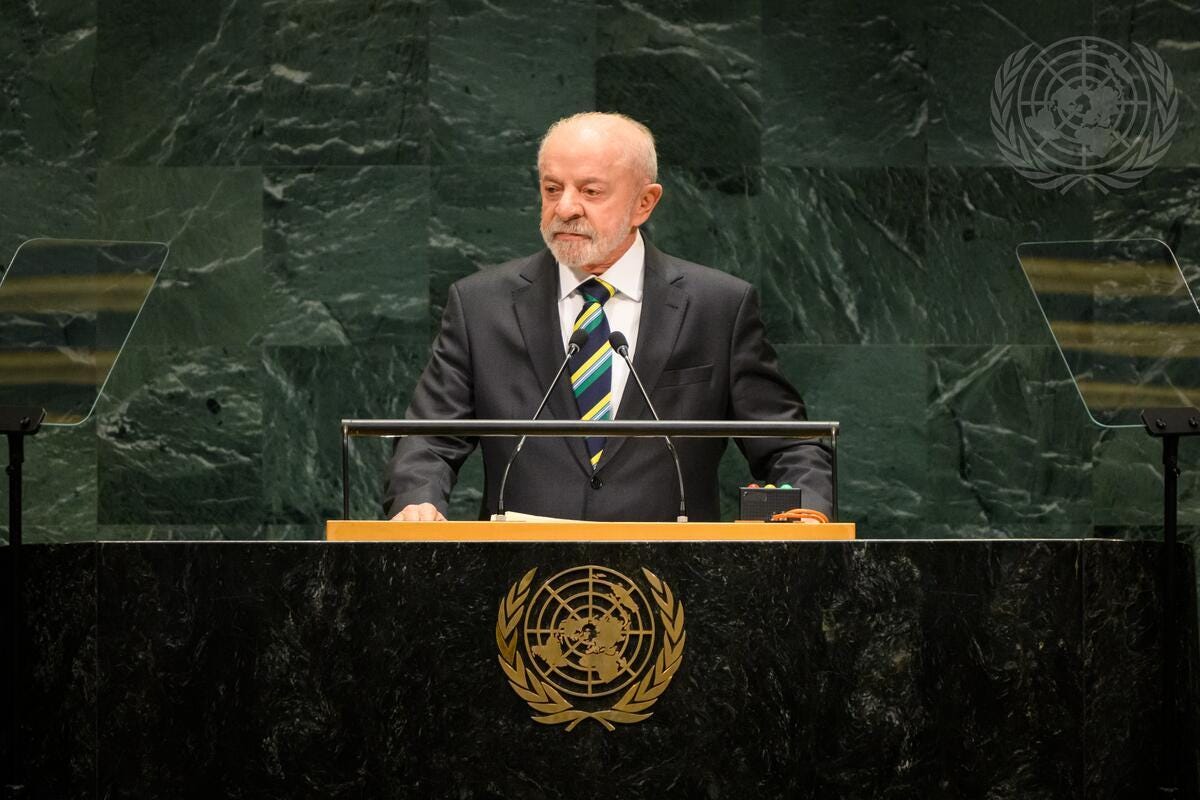
President Luiz Inácio Lula da Silva speaks before the U.N. General Assembly, on September 22, 2026 (United Nations)
Full Speech by Brazilian President Luiz Inácio Lula da Silva, in English.
My compliments to the President of the General Assembly, Ambassador Khalilur Rahman from Bangladesh.
I greet each of the Heads of State and Government and the delegates present. I address in particular the Secretary-General of the United Nations. During his two terms, António Guterres was a direct witness to the growing mismanagement of the superpower.
Mr. President, this is the tenth occasion in which I open the General Debate of this Assembly. Since I stood at this podium for the first time in 2003, this is the most critical moment of the United Nations. The feeling that moves me today is that of indignation.
The United Nations is failing in one of its highest missions, to free humanity from the fray of war. Its credibility has never been so low. Its ability to protect the most vulnerable, those who have no army or arsenals, has never been so small.
We are all victims of the immobility of a Security Council that does not fulfill its role. In 1946, already in the first session of this assembly, Brazil warned of the high price that the international community would pay for the right to veto. This vice, which gave rise to the U.N. Charter, conferred the great powers the privilege of insensitivity.
This original sin is now added to a profound crisis of leadership. The year 2025 recorded the highest number of armed conflicts since World War II. Trillions of dollars financed a new arms race.
Geopolitical tensions threaten to turn regional disputes into a conflict of global proportions. Those who hold the reins of crucial decisions must act responsibly and in a sense of urgency. The leaders of the countries that make up the Security Council must come together.
I know the realities of power, but the concessions to the law of the strongest have already crossed the limits. This is not idealism, it is pure realism. War is not the continuation of politics by other means, it is the total failure of politics.
In an interdependent world, to lead is to reconcile the interests of the homeland with that of humanity. This is the statement of someone who represents a nation that loves peace and freedom. Someone who fought against a military dictatorship and defended his country against a coup d’état.
It is the conviction of a factory worker, who was elected president three times and who won the fight against hunger in Brazil. This assembly has recently corrected historical distortions. It has recognized the trafficking of enslaved Africans as the most serious crime against humanity.
It has approved the most precise representation of the world map. Now we must debate about determining themes for the future of humanity. We are called to choose between multilateralism and unilateralism, democracy or extremism, sovereignty or subordination.
These choices demand courage, political will and clarity of objectives. This is what is expected of a statesman. Yasser Arafat and Yitzhak Rabin were statesmen.
They challenged the past to design a future of peace. They were defeated by hatred. Generations of Palestinians will carry the pain and trauma left by the genocide practiced by the Netanyahu government against women and children in Gaza.
Israeli civilians paid the price of radicalism and intolerance of the terrorist acts of Hamas. Pursuing the International Criminal Court and its members is an incentive for these crimes to be punished. The U.N. Special Rapporteur Francesca Albanese cannot be silenced for telling the truth.
Illegal settlements in the West Bank are becoming less and less viable. The two-state solution is essential so that Israelis and Palestinians can live in peace. Threatening the extinction of a civilization will not bring stability to the Middle East.
The Strait of Hormuz became a trench of war when it should remain a vital passage for international trade. Families all over the world pay for the increase in the price of fuel, fertilizers and food.
The war between Russia and Ukraine has dragged on for five years in a humanitarian drama that continues to save lives.
We all know that there will be no winners on the battlefield. Diplomacy is the only option. Initiatives such as the Group of Friends of Peace, created by Brazil and China, reveal the strength of the international community willing to work for dialogue.
In Latin America and the Caribbean, the geographical proximity to the world’s largest military power is inescapable, especially in the context of the worsening of hegemonic temptations. Brazil does not fit into anyone’s backyard. We need partners with a positive agenda that promotes development.
Ideological differences should not be an obstacle to greater integration between neighbors. Countries in the region have recognized the horrors of the regime of exception. We have come a long way to restore popular will.
Democracy is once again in check. We are once again witnessing foreign interference in electoral processes. The division of the world into areas of influence and neocolonial attacks for strategic resources constitute anachronistic gestures.
The Venezuelan people deserve to define their own destiny. Nicaragua will not solve its problems by preventing the opposition from running for office. The crisis in Haiti continues to test the limits of the indifference of the international community.
In Cuba, the world is suffering. The collective punishment imposed on 10 million people by an illegal economic embargo and energy blockade. Mr. President, Brazil does not underestimate the challenge posed by organized crime.
We are prepared to face criminal organizations that terrorize our communities. Workers are robbed, mothers lose their children, police officers do not return to home. People are tired of violence.
But we will not outsource the responsibility of defending our borders and guaranteeing the population the right to live without fear. We do not need aircraft carriers guarding our waters. We need cooperation to stop the flow of weapons and money that supplies organized crime.
This is the spirit of the proposal that I personally delivered to the president of the United States. We want to fight the money laundering carried out by Brazilian criminals abroad.
For a long time, Brazilian states have acted in their own way. Criminals took advantage of the lack of coordination. But this is changing. We created in Manaus, in the Amazon, the International Police Cooperation Center of the Amazon, bringing together the public security officials of the nine Amazon countries.
In 2025, we carried out the largest organized crime operation in the history of Brazil. We broke records in the seizure of drugs, goods and illicit resources. We are confronting all levels of organized crime, including crime magnates.
The Anti-Faction Law, which we have just passed, imposes on organized crime more severe penalties than those required for terrorism. Organized crime and corruption go hand in hand. The fight against corruption will continue to be relentless, no matter who may be hurt.
No one is above the law.
Ladies and gentlemen, the pillars of multilateralism are being corroded. The World Trade Organization is on life support. When governments capitulate in the face of those who use tariffs as a weapon of coercion and blackmail, the consequences are disastrous. In the age of disinformation, those who fight progress and knowledge resist the evidence of science. We will never forget the millions of lives lost by negligence in the fight against COVID-19.
Campaigns against vaccines are bringing back diseases that we considered eradicated. Weakening the World Health Organization makes everyone more vulnerable. Until recently, the response to climate change was consolidated in the center of the international agenda.
This year, the issue disappeared from the G7 debate and the G20 debate, forums that bring together the largest carbon emitters in the world. It is time to resume the offensive and impose a defeat to negationism. Nature reminds us every day that we have but one planet.
The Himalayan glaciers are melting. A super El Niño can cause torrential rains, droughts and forest fires in different parts of the globe. Its effects will impact, above all, the most vulnerable.
Brazil has been demonstrating that it is possible to combine economic growth with emission reduction. We have achieved our self-sufficiency in oil and we will continue to research the potential of new reserves such as the Equatorial Margin.
We will not renounce the environmental agenda. We will carry forward the roadmap for the decarbonization of the Brazilian economy. The Forever Tropical Forest Fund, launched at COP30 in Belém, shows that it is possible to change old paradigms. The forest is worth more standing than destroyed.
We will continue to reduce deforestation, which fell by half in the Amazon and reached the lowest level of deforestation in 11 years. We have the moral authority to reject protectionist measures disguised as embracing the environmental cause.
Brazil is a global leader in green energy. We have the critical minerals and rare earths that the world needs to carry out the energy transition. Our natural wealth belongs to the Brazilian people and it is for their benefit that they will be exploited. Access to our minerals will be a mandatory counterpart to the generation of value in our territory, the transfer of technology and the supply
of national strategic sectors.
Mr. President, we live in an unprecedented technological revolution, with great risks and opportunities. It would be an unforgivable historical omission not to face the challenge of regulating big tech and artificial intelligence. A handful of oligarchic technicians want to revive a version of digital neoliberalism without rules or transparency.
They are promoting a race without ethical restraints, beyond the backs of the U.N. and the Scientific Panel on Artificial Intelligence. As Pope Leo XIV warns, decisions on technology should never be separated from conscience and responsibility. Companies that know the risks of their products transfer to families the impossible task of facing algorithms.
The millionaire industry of betting apps turns addiction into profit. Its dizzying dissemination is indebting and destroying millions of homes. Brazil will not tolerate this business model.
We approved one of the most advanced legislations in the world to protect children, teenagers and women in the digital environment. We will ensure the joint remuneration of artists, musicians and audiovisual content creators. We will not give in to the pressure of multinationals who want to privatize our Pix, a public and free payment infrastructure that has made financial inclusion a reality for millions of Brazilians.
Ladies and gentlemen, sustainable development goals are the target of attacks from reactionary forces that want to naturalize injustice. Inequality and underdevelopment result from political choices. It is possible to put the poor in the budget and make the rich pay their share.
It is necessary to roll back privileges and invest in free, quality education and health.
There is a legitimate desire for change in the world. But changing is not going backwards.
Changing is not taking away rights.
It is not rehashing theories of racial supremacy or of female submission.
It is not recolonizing the Global South.
Changing is advancing to a future of more participation and more achievements. It is creating and sharing effective public solutions for the challenges of development through a democratic, strong, efficient and capable state. It is betting on the spirit of solidarity and cooperation with Africa, Asia, Latin America and the Caribbean.
Initiatives such as the Global Alliance Against Hunger and Poverty and the International Panel on Inequality are born from this political will. Brazil is in a hurry to become a developed and socially just nation. We have adopted an economic model that focuses on income distribution, creating jobs and wage increases.
We are betting on improving productivity, on increasing credit and on building a robust social protection network. Brazil has grown again in a sustainable way. We are the third largest destination for foreign foreign direct investment.
Despite the U.S. tariffs against our economy, this year we will hit a new record of exports. There is still a lot to be done. The labor market is transforming.
Older people want to remain active. Young people want to start a business. Workers need time to rest, to improve their skills and be with their families.
In Brazil, achieving this goal means ending the so-called 6x1 scale to guarantee workers two days off a week. This change is essential to alleviate the domestic overload that still falls on women.
We are building a Brazil where women don’t have to ask for permission to occupy positions of power or enter the labor market.
A country free of femicide where no woman, in or outside the home, lives under the threat of violence. This is a cause that the world needs to embrace.
Mr. President, upon receiving the Nobel Peace Prize, Mr. King said, “I believe that what self-centered men have torn down, other-centered men can build up.”
The UN was born under the symbol of hope. Over eight decades, it has contributed to decolonization, promoted human rights and supported sustainable development. It protected immigrants and refugees. It condemned racism, anti-Semitism and religious intolerance.
These were the achievements of leaders who stood at this podium, moved by indignation in the face of the injustices of their time. Men and women who refused to accept war as their destiny, colonialism as their right, apartheid as their legitimate system. This ability to say “no” to the inequalities gave birth to some of the greatest transformations that we have lived.
Faced with the paralysis of the United Nations, we need to rediscover the political will so that it can, again, be a temple of peace.
I want to conclude with a message about my country to all who listen to us.
On October 4, millions of Brazilians go to the polls to decide their destiny.
They will not just elect the President of the Republic, state governors and representatives of the legislative power. They will decide between democracy and negationism. If Brazil is going to move toward a future of more opportunities or return to a past of exclusion.
We will have a transparent and competitive election where candidates enjoy the broadest freedom of expression.
We know that some abuses of this freedom seem to be associated with the interests of foreigners, contrary to the country.
We do not underestimate the challenge of the disinformation network that intends to disrupt the public debate during the campaign.
But we have a modern and robust electoral system. Under the watchful eye of a plural citizenry and a free press, we will not allow the enemies of democracy, both internal and external, to attack the popular will.
Brazilian democracy belongs to Brazilians.
Brazil will continue to be a sovereign country.
No one, no one will take us away from this path.
May God bless us all. Thank you.
This speech was translated into English by Panamerican Dispatch. You can read the original in Portuguese, here. You can watch his speech, below.