


by Jamil Chade
The U.S. decision to threaten Brazil with new tariffs this week has solidified the view within Brazil’s Presidential Palace that the Trump administration “can't be trusted.”
In the eyes of Brazil’s executive branch, the time has come for the Lula administration to “reevaluate the relationship” with the United States and redefine how to respond to the coercive tactics deployed by the White House.
Members of the Lula government say the option of reciprocal action has not been ruled out, though the matter must be handled with “care.”
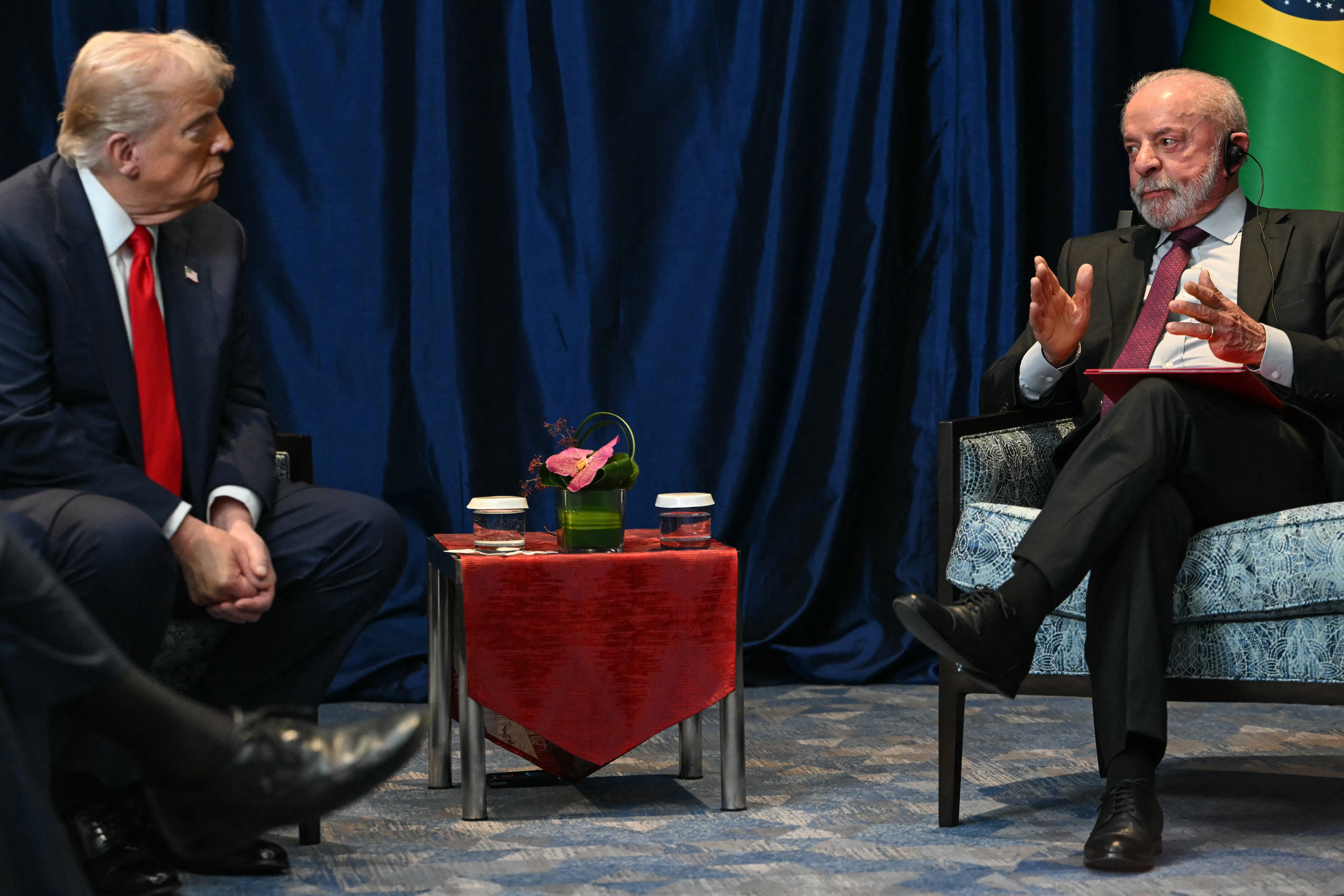
Brazil’s President Luiz Inacio Lula da Silva talks to US President Donald Trump during a bilateral meeting on October 26, 2025. (Photo by ANDREW CABALLERO-REYNOLDS / AFP) (Photo by ANDREW CABALLERO-REYNOLDS/AFP via Getty Images)
On Tuesday, Washington announced that, given the lack of changes to Brazil’s trade practices, it was proposing new tariffs targeting Brazil’s aircraft manufacturing company Embraer and Brazilian sugar. The move was met with indignation by the Lula administration.
Leading up to the Brazilian election, the Brazilian diplomatic strategy had been to manage Trump’s offensive against the country in order to avoid undermining Lula’s candidacy and to prevent further interference from the White House in support of far-right presidential candidate Flávio Bolsonaro.
The approach relied on maintaining a channel open for negotiation with the White House, while simultaneously signaling to the domestic private sector that the government would not stop fighting for the interests of impacted industries.
However, with the election now over, and in light of these new U.S. threats, the Lula administration is reevaluating how to deal with Trump. Brasília believes that Lula emerged from the polls in a stronger position and that, following the Democratic victory in the U.S. midterms, the landscape of the bilateral relationship has shifted.
While Brasília will not refuse to engage with the United States, the possibility of a phone call from Lula to Trump to discuss the issue has, for now, been ruled out. A meeting between the two heads of state, however, is not out of the question and could even take place in two weeks, in Miami, on the sidelines of the G20. But members of the executive branch believe that the U.S. threats against Brazil have shown that Trump cannot be trusted.
On one hand, the White House ignored the existence of a working group tasked with addressing trade issues. On the other hand, Brasília complains that Washington never presented a promised proposal for a framework to guide the negotiations.
Brazil has also concluded that the United States is seeking a “take-it-or-leave-it” agreement rather than a negotiated deal.
In Brasília, diplomats have examined the deals Trump signed with various economies around the world that were also targeted by tariffs. They concluded that those governments conceded to every demand, yet the tariffs on their products were only marginally reduced.
Brazil has already signaled that this strategy will not work here. Not coincidentally, Brazilian officials are beginning to evaluate crafting retaliatory measures, following a model previously adopted by Canada.
Caution
Retaliating would not be so easy. One of the factors being weighed is the potential impact of reciprocal actions, and the risk that they could trigger an even harsher response from Trump, leading to an escalation of tariffs and the trade war.
Brazil is identifying sectors where it could inflict damage on U.S. interests. The “Big Tech” sector is one such area.
Yet, given the current nervousness in the financial markets, some argue that any action by Brazil should be planned to take effect after February 2027.
Another strategy involves forging an alliance with the Democrats, who will hold the majority in the U.S. Congress in the coming term. The Lula administration’s assessment is that Trump’s new wave of attacks against Brazil could be explained by three potential motives:
1. To halt any action by Lula to regulate digital platforms, a move that would set a precedent deemed dangerous to U.S. interests globally.
2. To secure privileged access to sources of critical minerals in Brazil, a matter considered strategic by the Trump administration.
3. To undermine the Lula administration by destabilizing the economy. While the White House knows it cannot simply topple the Brazilian president, as it attempted in Venezuela, this strategy aims to ensure that the progressive wing reaches the 2030 elections in a weakened state.
Another path Brazil intends to pursue is continuing its dispute against the United States at the World Trade Organization, a move the White House hopes Brazil’s Foreign Ministry will abandon.
The Trump administration may choose to ignore a final ruling from the WTO’s adjudicatory bodies. But Brazil views a potential judgment against the United States as a political blow to the White House. And one with broader international repercussions.
The conclusion reached within the Lula administration is that these new tariffs confirm that negotiating with Trump is not a viable option. Moving forward, the goal will be to manage an erratic relationship while reducing dependence on the U.S. market by expanding ties with new partners. It is no coincidence that, in the coming years, Lula is expected to increase his travel to Asia and Africa.
For Brazil, the relationship with Trump will be the major challenge for the Lula administration over the next two years. However, repeating the formulas used between 2025 and 2026 will not be effective.
This reassessment creates openings for retaliatory measures and for undermining the United States on the international stage over its protectionist policies.
Normalization of Ambassadorial Status
Despite this new phase, the Lula administration believes that the situation regarding ambassadors’ visas could be normalized by the end of the year.
Daniel Perez, the nominee for the U.S. embassy in Brasília, is expected to be approved.
The Brazilian Foreign Ministry, however, will apply the principle of reciprocity, granting him the same type of visa that U.S. officials issued to Brazil’s ambassador in Washington, which allows for only a single entry.
Should the White House modify its restriction against Brazil and once again permit the Brazilian diplomat to travel freely, Perez will also be granted a multiple-entry visa.
This article was originally published with ICL Noticias. It was translated by Panamerican Dispatch. You can read the original, in Portuguese, here.