


by Michael Fox
Last year, I traveled to Rio de Janeiro to report on a story about the success of affirmative action and racial quotas at universities in Brazil.
Here’s one example. According to the 2022 Higher Education Census, more than 100,000 students benefited from racial quotas in Brazil in the previous year, alone.
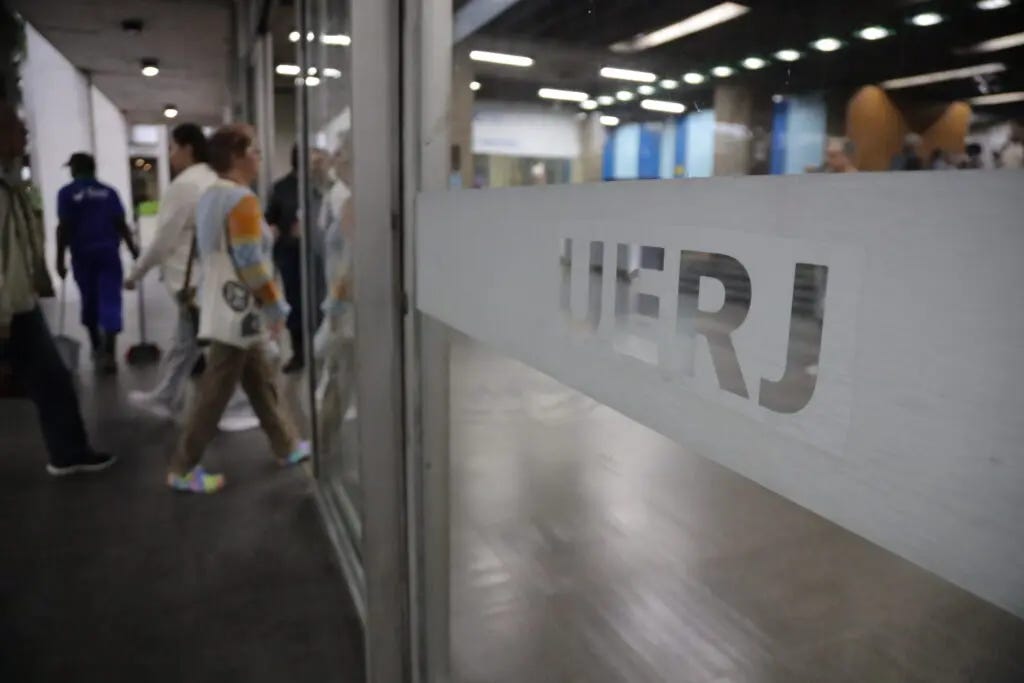
Students walk to class in one of the main buildings of Rio de Janeiro State University in July, 2025 (Michael Fox / The World)
In my reporting, I met David Gomes, the head of Student Affirmative Action Services, at Rio de Janeiro State University. He is a historian and the first of his family to go to college through the university’s racial quota system.
I reached back out to him last week to understand what’s at stake for students, universities, and affirmative action in this presidential election.
He says that if Flávio Bolsonaro wins, it will have “serious” repercussions for Brazil, and in particular, affirmative action at universities, which Bolsonaro and his allies have attacked over the years.
"If Flávio Bolsonaro is elected,” he says. "We will certainly go through a period of turbulence, where they will attack quota policies, despite the fact that quotas have already proven to be a real success.
He also described why Flávio Bolsonaro’s plan to transfer oversight of federal universities from the Ministry of Education to the Ministry of Science and Technology would be disastrous.
Among other reasons, it would mean that federal universities would lose access to the federal funding mandated under the 1988 Constitution. Currently, 18% of federal income tax and 25% of state income tax has to be designated to funding education. Today, that includes higher education.
Moving ministries would essentially be a tool to defund federal universities in Brazil.
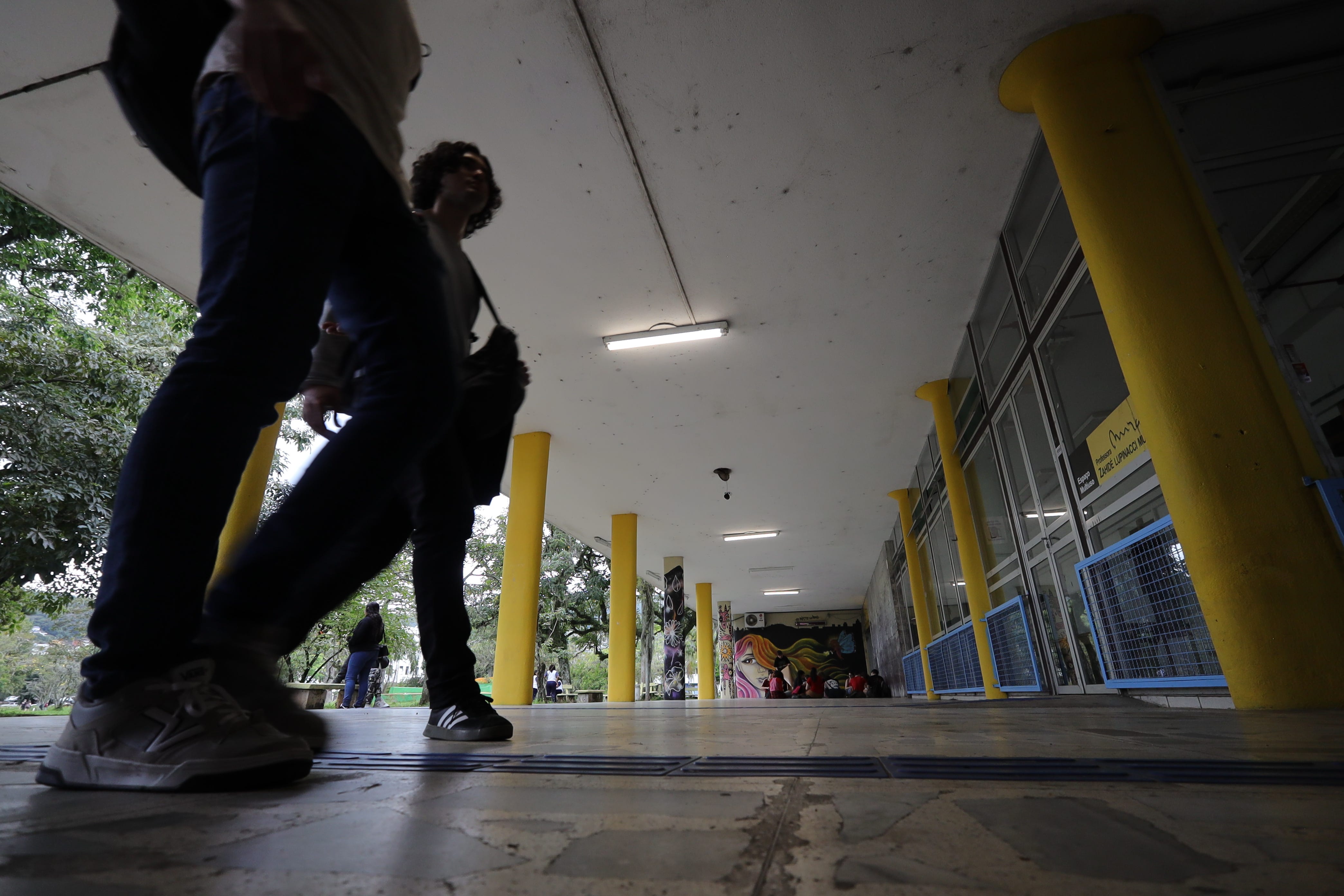
Students walk on the campus of Santa Catarina Federal University in October 2026 (Michael Fox / Panamerican Dispatch)
Michael Fox: David, for you, what is the major difference between the proposals for higher education from President Luiz Inácio Lula da Silva and Flávio Bolsonaro?
David Gomes: Well, I think there are two fundamental issues to evaluate the difference between the proposals for the universities contained in the government plans of President Lula and Flávio Bolsonaro. I think the first one is the legacy of what they've already done and delivered on.
We have, on one hand, President Lula. He was the president who built the most public federal universities in the history of Brazil. He built the most federal institutes and expanded universities.
We also have the quota policy, which Lula already helped to make happen. For the first time in the history of Brazil, we have more than half of university students coming from lower incomes, poor people, occupying public universities. This is a direct policy of President Lula and the Workers’ Party governments.
On the other hand, we have the legacy of Bolsonaro. Not Flávio, but his father, Jair Bolsonaro, who was a true enemy of education and of universities. He implemented cuts and didn’t build any universities during his four years of government. So I think this is the first thing we need to analyze. What both sides have already done for universities in Brazil.
Second, we need to analyze the government plans for this 2026 election. We have, in the case of President Lula’s government plan, a perspective of continuity of appreciating higher public education, with the expansion of our network of federal institutes and federal universities.
As for Flávio, we have something that is very serious. Flavio has said he wants to remove federal universities from the Ministry of Education and place them under the jurisdiction of the Ministry of Science, Technology and Innovation. At first, this may seem like he is worried about investment in science and technology, but in fact this is a maneuver to unlink the universities from the constitutional mandate of funds for education.
We do not have a constitutional mandate for investment in the Ministry of Science and Technology. So this could cripple universities by removing them from the guaranteed minimum investment, which they have today under the jurisdiction of the Ministry of Education.
And that is a maneuver already underscored by Flávio Bolsonaro in his government plan.
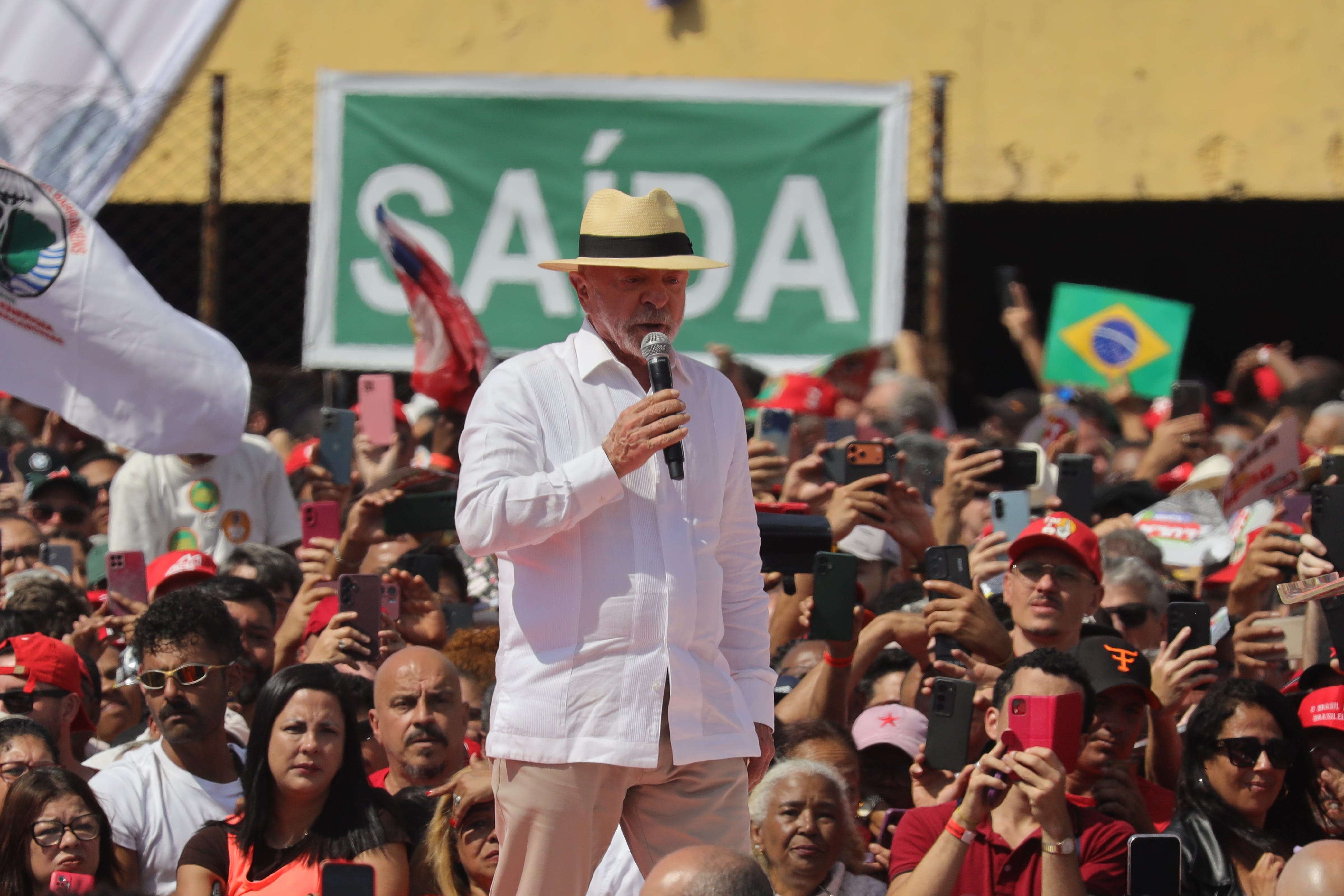
President Luiz Inácio Lula da Silva speaks at a rally in São Paulo in August 2026 (Michael Fox)
Michael Fox: What would be the impact of Lula’s reelection for higher education?
David Gomes: Well, I think the impact of President Lula’s reelection in higher education would be very positive. He’s already announced in his government plan and in the government measures that he would expand higher public education, with the construction of new universities and new federal institutes. In addition, President Lula also announced the creation of the Pe-de-Meia university plan. For those who don’t know, Pe-de-Meia [“Nest egg,” in English] is a policy that President Lula created in this term that would help build savings for high school students. And this helped to reduce the high school dropout rate.
In his policy measures for higher education, Lula has also announced a monthly scholarship so that these students can continue studying without dropping out of the university. This was a really positive announcement. President Lula’s government plan also expands student attendance, which will encompass this Pe-de-Meia university plan and other student assistance programs that are essential to ensure that poor students can remain in the university, and so that these students don’t have to drop out of school to go to work and ensure the sustainability of their home.
So we have a robust student assistance policy, which is fundamental, and I think that if President Lula is reelected, he will invest in this and it will have a positive impact on education.
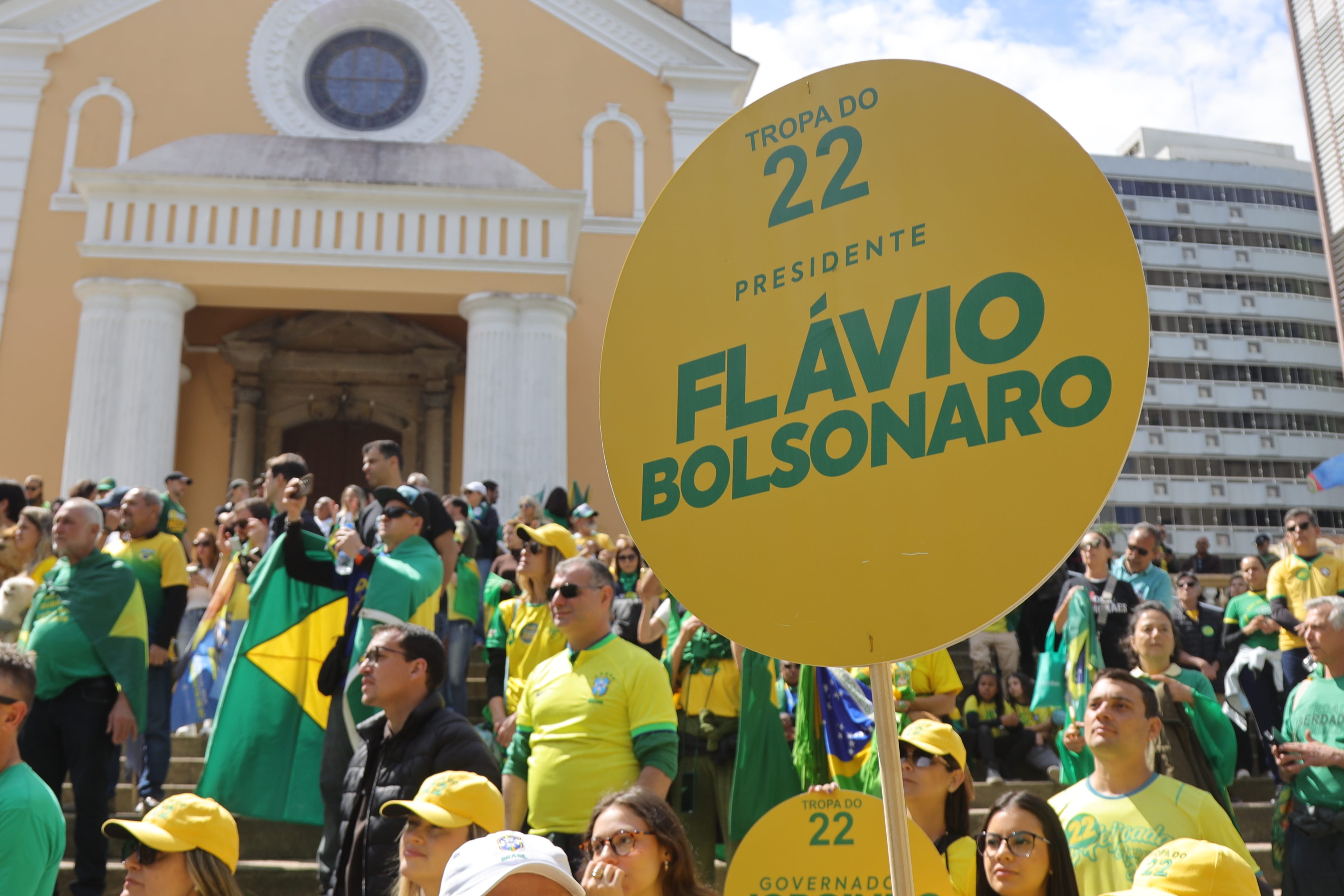
Supporters of Flavio Bolsonaro rally in Florianopolis on September 7, 2026 (Michael Fox / Panamerican Dispatch)
Michael Fox: Do you believe that Flavio Bolsonaro and his Liberal Party in Congress could try to take actions against quotas and affirmative action in the country?
David Gomes: Certainly, because attacking the quota policies is something that the Bolsonaro family and other members of their Liberal Party have been doing for a long time. There have been a series of interviews and public statements by figures linked to Flávio Bolsonaro and to Flávio Bolsonaro himself coming out against affirmative actions, and especially against the policy of racial quotas, which is what they attack the most.
Here in Rio de Janeiro, for example, we have individuals linked to the Bolsonaro family, who in the State Legislative Assembly of Rio de Janeiro presented bills to extinguish the UERJ, the State University of Rio de Janeiro, which was the pioneer of the quota policy in Brazil.
So if Flávio Bolsonaro is elected, we will certainly go through a period of turbulence, where they will attack quota policies, despite the fact that quotas have already proven to be a real success. That has been proven with all the statistics we have seen over the more than 10 years of quota policy at the federal level and the more than 20 years here in Rio de Janeiro.
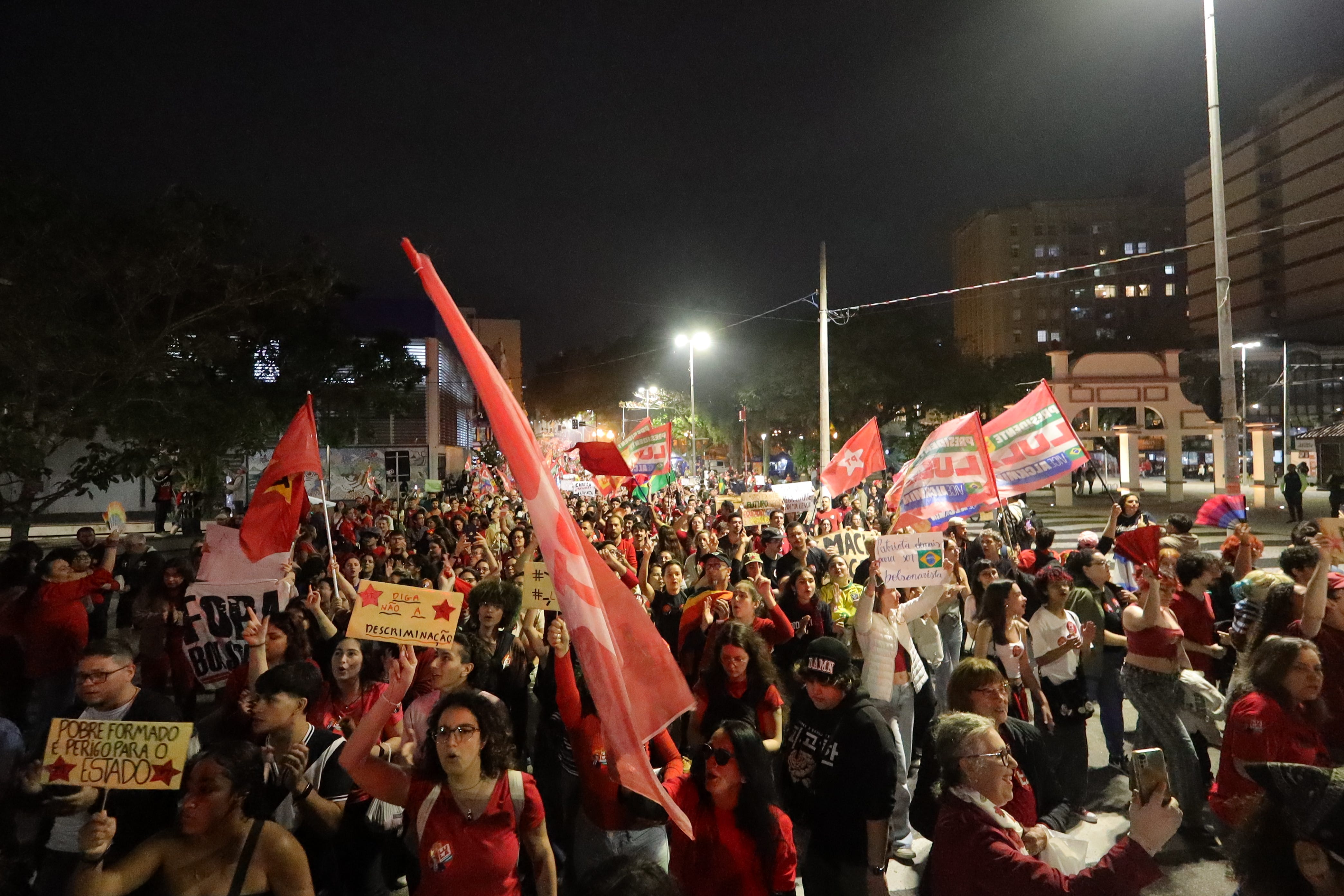
Students march in Florianopolis, Brazil, on October 13, 2026 (Michael Fox / The World)
Michael Fox: Do you believe that the student movement that is organizing for Lula can have an impact on the elections in favor of Lula?
David Gomes: For sure. Students have been a really important political force in the history of Brazilian democracy. From the creation of the National Students Union, through the “Oil is Ours” campaign, for 100% state-oil company Petrobras campaign. From the fight against the military-civil dictatorship, which was installed for 21 years in Brazil. And this is such a powerful political force that they were recognized by our adversaries, by the far-right. When the military coup took place in 1964, the first sector that was attacked was the student movement, with a fire at the National Students Union’s headquarters, here in Rio de Janeiro. Their headquarters was burned down by the military dictatorship, and the military dictatorship made the union illegal.
So, the students have strength, and the first mobilization after the first round vote was a march held by the students here in Rio de Janeiro, which filled the center of Rio. It set the tone for how this second round campaign would be. And from then on, several other spontaneous rallies were called in Brazil to show the strength of the student movement in support of the reelection of President Lula.
Michael Fox: David, for you, how important is this election for the United States, the region and the world?
David Gomes: Well, I think a final consideration to make, which is very important, is that the people of the United States and also of the whole world see the election in Brazil today as a strategic dispute in the world in terms of the confrontation with the far right.
Flávio Bolsonaro does not represent a democratic political force that wants to win the presidency of Brazil. Flávio Bolsonaro represents an international far right that is connected to the United States with the Trump government, and tied with other countries in Latin America that have been taken over by the far right. That's the case of Argentina with Javier Milei. And we see today that Argentina is in an economic crisis.
So Brazil today is not facing a normal democratic election, we are disputing the elections in confrontation with fascist forces of the far right, that need to be fought and denounced not only internally here in Brazil, but also by the entire international community.
We cannot normalize the far right and fascist political forces disputing governments worldwide.
Michael Fox is a journalist based in Brazil and an editor of Panamerican Dispatch.
