


by Michael Fox
On the campus of the Federal University of Santa Catarina in Brazil, it seems like just an ordinary day. The cafeteria is packed during lunch. Students walk back and forth to class.
But things aren’t normal these days.
“I don’t even know how to tell you how chaotic it is at universities right now,” said Carla Pereira, a 26-year-old pharmaceutical student. “There are a lot of demonstrations. It’s crazy.”
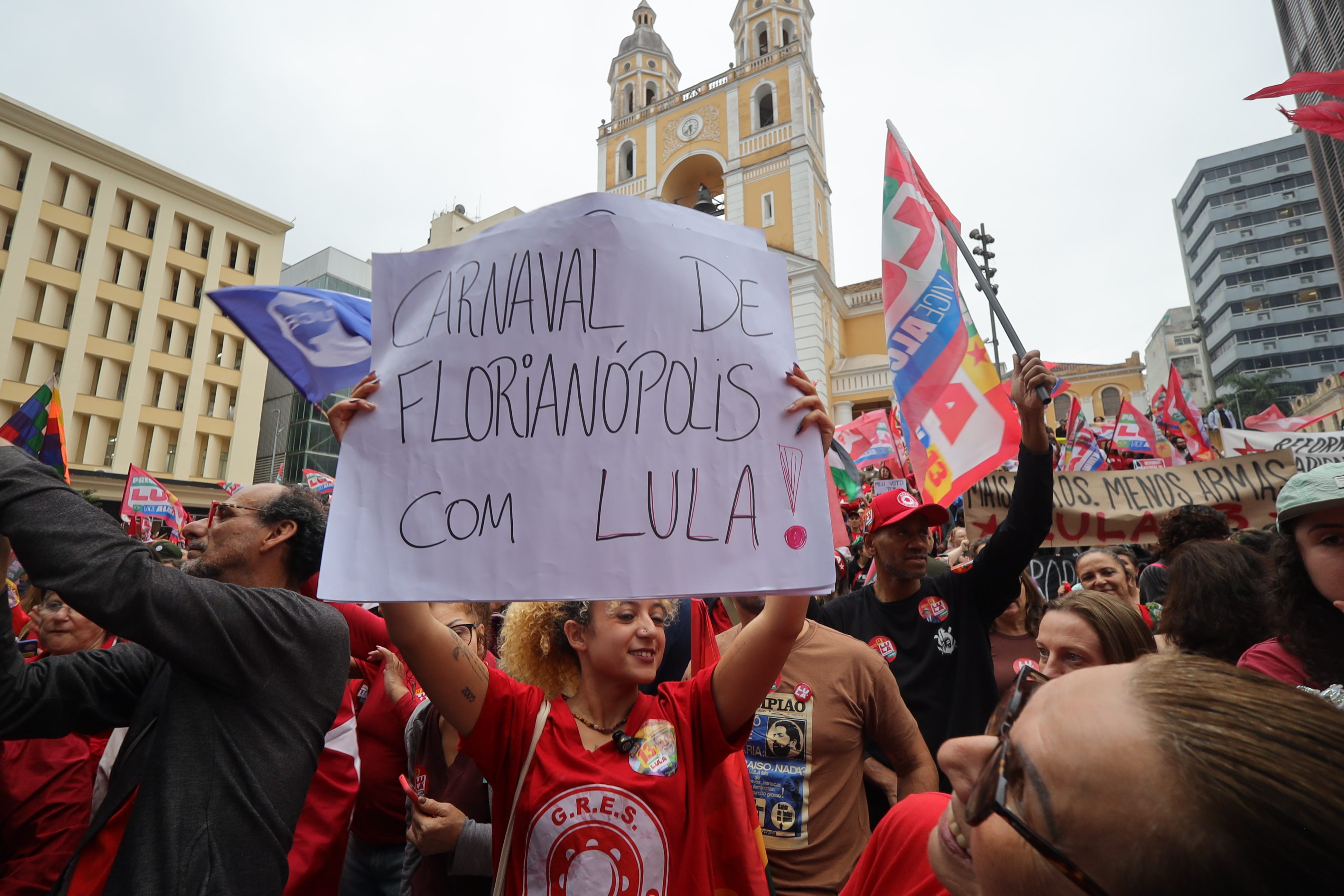
A student holds up a sign that reads: "Carnival of Florianopolis, with Lula” during a student rally this week in the Southern Brazilian city of Florianipolis (Michael Fox / The World)
Universities have become flashpoints for organizing around Brazil in recent weeks.
About a hundred students sit on the pavement in front of the university’s main administrative building. They’re making signs for a march this evening.
Tiago wears a red soccer jersey and holds a marker in his hand. That’s not his real name, though. He asked that it not be included, fearing attack from far-right supporters for speaking out. Students have faced this here in the past.
“We’re here because we’re afraid that if Flávio Bolsonaro wins, he will dismantle the public infrastructure for education and health in the country,” he said. “And that will affect a large part of the population.”
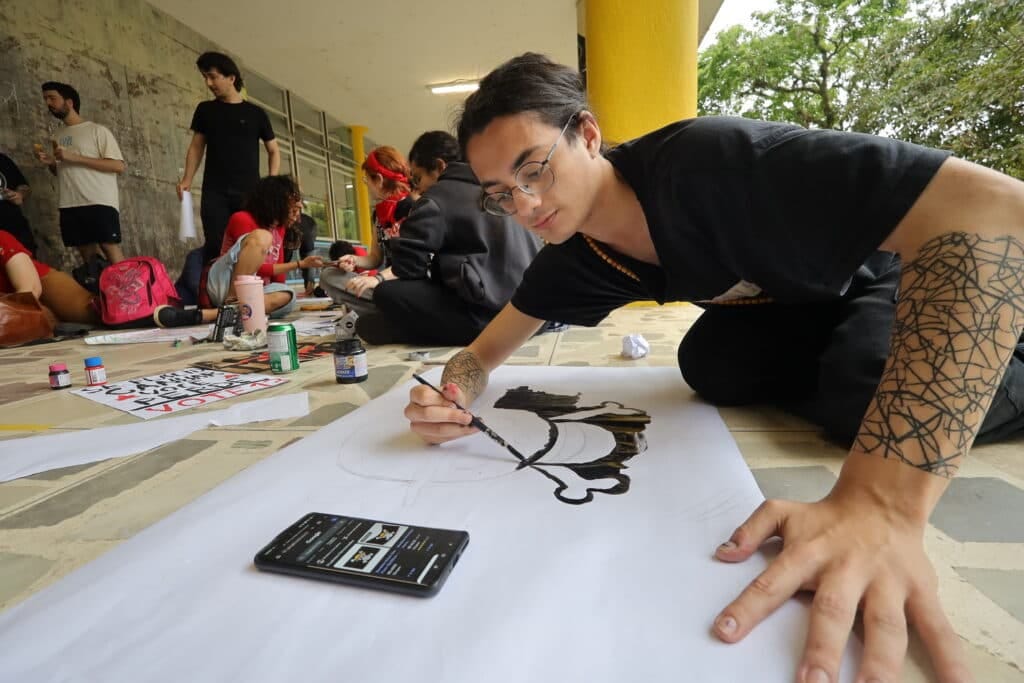
A university student makes a sign to display at a student-led march for the reelection of Brazilian President Luiz Inácio Lula da Silva (Michael Fox/The World)
Roughly 2 million students in Brazil today study at one of the more than 110 federal and state universities around the country. That accounts for roughly 20% of the students studying at universities in Brazil. It’s an important section of the student body.
“The best universities in Brazil are public universities. They either belong to the federal government or the state government,” said João Feres Júnior, a political science professor at Rio de Janeiro State University’s Institute for Political and Social Studies. “So yeah, they’re publicly funded. Students pay no tuition. There is no debt coming from tuition. And sometimes they can get a stipend too.”
It’s perhaps the biggest difference between public universities in Brazil and the United States.
More than half of students at federal and state universities today are from working-class or poor communities.
The Brazilian government also provides extensive federal funding for grants and research at both public and private universities.
But President Jair Bolsonaro, the father of candidate Flávio Bolsonaro, cut billions of dollars from Brazil’s federal universities when he ran the country from 2019 through 2022. He also tried to defund humanities departments like sociology and philosophy, which he accused of being “Marxist,” the Brazilian equivalent of “woke.”
At the time, grants dried up and universities scrambled for private investment. Brazilian Students led some of the largest protests against his government. Today, they fear a Flávio Bolsonaro administration will mean a return to the policies of his father.
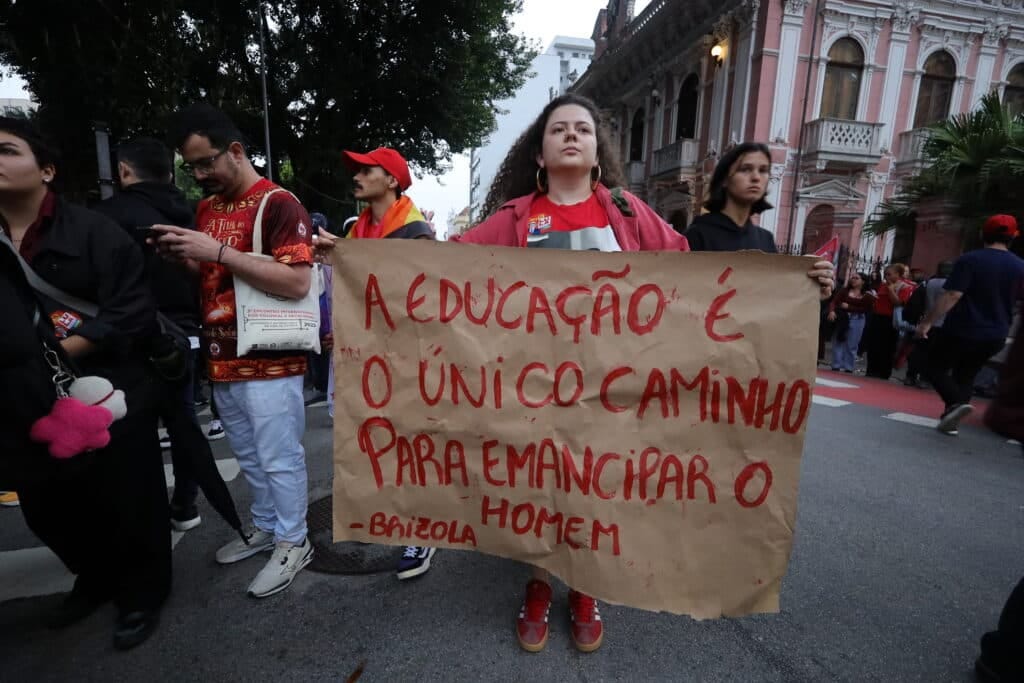
A student holds a sign that reads “Education is the only path for emancipation.” (Michael Fox/The World)
They have reason to be concerned.
At the launch of his candidacy in July, Flávio Bolsonaro danced on stage with a large pair of scissors alongside Argentine president Javier Milei. Milei has overseen widespread budget cuts to education in his country, sparking rolling protests there from teachers and students.
Flávio calls his plan, if elected, the “tesouraço,” which translates loosely to “The massive scissoring.” He has proposed transferring oversight of federal universities from the Ministry of Education to the Ministry of Science and Technology, as part of his promise to cut billions from universities and refocus higher education away from so-called “Marxist social sciences.”
“We have to teach our youth to have their own businesses,” he said on a Brazilian program earlier this year. “To study IT, computer science, technology, math, Portuguese, sciences. That’s all we need.”
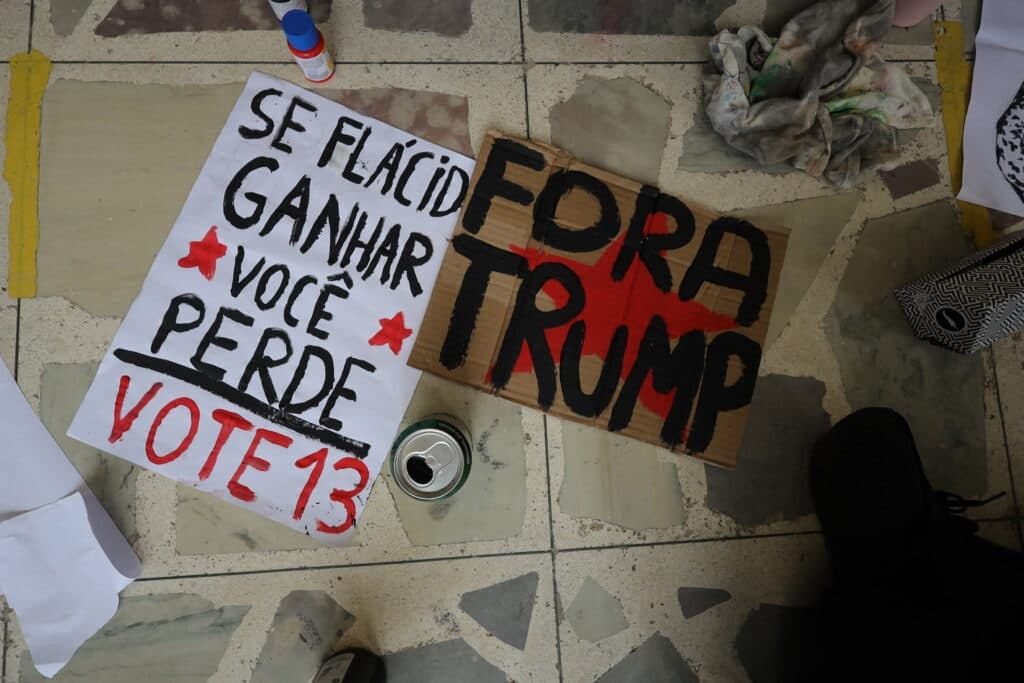
Student signs read, “If Flavio wins, you lose” and “Get Out Trump.” (Michael Fox/The World)
Guilherme Vargas says Bolsonaro is on the right path. Vargas, a mechanical engineering student at Santa Catarina Federal University, supports Flávio for the presidency and says Flávio’s promise to trim government fat and push for excellence won’t affect federal universities.
“No, I don’t believe there will be big cuts,” he said. “There’s no way to end funding for the Federal University, because it’s a source of research for the country, and research and education is necessary anywhere.”
But many students are scared. And they’ve been organizing. Earlier this week, they held marches across Brazil, hoping to turn the tide in the election.
“The student movement has woken up,” says Anderson Gheller Froehlich, a professor at UNEMAT, a state university in Mato Grosso. “And the youth are going to save the country. It’s the youth that are going to the streets to convince others to vote.”
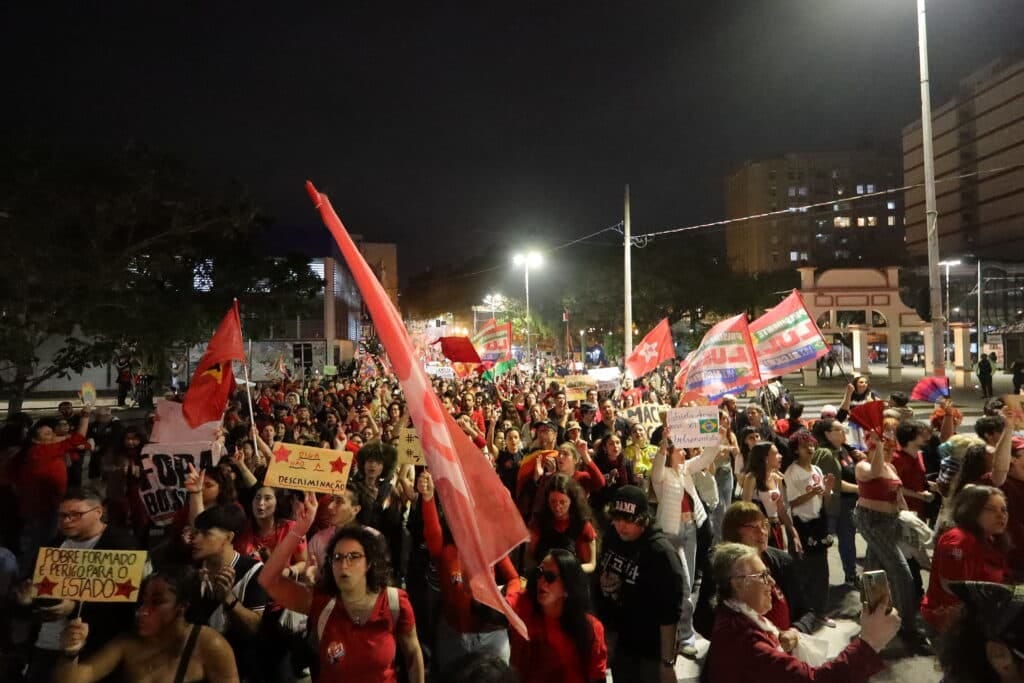
Students march in Florianópolis, Brazil, on Tuesday, October 13 (Michael Fox/The World)
Flávio Bolsonaro won the first-round election in early October by just over two million votes. Students have been leading the race, encouraging the 33 million people who didn’t vote to show up this time. They say this election is not just a fight over higher education in Brazil, but the future of other public services, like health and social security.
”I think that by going to the street and talking to the workers, the students absolutely have the ability to change this election,” said Ariadne Meneghel, a leader in the DCE student union at Santa Catarina Federal University.
The runoff vote between Lula and Flávio Bolsonaro is on Sunday, Oct. 25.
This article was originally published by The World. It has been reprinted here with permission.