


by La Línea
Ever since her years as First Lady during the administration of her father, Alberto, Keiko Fujimori was driven by a single obsession: to return the helm of the Presidential Palace to her clan.
In 2011, following an underwhelming stint as a congresswoman, Keiko began her long journey toward the presidency. As the leader of the Fuerza Popular, or Popular Force party, Keiko Fujimori failed in three consecutive attempts: 2011, 2016, and 2021, opting for a strategy of destruction and institutional capture.
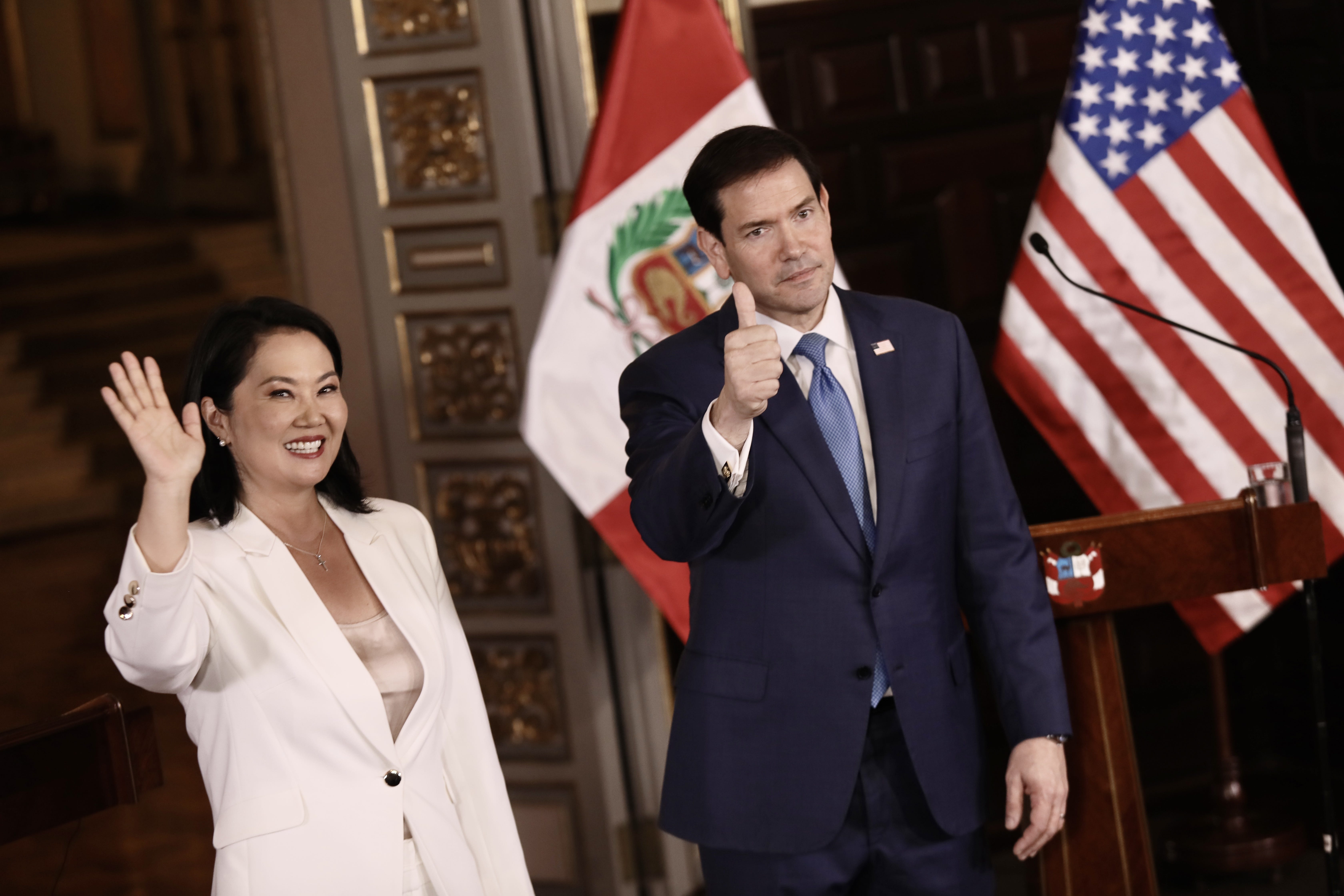
U.S. Secretary of State Marco Rubio meets with Peruvian President Keiko Fujimori at the Government Palace on September 10, 2026, in Lima, Peru. (Photo by Klebher Vasquez/Anadolu via Getty Images)
Over the course of a decade, Fujimorismo leveraged the power of its congressional bloc to reshape the Peruvian state to suit its own interests, eroding the institutional architecture and molding the constitutional order to subordinate public authorities. In practice, her political machine managed to exert influence over the Judiciary, the Constitutional Court, electoral bodies, and the Office of the Ombudsman, all while backed by a robust media and economic apparatus.
Given this accumulation of power, both her base and the political establishment anticipated that a Fujimori victory would provide a new impetus to shake the very foundations of the Peruvian state. Yet, the reality of her first 100 days in power has revealed a diametrically opposite picture: a profound ideological vacuum, strategic confusion, and a glaring lack of experience in state administration.
The Mirage of Strong Leadership and the Collapse in the Polls
Those who expected to find in Keiko Fujimori a “hard-line” figure, in the vein of Nayib Bukele or Javier Milei, have been swiftly disappointed. Rather than consolidating a conservative authority, Keiko Fujimori’s administration has favored a frivolous and inefficient digital approach to governing. This has led to a precipitous drop in public approval. In just three months, her popular support plummeted from a 61% favorable rating to a meager 28%.
Cornered by the momentum of a political crisis, characterized by the instability of Peru having had eight presidents in a single decade, Fujimori appears to have resigned herself to managing the remnants of a failed state and an exhausted economic model. The structural shift promised to her supporters has not materialized, nor has the much-touted institutional refoundation of the country.
Faced with the structural problems that stifle the average citizen, the executive branch has displayed a concerning lack of solutions. Inequality gaps have increased, the cost of living continues to rise, and public insecurity remains the nation’s primary concern, all while the president and her advisors fail to outline any tangible solutions.
The first hundred days have confronted the country with an undeniable truth: the fifteen years of continuous campaigning it took Keiko Fujimori to reach the presidency did not prepare her for effectively exercising power, nor for assembling a team with a statesmanlike vision.
Far from addressing the country’s urgent socioeconomic problems, Fujimori’s initial focus has been on aligning with the U.S. security agenda and U.S. geopolitical interests in the region.
The Washington Axis and the Dispute Over Critical Minerals
The diplomatic turning point in favor of the United States was solidified following Fujimori’s inauguration, though the country had already taken preliminary steps toward the new alignment demanded by Donald Trump. In February 2026, for instance, Peru signed on to “Project Vault”, an initiative aimed at creating a regional reserve of critical minerals for Washington’s use. Keiko’s administration has deepened this commitment through a memorandum of understanding, as well as agreements on cybersecurity and artificial intelligence, seeking to anchor Peru firmly within the U.S. technological and security sphere.
With Keiko Fujimori in power, Peru’s formal participation in hemispheric cooperation initiatives, such as the “Shield of the Americas”, was sealed. This process was capped by a visit to Lima from U.S. Secretary of State Marco Rubio in September. This decision has brought to light structural tensions within Peruvian politics. While the executive branch prioritizes global geopolitical containment, various economic and political sectors warn of the risks of subordinating Peru’s commercial sovereignty to interests dictated by the White House. China, for instance, remains Peru’s primary trading partner.
Parliamentary Fragmentation and Authoritarian Impulses
Despite her electoral victory, members of Keiko Fujimori’s party lack a majority in the Chamber of Deputies. Furthermore, the opposition political parties hold divergent agendas and cater to different segments of the population. The opposition alliance in Congress has revealed its limitations, and its fragmentation has led to legislative paralysis. Moreover, laws passed by the deputies risk being rejected by a Senate dominated by Fujimori’s allies.
Faced with the risk of institutional deadlock between the executive and legislative branches, the government opted to request extraordinary legislative powers to address matters deemed urgent. The approval of a scaled-back version of these powers reflects both the president’s inability to impose an agenda without resistance and the deep fragmentation within both chambers. Through these temporary powers, the government seeks to bypass the political impasse, though this has also reignited concerns over authoritarian tendencies and the consolidation of absolute control over institutions, all against a backdrop of growing social discontent.
Parliament has failed to establish itself as an effective check on power, demonstrating a level of legislative productivity as precarious as that of the executive branch itself. In these first one hundred days, the legislature’s track record has amounted to only three enacted laws, all of which lack any significant impact. This is a negligible output given the scale of the looming crises.
With a potentially catastrophic El Niño phenomenon on the horizon, and poverty rates and public insecurity on the rise, the national legislature has shown an alarming inability to address the country’s urgent demands.
The opposition remains caught between inertia and a profound disconnection from reality. Political groups opposed to the regime have chosen to focus on minor squabbles within the established power structure. They are incapable of forming a solid front and remain disconnected from the social organizations that could mobilize opposition from the streets. This vacuum in representation leaves the political landscape adrift and allows Keiko to survive without any major setbacks.
Sailing With the Wind, but Without a Fixed Course
Despite a dismal track record on social well-being, the executive branch appears to be sailing with the wind at its back. Kieko Fujimori controls key state institutions, benefits from a fragmented opposition, and faces no significant social unrest.
Yet, this apparent prosperity masks her extreme vulnerability. Persistent incompetence in public administration and the lack of a clear political vision threaten to squander this period of hegemony. If the government continues its inaction, the accumulated discontent will eventually open the door not only to a reorganization of the institutional political opposition but also to a resurgence of social upheaval.
This article was originally published by the Peruvian outlet La Línea, early this month. It was translated by Panamerican Dispatch. You can read the original, in Spanish, here.
The views expressed in this article are those of the author and do not necessarily reflect the position of Panamerican Dispatch.
