


by Nicole Froio
A woman dances in a blue and white skirt and a tube top alongside far-right presidential candidate Flávio Bolsonaro during one of his rallies. She appears in several videos posted online.
But she’s not real. She is created with artificial intelligence.
These videos, however, have accumulated millions of views. She is an attractive representation of Bolsonaro supporters across the internet. And despite the fact that she is not real, she’s boosting the candidate’s reach.
It’s just one example of the use of AI deep-fakes in the Brazilian presidential election campaigns.
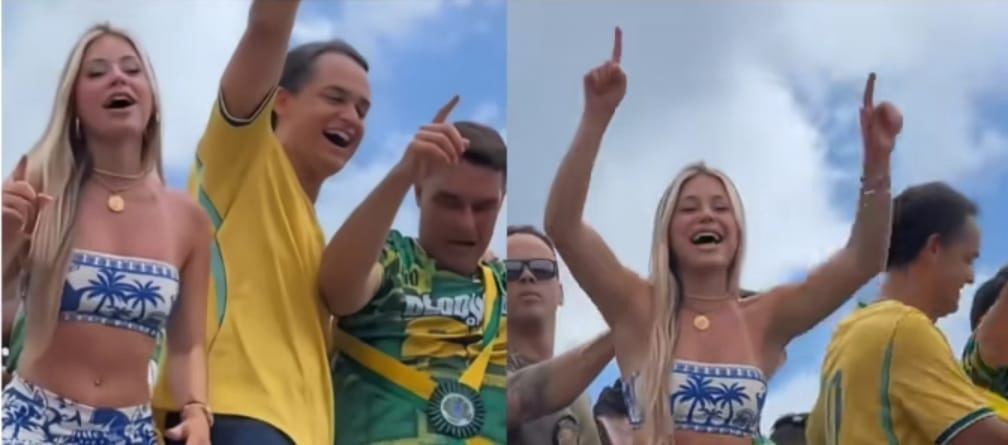
A pair of screenshots of a pro-Bolsonaro video with an AI-generated woman.
The battle for Brazilian democracy is being fought just as much on the streets of the country, as it is online. AI-generated deepfakes and manipulated images are aiding the spread of fabricated misinformation in the Brazilian presidential race.
The images created by Bolsonaro supporters and allies are used to lift Bolsonaro’s candidacy and smear the Workers’ Party and its supporters, as well as President Luiz Inácio Lula da Silva.
President Lula is facing off against Bolsonaro in a runoff vote on October 25. Flávio Bolsonaro is the son of the former far-right president Jair Bolsonaro, who is under house arrest for attempting a coup to remain in power after his electoral loss in 2022.
The spread of AI-generated political content started well before the official electoral campaign.
In May, Bolsonaro supporter and digital creator Daniel Cristiano created “Dona Maria,” an AI-generated black elderly woman who went viral on TikTok and Instagram when complaining about the Workers’ Party and the broader left.
At the time, the Workers’ Party requested the deletion of the account through the Superior Electoral Tribunal. It said the account was “a clear political tool” used to anonymously spread “untrue information, decontextualized facts” and “support certain political figures,” according to court documents.
In one video reviewed by Panamerican Dispatch, Dona Maria says she “gives voice to poor Brazilians that television makes invisible” and that she “isn’t alone, there are many Brazilians who want to defend their freedom.” In other videos, Dona Maria connects the Workers’ Party to corruption and the enrichment of left-wing politicians.
The creation of AI-generated content for political ends strategically uses “stereotypes, social identities and emotions,” according to researcher Rafaela Ferreira, project manager at the Institute for Research on Internet and Society.
Dona Maria’s image was not created at random. According to the 2022 census, over 57 million people in the Brazilian population are black women, a demographic that also leads six out of ten households in Brazil
“The choices made for this character are meant to rouse identification with working-class experiences,” Ferreira told Panamerican Dispatch. “They’re meant to beckon realities that are present in a large part of the population.”
Ferreira added that the fact that Dona Maria is an elderly woman adds credibility to her words, as older populations are generally seen as wiser.
“Research indicates that all of this is done strategically to disseminate specific political narratives,” said Ferreira.
By April, a Dona Maria account on Instagram had amassed 730,000 followers. Another, on YouTube, had 28,000 subscribers. On TikTok, the account @dn.marias had 261,100 followers and 2 million likes. It described itself as “AI-generated” and “the voice of the Brazilian people.”
The Superior Electoral Court, which oversees the elections, did not request the removal of the accounts, but TikTok and Instagram deleted the content. The same month, the court published protocols for AI-generated political content ahead of the elections. That policy determined that AI-generated content, including video, audio and text, must be explicitly labelled as such in campaign materials.
However, the creator of the Dona Maria account immediately created other accounts after the social media platforms deleted the first accounts. The move challenged the platform’s abilities to moderate AI-generated content, and the court’s decisions on how to moderate content at the pace of the internet.
Days before the last round of elections, Panamerican Dispatch found two small accounts on TikTok that reposted Dona Maria videos along with other far-right posts, but most other Dona Maria content had been removed.
On October 13, 12 days before the runoffs, another AI-generated image went viral, this time on X. Incoming far-right state assembly representative Eduarda Campopiano shared a deepfake image of a black woman cleaning the streets of São Paulo. She claimed that the image happened after Workers’ Party supporters held a large protest on Avenida Paulista on Saturday, October 10.
“They say they defend the workers, but who cleans the dirt?” Campopiano posted. “The cleaning workers, on a Sunday! It has never been easier to pick a side.”
The post was viewed 2 million times and widely shared by Bolsonaro supporters without any AI-generated labels, which is against the electoral court’s rules and subject to fines from $1,000 to $6,000..
“This computer-generated image adds a character to a real situation: the graffiti that was done by Workers’ Party supporters,” said researcher Rafaela Ferreira. She explained that the image was created to fuel a fake political division between Black working-class workers and white Workers’ Party supporters.
“This will provoke emotional reactions and reinforce a political interpretation,” she said. “We need to discuss not only the content of the message but also the transparency around who is posting, what responsibility they hold and who is disseminating this message.”
Both in the case of AI-generated content and misinformation more broadly, the Brazilian judicial system faces real-time challenges when it comes to moderation during the elections, especially when the majority of political social media traffic happens on platforms owned by U.S. Big Tech companies like Meta and Google.
In the days following the first round of the election, Meta admitted in a statement that “technical issues” limited the reach of Lula’s campaign on Instagram and Facebook, but denied political interference, adding that “any suggestion that Meta favors one side is false.”
“It’s complex for the Superior Electoral Court to moderate content while balancing transparency and the privacy of private companies [like Meta],” Ferreira said. “The electoral court’s own protocols contain overlaps, gaps, and issues of interpretation that create a great deal of legal uncertainty.”
Moderation becomes even trickier amid widespread accusations of partiality toward Bolsonaro’s campaign from the Superior Electoral Court President Kassio Marques Nunes, Ferreira said.
Ferreira highlighted that Nunes censored a pro-Lula WhatsApp group with millions of followers with unfounded allegations that the group was being used to disseminate fake news. But he left a similar pro-Flávio group, untouched. Ferreira said the scenario is “delicate.”
“We’ve seen controversial and questionable decisions by the electoral court, not only over the removal of content, but also how that content is removed,” she said. “Combating disinformation needs to be consistent and effective, especially juridically.”
Platform Neutrality
The mishandling of the debate online by social media companies amid the Brazilian elections and the electoral court goes beyond the moderation of AI-generated content. On October 10, the Lula campaign accused Meta of interfering in the Brazilian elections by minimizing the president’s campaign on the platform, even going as far as suspending Lula’s Facebook account days before the first round of the elections.
A few days later, Meta whistleblower Nadia Beller accused the Bolsonaro family of using contacts at the company to manipulate the elections. According to a report by Revista Forum, there were 1,088 reports of censorship, account bans, restrictions, or reduced reach during the election period. Meta denies taking any sides.
Researchers point out that the weaponization of social media ecosystems for political ends has been well documented since Brexit, with misinformation campaigns taking place across WhatsApp, Facebook and Instagram.
“Certain kinds of content are pushed to users because of a political desire,” Juliana Zaniboni, a researcher of defense and security at the Federal Fluminense University, told Panamerican Dispatch. That political desire, Zaniboni says, is connected to Big Tech’s expansion both in the digital sphere, where companies like Meta want to see continued deregulation of the internet, and the physical sphere, where Big Tech companies are seeking to mine rare earth minerals in Brazil to continue technological expansion.
“[Consequently] we’ve been noticing a pattern that benefits right-wing content,” she said.
Zaniboni added that it’s well-documented that users are more likely to be shown far-right content than left-wing content on these platforms.
“If you create an account on Instagram from zero and inform the platform that you’re a young man, it’s almost automatic that the algorithm will start showing you far right or manosphere content,” she said. “So the algorithm isn’t really neutral. It bends in a specific way, to the right.”
In this way, she says, far-right ideology benefits from “the deregulation of social media platforms.”
The relationship between the Bolsonaro family and Big Tech companies was underscored by Intercept Brasil in June, when journalist Sérgio de Souza reported on presentations given by Meta and Google executives during a communications conference held by Bolsonaro’s far-right Liberal Party.
De Souza reported that both Big Tech companies taught Liberal Party members and far-right influencers on how to use their latest tools, including artificial intelligence. According to De Souza, Meta AI executive Felipe Ventura explained how to use the technology and gave shortcuts to make prompts more efficient.
“It’s not enough for Meta to say, in very superficial statements, that its system is neutral,” Ferreira said.
Ferreira said Big Tech companies should be more transparent about their algorithms..
“There are material issues around understanding what’s happening,” she said. “We need to have the means to investigate what’s happening, so we need these companies to collaborate.”
Last week, Meta users were shocked to find that Meta AI refused to create promotional materials for Lula’s campaign, but generated campaign materials for Flávio, in direct violation of campaign regulations.
Panamerican Dispatch tested the app on October 14 and confirmed that Meta AI created promotional campaign materials for Flávio, but refused to do so for Lula.
“We have taken additional measures to ensure that search queries using only the candidates’ first names and their ballot numbers also do not return any images,” Meta told the newspaper Globo, after being confronted with the issue.
On October 20, Panamerican Dispatch was not able to generate images for either candidate on Meta AI.
Digital Sovereignty
Brazilians have responded to what they see as Meta’s bias. In the weeks following the first round of elections, thousands took to the streets and to social media to demand that Meta and other Big Tech companies stop meddling in the Brazilian elections. They have protested in front of Meta headquarters in São Paulo. The U.N. recently called on Meta not to interfere in Brazil’s electoral process.
For many people in the streets, Brazil’s lack of digital sovereignty is an urgent issue to be reckoned with, especially after witnessing the far right win elections in Argentina and the United States with similar digital warfare methods. Mark Zuckerberg and other tech CEOs are close allies of U.S. President Donald Trump, as is the Bolsonaro family.
“Bolsonaro’s Party is part of the global far right,” Zaniboni said. “They’re not doing anything that is different from what we’ve seen of the rise of the far right across the world.”
Zaniboni added that Brazil’s reserves of rare earth minerals is a big motivation for Big Tech meddling in the elections, as American companies need easy access to minerals to build technology.
“Bolsonaro’s party is just an actor within an international system of the rise of the far right,” she said. “And Big Tech uses this actor to achieve its goals in the Brazilian government.”
Nicole Froio is a writer, researcher and journalist currently based in Brazil. She writes about women’s rights, digital cultures and popular movements.