


by Jamil Chade
Meta’s conduct during Brazil’s election has become a global warning sign. On Wednesday, U.N. special rapporteurs criticized the American company and called on the platform not to interfere in Brazil’s democratic process. ICL Notícias obtained exclusive access to the email sent to the Brazilian government detailing the complaint.
According to a statement, “reports of restrictions on legitimate political expression on Meta’s platforms during the Brazilian election raise concerns regarding freedom of expression, freedom of association, political participation and equal treatment of different political positions.”
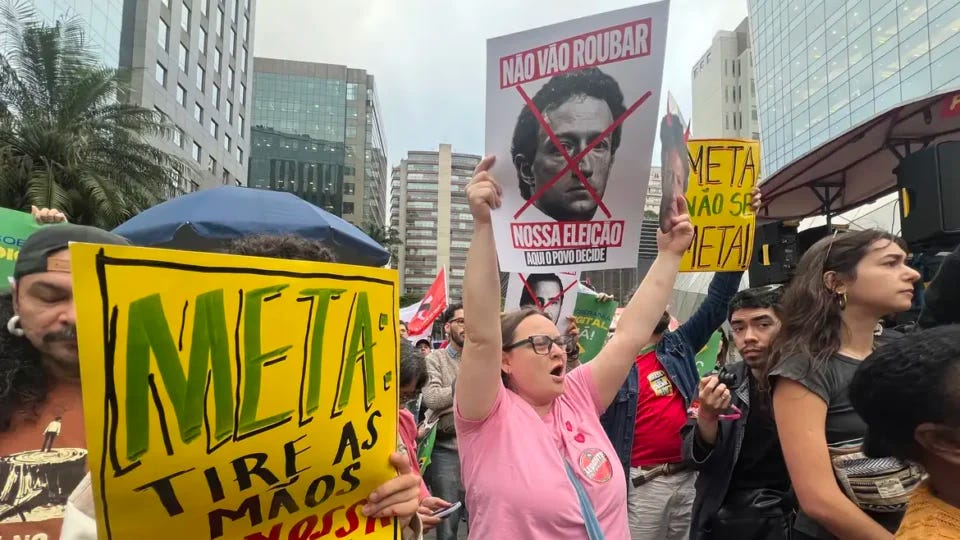
Protest in front of Meta headquarters in S. Paulo (photo: ICL)
“Online platforms are key actors in democratic debate. Preventing people from expressing themselves or reaching audiences without explanation affects who gets heard,” they wrote.
In their statement, the U.N. rapporteurs asked Meta to assess whether its moderation, recommendation and artificial intelligence systems had disproportionately restricted one side of Brazil’s election debate.
They also asked the company to provide adequate explanations and remedies, apply its rules consistently and without discrimination, maintain transparent dialogue with civil society, and ensure complaints can be addressed throughout the election period.
“Digital platforms should not become unaccountable gatekeepers of political debate, nor should their systems be vulnerable to undue influence from political actors. Democracy and free and fair elections depend on independent, consistent platforms, as well as an open and pluralistic environment where people can access information, scrutinize those seeking power, exchange opinions and organize without arbitrary interference,” they concluded.
ICL NotíciasThe document was signed by Leopoldo Maldonado Gutiérrez, U.N. Special Rapporteur on the promotion and protection of the right to freedom of opinion and expression; Margaret Satterthwaite, U.N. Special Rapporteur on the independence of judges and lawyers; Gina Romero, U.N. Special Rapporteur on the rights to freedom of peaceful assembly and of association; Andrea Bolaños Vargas, U.N. Special Rapporteur on the situation of human rights defenders; and independent experts Robert McCorquodale, Fernanda Hopenhaym, Lyra Jakulevičienė, Pichamon Yeophantong and Damilola Olawuyi, from the U.N. Working Group on Business and Human Rights.
According to the rapporteurs, international election observers raised concerns about Meta’s platforms. Reported incidents include:
Temporary interruptions to one candidate’s campaign account
Differences in audience engagement, user feeds, view counts and reach
Restrictions on this campaign’s posts on Instagram
Differences between the leading political parties in AI generated image results, WhatsApp channel search results, candidates’ Stories, and the distribution of political content, potentially favoring the opposing candidate’s campaign
“Monitoring reports show that thousands of accounts and posts faced suspensions, reduced visibility and sharing limitations, including those belonging to journalists, human rights defenders, civil society actors and content creators,” they wrote.
“Information, including from Meta employees, suggests that accounts linked to one side of the presidential race were disproportionately affected,” they found.
The statement notes that a Superior Electoral Court justice ordered Meta to apply the same rules to both candidates through the runoff, prohibiting unequal restrictions on campaign reach, recommendations and search results.
“Losing reach can mean losing a voice in public debate and the ability to mobilize communities. Algorithms, AI systems and content moderation decisions should not become invisible arbiters of political discussion. When political expression appears to be disproportionately restricted, platforms must explain why, correct unequal impacts and guarantee effective remedies,” they said, warning that that such restrictions can affect access to information and freedom of peaceful assembly and association, and can undermine elections when fundamental freedoms are not respected throughout the entire electoral process.
“The responsibility to respect human rights requires technology companies to identify, prevent and address adverse impacts, in line with the U.N. Guiding Principles on Business and Human Rights, including in platform governance and content moderation,” they wrote.
One point the U.N. experts emphasized is the strategy of causing harm that remains in effect even after being condemned, since the damage has already been done by that point.
“During elections, delayed remedies can have irreversible consequences. Freedom of expression and the integrity of information must therefore go hand in hand. Measures against disinformation should not arbitrarily restrict legitimate political expression,” they warned.
The U.N. statement also addresses the judiciary’s role. According to the rapporteurs, “an independent and impartial judiciary, including electoral courts, is a fundamental pillar of democracy.”
“Any restrictions on political expression, including on private platforms, must be subject to due process and effective remedies. Electoral processes depend on open and dynamic debate, requiring judges to exercise particular caution when considering such measures. Even the perception of unequal treatment can erode public trust,” they concluded.
This article first ran in ICL Notícias, has been translated by Panamerican Dispatch with express authorization of its editor, and can be read in its original Portuguese here.