


On October 25th, The Brazilian people wrote another extraordinary page of their history. Luiz Inácio Lula da Silva was elected president for the fourth time with 51.8% of valid votes. A total of 64 million Brazilians chose Lula’s ballot number, 13. It was the most votes ever received by a presidential candidate. For the first time in the country’s democratic history, a candidate who finished second in the first round won the runoff. The first factory worker elected president of Brazil is now also the first Brazilian to turn a first round deficit into a runoff win!
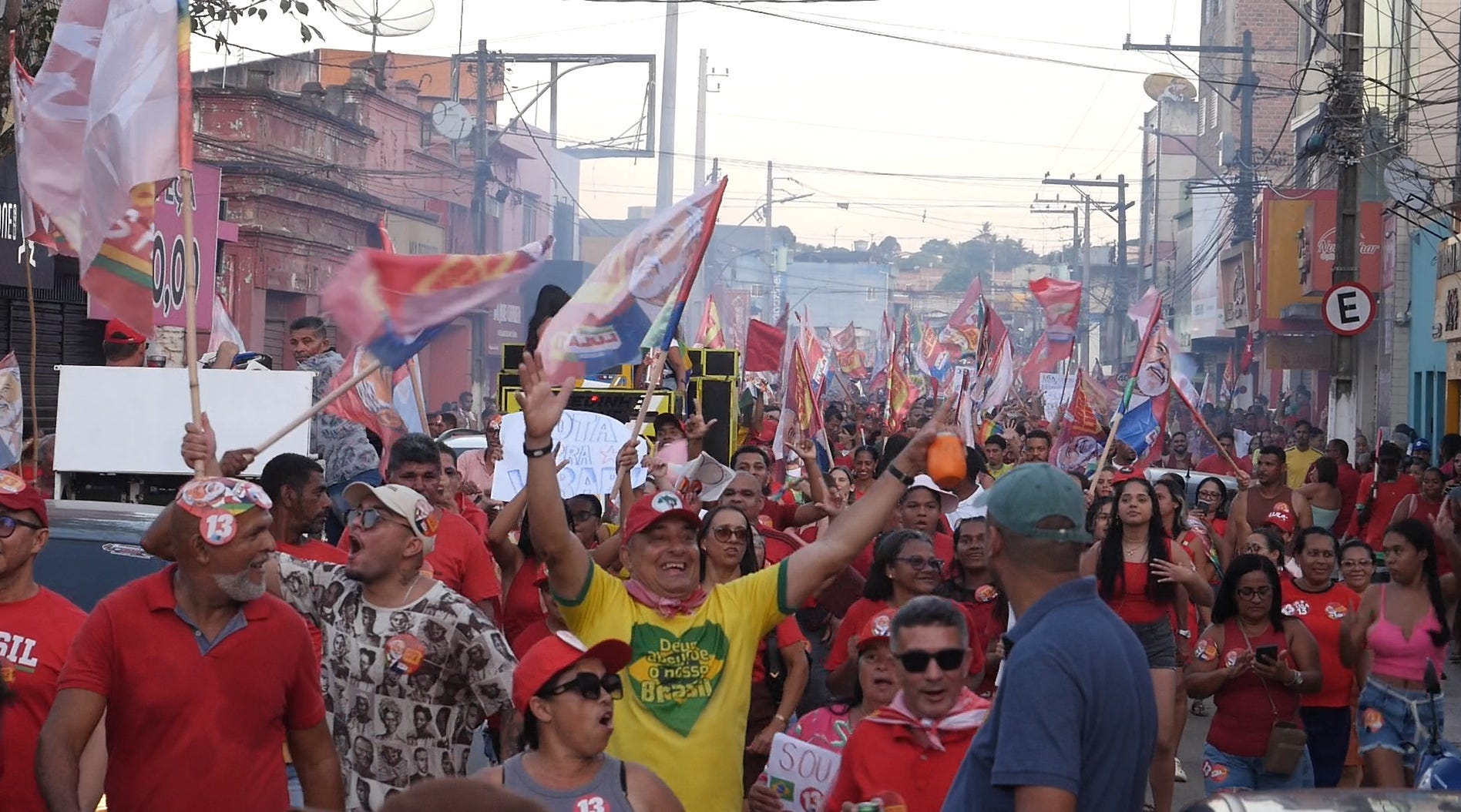
On October 18, over half the population of the small town of Paudalho, Pernambuco came out to the streets to show support for Lula, in a scenario underway in hundreds of towns and cities across Brazil that day
The people built this victory with courage, hope and an extraordinary ability to mobilize. Between the first round and the runoff, we won more than 10 million votes. We grew in every state and in the Federal District. We flipped the result in more than 100 municipalities. Our opponent flipped it in just one. Brazil also recorded its lowest abstention rate since 2006. Millions of Brazilians decided they would not stand on the sidelines of history.
Popular mobilization was the main force behind this victory. Brazil saw a remarkable wave of political participation. Young people took to the streets, organized large demonstrations, drew crowds and mobilized schools and universities. They showed that a new generation is ready to take its place in building the country’s future. Students led the way with their irreverence, creativity and organizing skill. From mass rallies to dialogue brigades on the outskirts of cities to fan communities, young people showed that politics can again be a place for hope, belonging and change. When democracy is threatened, artists and intellectuals take a stand, because there is no full citizenship without culture and no democracy without freedom of expression.
Older Brazilians bravely went to the polls. Their experience, historical memory and long record in social and democratic struggles were essential to the mobilization. Women, LGBT people and Afro-Brazilians were also leaders of this victory. In the streets, online, in communities, in workplaces and in families, they mobilized to defend democracy, rights and a future with more equality. Indigenous peoples also played a major role in defending democracy, national sovereignty, their territories, their original rights and the environment. They are indispensable historic and political actors in building a Brazil that is more just, democratic and plural. Their voices were decisive in defending life, in fighting misogyny, racism and prejudice against LGBT people, and in affirming that there is no true democracy without participation, freedom and equality.
Our activists wrote one of the finest chapters in the Workers’ Party’s history. In every city and neighborhood, on the outskirts and in the interior, thousands of comrades did what they have always known how to do. They organized the people, talked, listened, persuaded and turned hope into collective action. They never gave up, even in the hardest moments of our history, and they showed their strength once again. The comeback began in the streets, in collective work, in generosity and in the conviction that Brazil is worth every effort.
The mobilization was also extraordinary on social media. “Lula’s Army,” led by Rep. André Janones, joined forces with party activists, grassroots communicators and millions of supporters. Together they helped change the digital debate and counter disinformation.
This victory went beyond party lines. Allied parties, popular movements, unions, artists, intellectuals and broad sectors of civil society took part. So did liberals, conservatives and people on the democratic right. They recognized the seriousness of the threat posed by a continuation of Bolsonarismo. Despite political differences, they understood that defending democracy must come before electoral disputes.
We won by defending national sovereignty, democracy and a development project committed to the lives of the Brazilian people. We defended the public Unified Health System (SUS), education for the whole school day, universal access to day care, a stronger response to violence and expanded social programs. We called for an end to the 6x1 work schedule (six days of work, one day off) and for free public transportation. We called for using national wealth to create development, jobs and opportunity in Brazil.
We stood up to lies, denialism, political violence and attempts at foreign interference in Brazil’s democratic process. We will tie national development to income distribution, higher wages, broader labor rights and shorter working hours. We will fight inequalities of class, race and ethnicity, gender and region. We will also build in environmental sustainability and respect for work in the countryside and in the city.
Voters elected Lula to bring change. His new term should open a cycle of structural change. The priorities are reform of the justice system, reform of the political and electoral system, and democratic regulation of the big digital platforms. Brazil must deepen its democracy, confront historic inequalities and make sure development brings better living conditions to its people.
We will build a national strategy for digital and technological sovereignty. It will include investment in science, artificial intelligence and Brazilian technologies, data protection and wider access to digital tools. We must confront technological dependence and the concentration of power in the big platforms. These changes must serve democracy, national development and the rights of the population, without imposing austerity on the poorest.
Brazilians have entrusted us with four more years to govern the country. Our responsibility is to make this a time of great achievements, expanding gains, strengthening rights and deepening dialogue with society. Lula said this will be a government of much dialogue.
The PT’s role is to be a permanent bridge between the government, political parties, social movements and different sectors of society. It must keep alive the democratic energy that showed up in the election. We will push for a government in which the people take part in political decisions, with participatory budgeting. We will keep the public mobilized to deliver the program that elected Lula president!
Celebrating this achievement does not lessen our responsibility to face the challenges that remain. Sen. Flávio Bolsonaro fled Brazil just two days after the runoff result, amid corruption allegations and investigations. His flight shows how serious the political moment is.
Flávio Bolsonaro, a fugitive in the United States, wrote a letter calling himself “the real president.” He did not recognize the election result and cited false claims about the vote. He contests the result of elections that were legitimate, auditable and transparent. Those elections expressed popular sovereignty in choosing state legislatures, the federal Chamber of Deputies, the Senate, governors and the presidency. The Superior Electoral Court (TSE) and all political parties, including the Liberal Party (PL), recognized the results.
This is not the first time the Bolsonaro family has refused to accept an election result. In 2022, the family contested the results while planning a coup attempt and the assassination of the elected president and vice president. Democratic institutions defused that attempt. It ended with the imprisonment of Jair Bolsonaro and the military officers involved. Now Flávio Bolsonaro’s letter calls for outside interference. That marks a new step in the authoritarian reaction of those who lost at the polls.
U.S. President Donald Trump’s position on the election result and on Flávio Bolsonaro’s presence on American soil also demands attention. Brazil will not accept foreign interests interfering in its democracy. Nor will it accept political disputes serving as a pretext to disrespect the sovereign will of the Brazilian people in elections that were widely monitored and recognized as fair.
We are also deeply concerned about episodes of political violence in the last days of the campaign and after the vote. On Oct. 24, a rock thrown during a motorcade hit Iara Pimentel, a PT city councilwoman in Montes Claros, in Minas Gerais state, in the face.
There are allegations of killings, attempted killings, assaults, threats and intimidation. There are also serious accounts of electoral harassment in workplaces, with threats of firing, persecution and pressure against workers who voted for Lula. It is unacceptable for anyone to threaten the free exercise of the vote, one of democracy’s most basic rights, through any form of violence or coercion. The Labor Prosecutor’s Office should pay special attention to complaints of electoral harassment and act firmly to investigate and hold those responsible to account.
We also instruct municipal and state directorates to report all incidents of political violence and electoral harassment to the National Directorate through the form at pt.org.br. This will let the party track cases, send complaints to the proper authorities and take the appropriate steps.
The electoral victory does not end the task of defending democracy. We must turn it into permanent popular organization, strengthening the PT’s base committees and directorates in the countryside and in cities. That requires expanding political education, holding local assemblies, strengthening popular, social and union movements, and creating permanent spaces for listening and participation.
The party must adopt new forms of organization and mobilization, renew its communication and expand its presence in communities. It must turn electoral support into organized social force.
We must preserve social participation, strengthen popular organization and keep open the paths of dialogue and mobilization that made this victory possible. The PT will also strengthen its dialogue with different religious traditions, while respecting freedom of conscience and the secular nature of the state.
We will build common ground around democracy, social justice, solidarity and human dignity. We will confront religious intolerance and the use of faith as a weapon against rights and democracy.
We urge directorates, social movements and labor union confederations to stay organized. They should help defend democratic institutions and monitor the carrying out of the program voters approved at the polls.
Afro-Brazilians played a decisive role in Lula’s victory and in the popular mobilization to defend democracy, national sovereignty and a country with less inequality. In outlying neighborhoods, social movements, online and in the streets, Afro-Brazilian men and women were on the front lines of the campaign. They confronted racism, disinformation and the inequalities that have long limited their political participation. This leadership must lead to more policies for racial equality, more Afro-Brazilian representation in politics and a fight against structural and institutional racism.
The PT should call on its activists, sector groups, secretariats for fighting racism, elected lawmakers and the Afro-Brazilian movement to mount a broad mobilization during Black November. Nov. 20, the National Day of Zumbi and Black Consciousness, should be a milestone for struggle, reflection and organization. The party must fill the streets and social media with rallies, assemblies, training and debates in communities. The message is that there is no full democracy without racial justice, historical reparations and equal opportunity.
The young people who took to the streets should have a central place in this new moment. The PT needs to open its doors, renew how people take part and build new paths of political organization with young people. We call for a broad campaign to recruit young members to the Workers’ Party. It should include spaces for listening, training, participation and welcome for a generation that showed such willingness to build Brazil’s future. The PT must take on its historic responsibility to continue and deepen the democratic and popular project. It must train new leaders, renew its practices and strengthen its organization for the challenges of the period after Lula.
On Jan. 5, 2027, Lula will be sworn in as president for the fourth time, in what will be his last term in office. It will be a historic day that marks a path of struggle and change for Brazil. To celebrate, we invite state directorates, lawmakers, unions and social movements to organize caravans so activists can attend and celebrate the inauguration in Brasília.
We have called a meeting of the PT National Directorate for Nov. 13, 2026, to review the elections and analyze the political situation. The meeting will produce a document with the party’s detailed political assessment of the historic victory and guidance for the next cycle.
We celebrate this achievement with joy, gratitude and a sense of history. Brazil has shown that democracy has deep roots, that hope can beat fear and that social struggle can change the course of a nation. From the hands of workers to the boldness of students, from the courage of women to the perseverance of our activists, millions of Brazilians made this victory a collective effort.
Brazil wrote an extraordinary page of its history. Now it is time to turn the force of this victory into a new cycle of democracy, rights, sovereignty and social justice.
This public statement from the Workers’ Party national directorate originally appeared as a press release and an article on the party’s website, which can be read in Portuguese here. It was translated by Panamerican Dispatch.