


Ahead of Brazil’s presidential run-off election on Sunday, the Center for Economic and Policy Research (CEPR) warned of interference by the Trump administration in favor of far-right candidate and senator Flávio Bolsonaro. CEPR experts also warned that should incumbent President Lula da Silva win reelection, the Bolsonaro campaign, backed by the Trump administration, is likely to reject the results as “fraudulent.” CEPR urged world leaders, the Organization of American States, the United Nations, and other institutions to commit to recognizing the legitimate winner of the elections and to push back against unproven narratives of fraud or “stolen” elections.
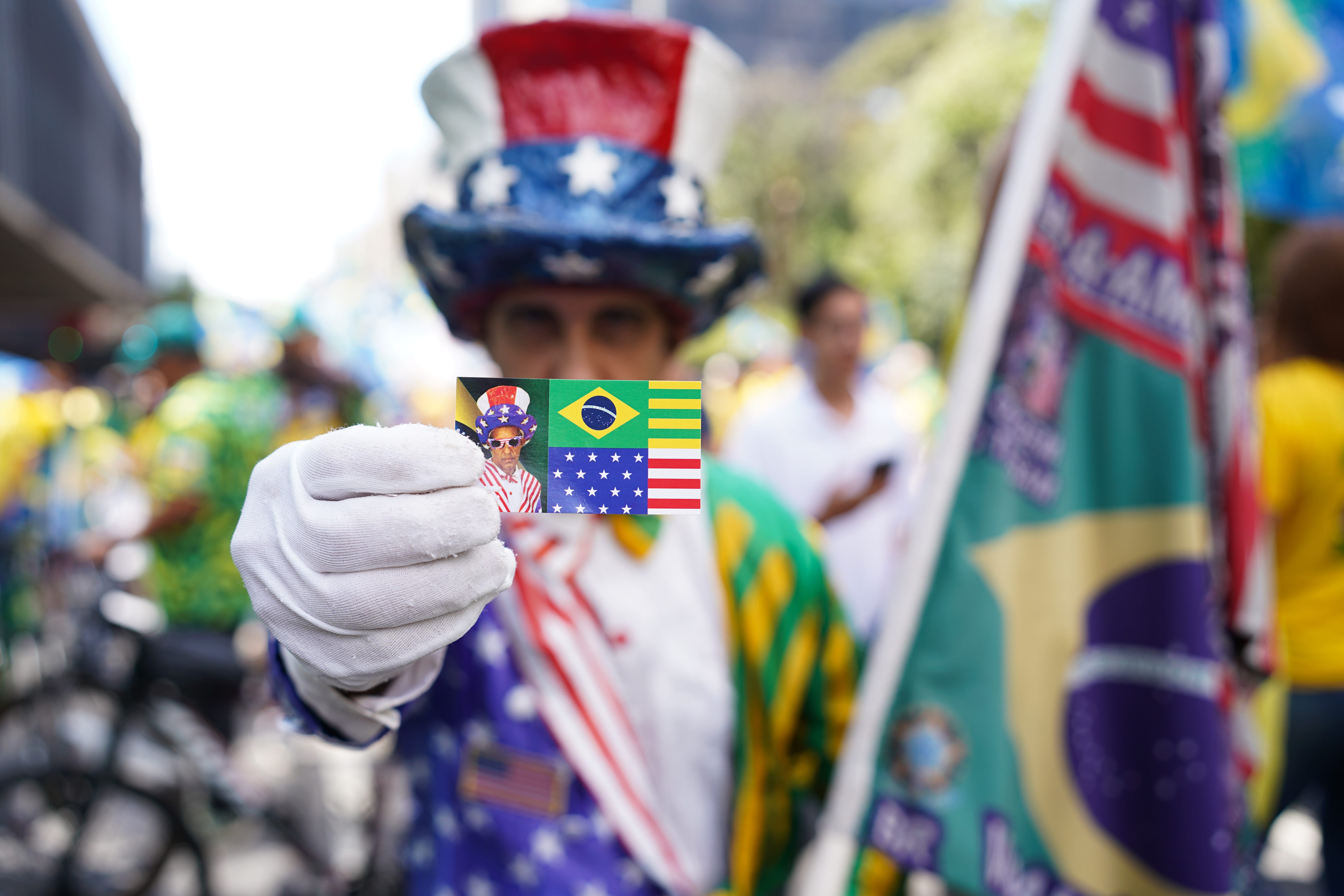
A man dressed as Uncle Sam rallies for far-right candidate Flavio Bolsonaro in São Paulo, Brazil in October 2026 (Nicolas Hernandez/Anadolu via Getty Images)
“This is going to be a very close election,” CEPR’s Director of International Policy Alex Main, who will be in Brazil to observe the election, said. “Polls have had Lula and Bolsonaro statistically tied for several days. Many people are deeply concerned that Bolsonaro will not recognize a Lula victory if it happens. And perhaps worse, the Trump administration may not recognize a Lula victory either. They have interfered repeatedly to undermine Lula and clearly want Flávio Bolsonaro to win and be another faithful ally in the region.”
In recent days, the Lula administration has been able to push forward new policies, despite initial resistance from Brazil’s Congress, that may explain much of Lula’s rise in the polls. Most important was a constitutional amendment that lowered the six-day work week to five days. This is a measure that Lula had spent years fighting for, but Flávio Bolsonaro and his allies had been blocking and finally allowed under electoral pressure. Bolsonaro has since signaled to the business community that he will review the change if he is elected president. Lula is also proposing a constitutional amendment that would ensure free transit on weekends. He has announced debt forgiveness for small enterprises, increased benefits through the popular Bolsa Família program, and announced an auction whereby the government will purchase and restructure household debt.
Flávio Bolsonaro has also been dogged by scandals. He is heavily implicated in the Banco Master corruption scandal following the publication of leaked audios that show Bolsonaro soliciting millions of dollars of funding from disgraced banker Daniel Vorcaro to fund a biopic about Flávio’s father; Vorcaro has been jailed in the largest bank fraud in Brazilian history. Bolsonaro is also alleged to have undisclosed offshore assets and is the subject of a money-laundering investigation involving a businessman, Willer Tomaz, who is accused of stealing money from Brazilian old-age pensioners.
U.S. billionaires and their social media companies have also played a controversial role in the election by favoring and amplifying pro-Bolsonaro posts while restricting posts by, or in support of, the Lula campaign. Lula’s campaign won an electoral court challenge against Meta for suppressing content in favor of his campaign while boosting content in support of Flávio Bolsonaro. Separately, Elon Musk has long publicly attacked the Lula government and Supreme Court Justice Alexandre de Moraes for their attempts to regulate social media platforms, in particular to limit the dissemination of electoral disinformation in the wake of Jair Bolsonaro’s attempt to overturn the 2022 presidential election. In 2025, President Trump cited alleged “censorship” of social media platforms by Brazilian authorities in his decision to impose 50 percent tariffs on Brazil, a move that many speculate was driven by owners of social media companies with close relations to the US president.
U.S. Members of Congress have called out Trump’s electoral interference and urged the Trump administration to respect the election results and recognize the next Brazilian government regardless of who wins. In a September 24 letter, 30 House members and Senator Bernie Sanders (I-VT) asked, “Will the Administration commit to respecting Brazil’s electoral process, which is widely regarded as one of the most secure and reliable in the world?” and “Will the Administration commit to recognizing the certified outcome of Brazil’s 2026 democratic elections and to upholding standard diplomatic relations with whichever candidate is legitimately chosen by the Brazilian electorate?”
In a September 28 letter to Secretary of State Marco Rubio, Senators Jeane Shaheen (D-NH), Peter Welch (D-VT), and Tim Kaine (D-VA) asked whether “the Administration [will] commit to recognizing the certified outcome of Brazil’s 2026 democratic elections and to supporting normal diplomatic relations with whichever candidate is freely and fairly chosen by the Brazilian people?” In its response to both these letters, the Trump administration failed to commit to respecting the results of the election and maintaining relations with the next government of Brazil.
“This refusal by the U.S. State Department to answer a simple question from the U.S. Congress about whether they would recognize Brazil’s election results seems like a deliberate threat,” CEPR Co-Director Mark Weisbrot said. “Especially given that both Trump and Jair Bolsonaro have refused to recognize election results and supported violent resistance when they lost their elections. Rubio and Trump seem determined to capture another government that will support their military and economic violence in the region, and this one, the biggest country in Latin America.”
The Center for Economic and Policy Research is an independent think tank co-founded by economists Dean Baker and Mark Weisbrot in 1999.