


By Henrique Rodrigues
In a deeply questionable approach to the journalistic scrutiny this story demanded, The Washington Post published an article on Saturday that gave wide space to known falsehoods spread by fugitive Brazilian Senator Flávio Bolsonaro. The paper did not push back on them as sharply as the subject requires. It let a right wing extremist spread absurd lies about Brazilian institutions with no emphatic corrections. Owned by billionaire Jeff Bezos, the paper handed readers an unmistakable “softball” piece. It was built on a sympathetic, condescending narrative that ignores the gravity of the facts and Brazil’s laws.
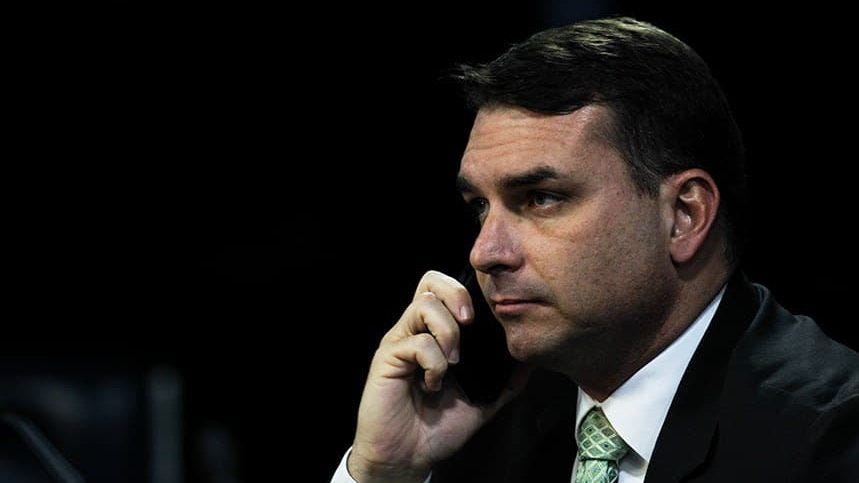
Flávio Bolsonaro, who WAPO portrays wistfully gazing at a chocolate donut, is currently under Brazilian federal police investigation for allegedly laundering US $12 million. (photo: Beto Barata/Agência Senado)
While Brazilian democracy comes under attack from a coup narrative with no factual basis, The Post chose to open its story with a picturesque scene. It shows Bolsonaro in a Florida coworking space, gazing wistfully at an iced chocolate doughnut with sprinkles. By painting its subject as “sad,” “confused” and prone to typically American habits, the paper softens the image of a a man under investigation for serious crimes who recently snuck out of Brazil. It also exposes its own permissive editorial line toward the rise of the global far right.
The paper’s promotional post on social media, though, seems to strike a different editorial tone. “After losing Brazil’s election, sneaking to Miami and proclaiming himself rightful president, Flávio Bolsonaro tells The Post he doesn’t know what he’s going to do now, or next.” reads the post on the paper’s official X account.


Complicit Silence in the Face of Lies and the Denial of Democracy
The Post’s loudest failure is its deliberate refusal to rebut him with the force serious journalism demands. In the interview, unlike in the tough promotional post, Bolsonaro repeated the absurd claim that Brazil is no longer a democracy. He said, without offering a shred of evidence, that Donald Trump is “convinced” of this premise. Bolsonaro himself admitted to the reporter that he has no proof of the electoral fraud he alleged. Given such an explicit admission of disinformation, any outlet committed to the truth should have flatly contradicted him. It should have restored the facts in the final version that reached its readers.
Brazil is the world’s ninth largest economy and one of the most influential nations on the planet. It has been a consolidated, unbroken democracy since 1985, when the country ended its last military dictatorship. Its elections are auditable, fast and internationally recognized for their undisputed integrity. They even elected Bolsonaro and his father several times over the decades. Staying silent, or simply noting “what the other side says,” gives a stage to ideological lies. As a matter of fact, there is no “other side” when the question is the integrity of the electoral system. The election was clean, and there was no fraud of any kind.
The Post’s story also stumbles badly in how it describes the players in the justice system, not just in what it leaves out about Brazilian democracy. It calls Justice Alexandre de Moraes of the Supreme Federal Court a “longtime adversary of the Bolsonaro family.” That phrasing is false and perverse. Moraes is not a political or personal rival. He is a Supreme Court justice carrying out his constitutional duties. He is the lead justice in the criminal cases and investigations that held hundreds of people accountable for attempting a coup.
Different Outlets, Different Journalistic Treatment
The Post’s stance looks even worse next to the work of other mainstream media outlets. The New York Times showed how journalism should respond to authoritarian figures. For every unsupported claim from Flávio Bolsonaro or his allies, correspondent Ana Ionova issued explicit corrections. She directly rebutted at least eight lies with data, facts and historical context. The Times dismantled the “political persecution” pose with rigor, and it subtly, discreetly mocked the role of victim the fugitive has taken on.
At Bezos’ paper, by contrast, readers find a gently toned human interest story about a man “uncertain about the future.” The story softens the real situation of the people involved. Jair Bolsonaro is not a wronged man. He is a convicted criminal who plotted a violent military coup against the republic, and he is serving his sentence under house arrest. Likewise, Flávio Bolsonaro is not a “humanitarian exile.” He is under investigation for several crimes, including money laundering and corruption. He also defied explicit court orders to flee the country and avoid answering to the courts.
Political Alignment and the Interests of Billionaire Capital
The Post’s condescension does not exist in an editorial vacuum. It reflects the ideological turn driven by its owner, billionaire Jeff Bezos. In recent years, Bezos has openly moved closer to Donald Trump’s political circle and the Republican Party. He has made large financial donations to the group’s campaigns. He has also intervened directly in the paper’s decision making, including blocking its traditional editorial endorsements of Democratic candidates.
The Post’s story leans on Trump to back its criticism of Brazil. Yet Trump himself has repeatedly denied the results of U.S. elections and incited the 2021 storming of the Capitol. Using him as a yardstick for the quality of a foreign country’s democracy is an untenable logical contradiction. The Post’s alignment with this view serves its owner’s geopolitical and economic interests. It sacrifices factual truth for a narrative convenient to Trumpism.
By the end of the Post’s article, what stands out is not a search for the truth but a piece built on sympathy and passivity. The paper turned criminal accusations and antidemocratic theories into a mere “personal dilemma” for a man enjoying a doughnut in a Florida office. In doing so, it did a disservice to global public opinion. It also confirmed that a press kept by billionaires aligned with extremism would rather cover for lies than face the facts.
This article initially appeared in Revista Fórum, was translated with the express authorization of its editor-in-chief by Panamerican Dispatch, and can be read in its original Portuguese here.
And yet another reason I dumped the post 8 years ago
Can everyone stop saying big tech only bent the knee to Trump so they could preserve whatever business goal makes it seem okay? They show up with bags of money or whatever service request any fascist asks of them because they support it.