


Congresswomen Sônia Guajajara and Célia Xakriabá are demanding urgent action from Brazil’s Justice Ministry, the Ministry of Indigenous Peoples, the Federal Prosecutor’s Office and the Superior Electoral Court. The request follows threats to poison the water supply of Guarani Kaiowá Indigenous people in the Sassoró village in Tacuru, Mato Grosso do Sul.
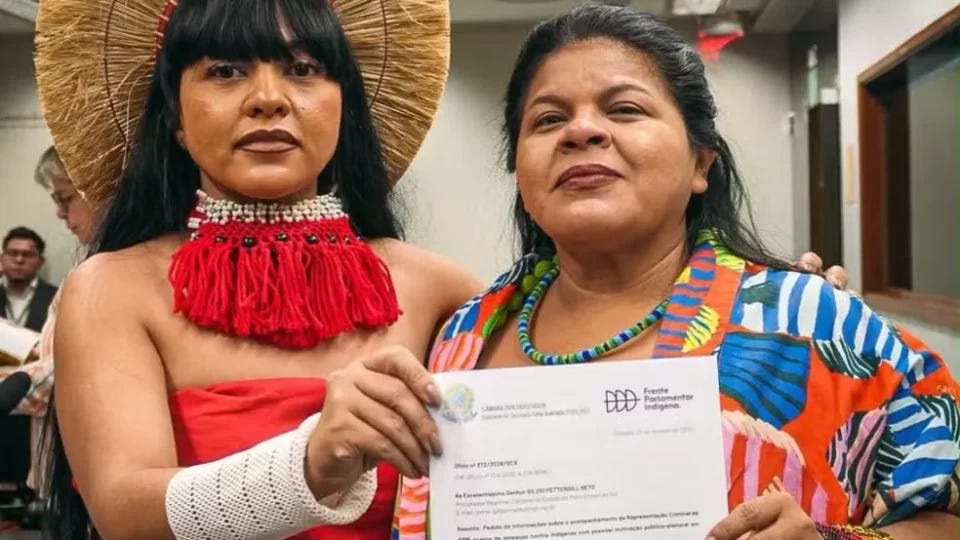
Federal Deputies Célia Xakriabá (PSOL) and Sônia Guajajara (PSOL)
The two lawmakers sent a formal letter to those agencies asking them to investigate the case, identify and hold the people responsible accountable, and take immediate steps to protect Indigenous communities.
The threats came to light after audio recordings began circulating that are attributed to a Tacuru city government employee. In them, the speaker mentions the possibility of poisoning the water the Indigenous residents drink. The complaints surfaced after President Luiz Inácio Lula da Silva won reelection.
Tacuru Mayor Rogério Torquetti (PSDB) said the employee has been removed from his post and faces an administrative disciplinary proceeding. The employee’s name has not been released. After the backlash, the mayor also asked the Indigenous community to forgive the comment.
The federal government has asked the Federal Police to investigate the threats and any racist statements aimed at Indigenous peoples in Mato Grosso do Sul after the 2026 presidential runoff. The Ministry of Indigenous Peoples received a complaint from a representative of the Sassoró village and forwarded it to the police. It asked investigators to verify whether the recordings are authentic, identify those responsible and assess whether crimes were committed.
The ministry stressed that there is no proof the water has been contaminated. It also called for preventive measures to ensure the community has a safe water supply.
Chief Ivan Montiel, a leader of the Sassoró village and a Tacuru city councilman, condemned the statements attributed to those involved. He said he will seek accountability through both criminal and civil courts. He also stressed that Indigenous people have the same right as any other citizen to choose their candidates freely.
The Articulation of Indigenous Peoples of Brazil, known as APIB, reported other episodes of violence in the state. These include deaths, hit and run incidents, threats and suspected water poisoning in Tacuru and Nioaque. One Indigenous man died after being struck by a vehicle on highway MS-289, between Coronel Sapucaia and Amambai, in the early hours of Saturday. The circumstances of the crash have not yet been clarified.
Mato Grosso do Sul’s Secretariat of Justice and Public Security denied that genocide is taking place against Indigenous peoples in the state. The Indigenous Missionary Council said it is looking into the reports.
This article originally appeared in ICL Notícias, was translated with express authorization of the editor, and can be read in its original Portuguese here.