


By Florestan Fernandes Jr.
President Donald Trump’s crushing defeat in the U.S. midterm elections and President Luiz Inácio Lula da Silva’s historic victory in Brazil mean much more than two election results. They send an enormous political message to the world. In the two largest and most important countries in the Americas, voters are saying they do not accept a unipolar world order. They reject the ideology of white supremacy. They say no to political projects that turn immigrants into enemies by persecuting them, criminalizing them and denying them fundamental rights.
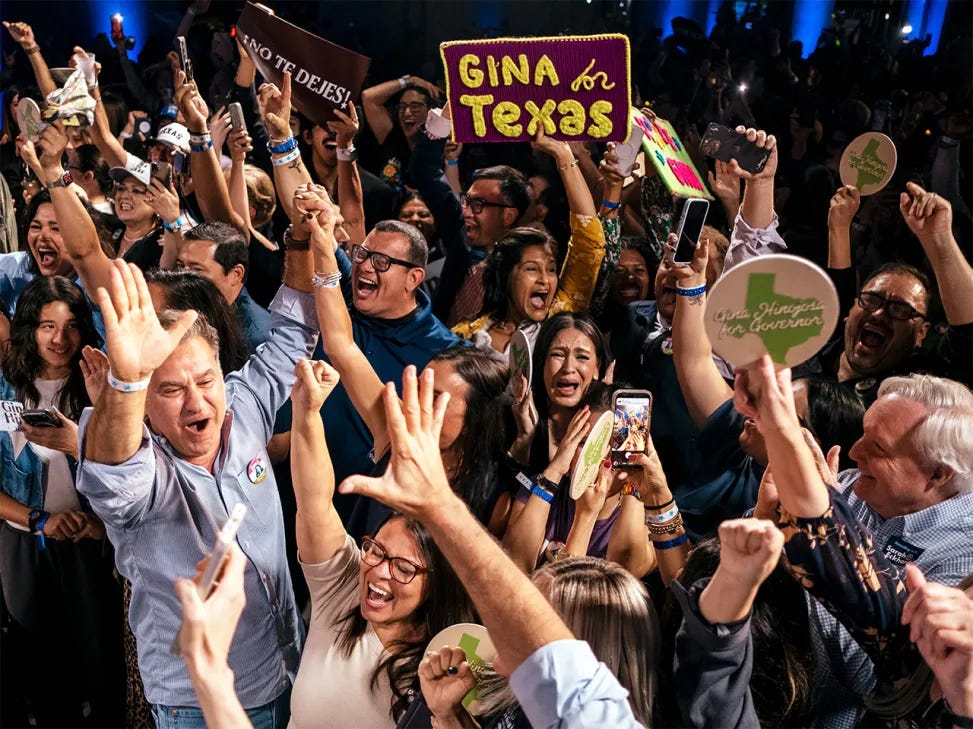
Texans celebrate the gubernatorial victory of Gina Hinojosa (Joel Angel Juarez/Getty Images)
But the message is broader. People want peace. They want an end to wars, military threats and unilateral sanctions that undermine free trade and relations among nations. They want a world where dialogue and diplomacy prevail over force, intimidation and one power imposing its interests on all others.
The results are also excellent news for the United Nations, which Trump’s foreign policy has treated with contempt. The UN now has a chance to regain a leading role. It can advance the reforms needed to play a truly central part in building a new international order. That order would be more democratic, multipolar and committed to peace, the sovereignty of peoples and cooperation among nations.
Another phenomenon is even more significant. A wave of popular mobilization is growing in Brazil, the United States and several European countries. It brings together young people, workers and broad sectors of society. Street demonstrations have outpaced traditional parties and political leaders, and often their ability to respond. The rise of autocratic governments and projects, threats to democratic freedoms and attacks on social rights are putting crowds in the streets around the world.
This reaction crosses borders and party ideologies. It puts popular participation back at the center of the fight over the future of democracy.
In Latin America, the hope is that this wave of democratic resistance will also halt the advance of governments unconditionally aligned with Trump. A string of electoral victories for the far right in the region came with a political influence operation by Washington, led by Secretary of State Marco Rubio. The United States gave financial, diplomatic and electoral support to conservative candidates. The strategy went as far as the direct use of military force in the Caribbean, culminating in the operation against Venezuela. It is a new version of the long history of U.S. intervention in Latin America. That policy now faces signs of resistance. It may begin to lose strength as the shifts seen at the ballot box and in the streets take hold.
More than a reaction to the rise of the far right, what is taking shape at the ballot box and in the streets is a fight over the future of humanity. That future cannot belong to autocrats, warlords and those who own the money. It must belong to the people.
Florestan Fernandes Jr is editor of the nightly web TV program, Boa Noite 247, and has worked for many of the largest media outlets in Brazil, including Folha de São Paulo, Jornal da Tarde, TV Globo, TV Manchete, TV Cultura, TV Gazeta, and TV Brasil. He is also a member of Brasil 247’s board of directors.
This article, which does not necessarily reflect the opinion of Panamerican Dispatch, originally appeared in Brasil 247, was translated with express authorization of its editor-in-chief, and can be read in its original Portuguese here.