


by Lucas Pordeus León
Approximately 210 million voters in the United States head to the polls this Tuesday, October 3, to elect all 435 members of the House of Representatives, as well as 35 of the 100 seats in the Senate.
Americans will also elect governors in 36 of the country’s 50 states. The outcome of the election will determine President Donald Trump’s future in the White House, as the Democrats could secure a majority in Congress, a shift that would also have political repercussions for Brazil.
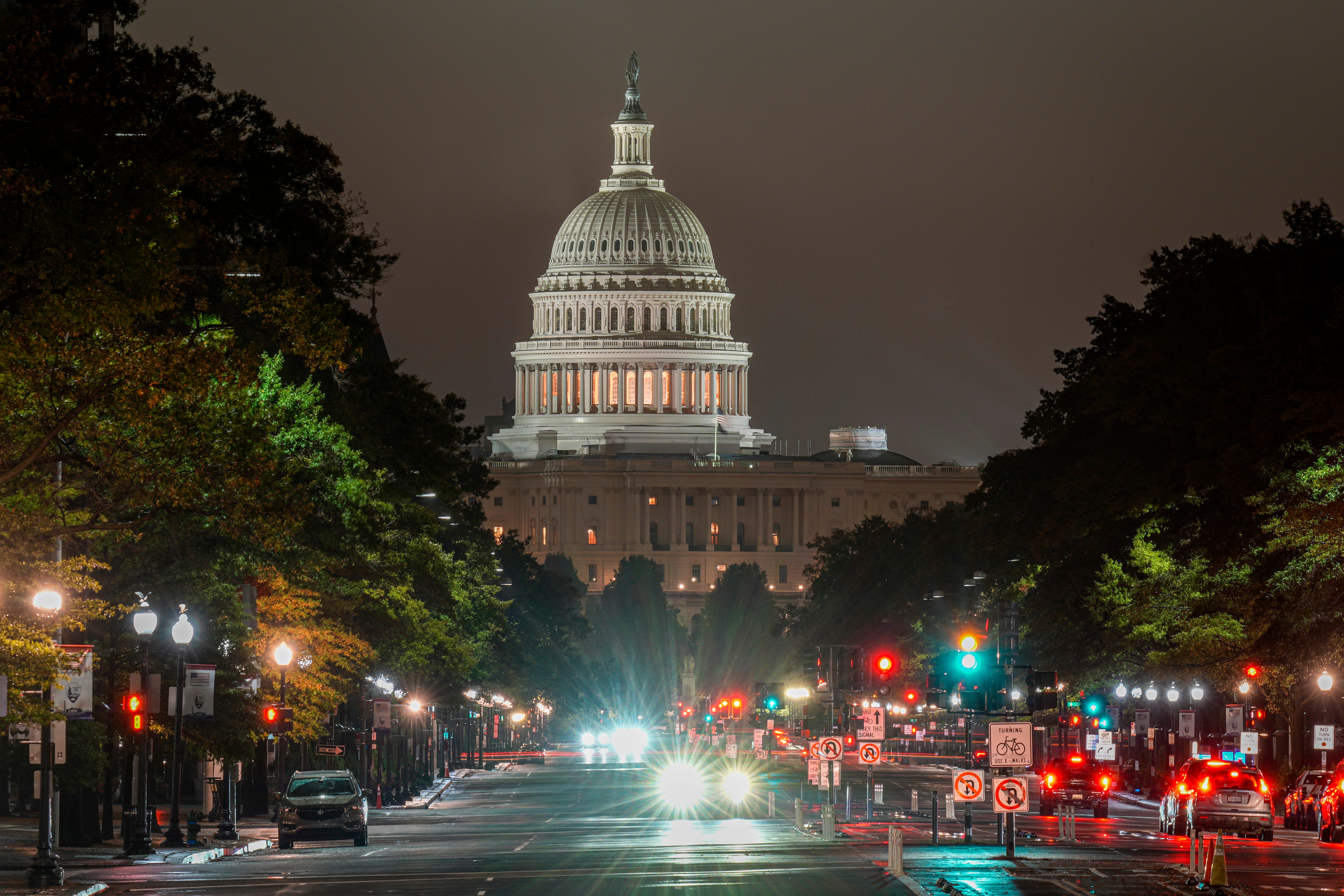
Traffic moves along rain-slicked Pennsylvania Avenue before the U.S. Capitol Building on October 11, 2026, in Washington, DC. (Photo by J. David Ake/Getty Images)
That is because the U.S. opposition has questioned the White House over alleged interference by Trump in Brazil, such as U.S. funding for campaigns directed against the Supreme Federal Court.
Currently, both legislative chambers hold a narrow Republican majority, which has given Trump greater freedom to implement his policies.
Opinion polls have pointed toward a Democratic victory, driven in part by the rising cost of living. The conflict initiated by Trump against Iran is cited as one of the causes of inflation, as it led to an increase in fuel prices following restrictions on navigation in the Strait of Hormuz.
Over the past few months, the U.S. president’s disapproval rating has risen to 61%, against an approval rating of 36%, according to an average of polls calculated by The New York Times.
Amid this unfavorable landscape, Trump has promised a $5,000 payment to every adult in the country should the Republicans win the House and Senate elections. He has spent the last few days traveling across the nation to campaign for his allies.
Paulo Abrão, executive director of the Brazil Office Alliance, an organization that connects Brazilian researchers working in the U.S., says that the outcome of the election will determine the degree of control the legislative branch will have over President Trump.
“If the opposition wins one of the chambers, they could expand investigations, demand explanations from the administration, and hinder his legislative agenda. Control of the House is particularly significant for oversight,” Abrão told Agência Brasil.
Abrão added that control of the Senate grants the power to confirm or reject the appointments of officials and judges.
“If the Republicans retain both chambers, Trump will have a more favorable political environment to advance his agenda, though this does not eliminate internal disagreements within his own party,” said Abrão.
Trump has raised a series of questions concerning the security of the U.S. electoral system. In 2020, after losing to Joe Biden, Trump claimed the election had been rigged, though he provided no evidence. Last week, when asked by journalists, Trump stated that he would respect the outcome “if it’s an honest election.”
Foreign Policy
There is an expectation that a Democratic victory could lead to shifts in U.S. foreign policy, particularly over the situation involving Iran. Abrão notes that the U.S. presidency holds a wide margin of maneuver in foreign policy, even without a majority in Congress.
“A more independent Congress could increase political costs, scrutinize decisions, and contest the allocation of resources, even if it does not directly control diplomacy,” he said.
Implications for Brazil
Any political weakening of Donald Trump would likely also affect U.S.-Brazil relations, which have been marked by significant tariffs and friction with the administration of Luiz Inácio Lula da Silva. That is particularly the case if Trump should lose his majority in one or both chambers of Congress.
Abrão says that Democrats could expand the investigation into the Bolsonaro family’s activities in the United States, exposing their connections to the Trump administration.
“Democratic lawmakers have already been demanding explanations [over alleged interference by Trump in Brazil],” said Abrão. “The core issue would be to clarify whether U.S. state instruments were used to favor a foreign political group, and, if so, for what reasons and on what grounds.”
He points out that a congressional investigation could examine allegations against Meta, the parent company of Facebook, Instagram, and WhatsApp, over the favoring of candidate Flávio Bolsonaro during the Brazilian elections.
The reduction in the social media reach of accounts linked to candidate Lula was attributed by the tech giant to “technical issues.”
“A shift in control of Congress could transform inquiries, currently expressed through letters from lawmakers, into investigations with a greater capacity to gather evidence and demand answers,” said Abrão, who is also a law professor. “This is not automatic. It depends on the priorities of the new majority and could face resistance and legal challenges.”
In recent weeks, Democratic members of Congress have questioned the White House in letters on a range of issues, from Meta’s actions during the Brazilian elections to the decision to revoke the visa of Brazil’s ambassador to the U.S., Maria Luiza Ribeiro Viotti.
Last Thursday, October 29, the Democrats demanded answers over potential White House involvement in the departure of Senator Flávio Bolsonaro from Brazil, which occurred despite a Brazilian court order prohibiting him from leaving the country.
Flávio is facing legal proceedings for money laundering, corruption, and currency evasion.
This article was originally published by Agência Brasil. It was translated by Panamerican Dispatch. You can read the original, in Portuguese, here.