


By Alice Maciel, Juliana Dal Piva, Flávio VM Costa, Paulo Motoryn, Igor Mello and André Uzêda
Retired Army Gen. Augusto Heleno, 78, is working from house arrest to line up who would command Brazil’s armed forces under a potential presidency of Sen. Flávio Bolsonaro, should he win Sunday’s election. One of Heleno’s contacts is the current commander of the Brazilian Air Force, Lt. Brig. Marcelo Kanitz Damasceno, who was appointed by Lula in January 2023.
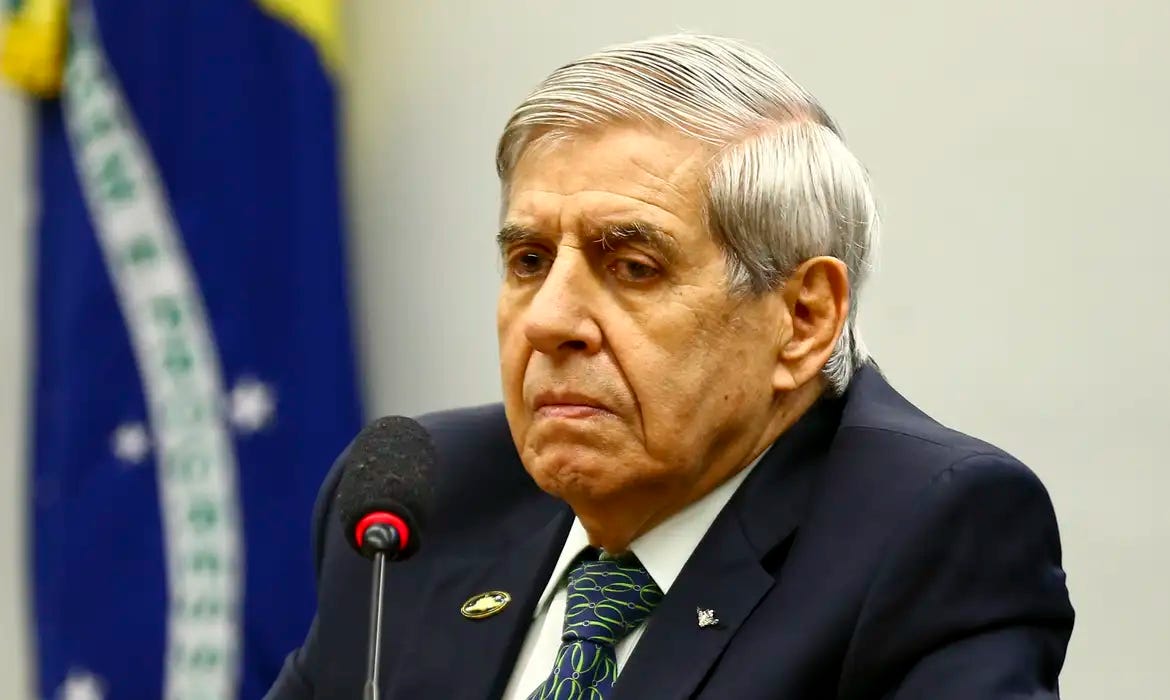
Gen. Augusto Heleno was the UN MINUSTAH military commander during the 2005 Cité Soleil massacre in Haiti (photo: ICL)
ICL Notícias’ investigative unit spoke with military sources who described details of the plan, which also involves a “general amnesty” for everyone convicted by the Federal Supreme Court over the attempted coup.
The plan also includes naming Alexandre Ramagem, who was convicted in the same trial and sentenced to 16 years in closed detention, as director general of the Federal Police. Ramagem is currently a fugitive of justice in the United States. Under Jair Bolsonaro’s government, he served as director general of Brazil’s intelligence agency, Abin.
A meeting took place on Tuesday with senior Air Force leadership, where names put forward by Heleno for military posts were discussed. Among those names, handpicked by the general, were officers who remained loyal to him even after his conviction. Heleno, Jair Bolsonaro’s former chief of the Institutional Security Cabinet, was sentenced by the Supreme Federal Court to 21 years in prison for his role in the coup plot.
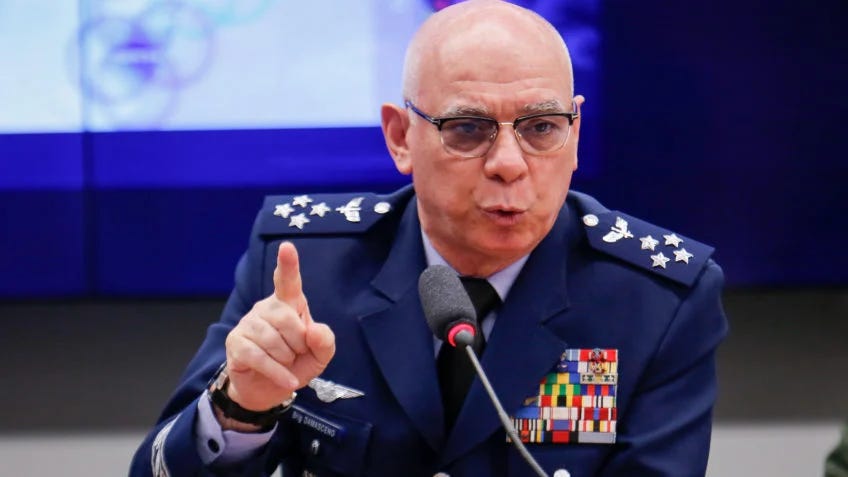
Marcelo Kanitz Damasceno, Commander in Chief of the Brazilian Air Force (photo: ICL)
According to a military source who had knowledge of what was discussed at the meeting, loyalty to Heleno was a central theme, and Lt. Brig. Damasceno was present. The goal, in the source’s words, is to “get the house in order.” The source also said Heleno is treating Flávio Bolsonaro’s victory as a certainty and expects to benefit from an end to his detention. (See below for how this “amnesty” would work if Flávio wins.)
The leading candidate for defense minister is Marcos Degaut, chief executive for Latin America at Edge Group, an Emirati defense company that has been rapidly expanding in the region’s defense industry through acquisitions of the Brazilian firms SIATT, Condor and Akaer.
Degaut previously served at the Secretariat of Strategic Affairs under Michel Temer’s administration, and was secretary of defense products under Bolsonaro. He is also close to Eduardo Bolsonaro, whose mandate as a federal deputy was revoked.
ICL Notícias reached out to Gen. Heleno’s defense team, Lt. Brig. Damasceno and candidate Flávio Bolsonaro for comment on this reporting. None had responded as of publication. The offer to comment remains open.
The Defense Ministry under Lula’s government was also contacted. The Brazilian Air Force responded in a statement that “the Air Force commander did not take part in a meeting with Gen. Augusto Heleno.” The statement added that “on the date in question (October 20), the Air Force commander was delivering an institutional lecture to active duty and reserve Air Force personnel at the Air Force University (UNIFA) in Rio de Janeiro. He returned from that assignment on the morning of today (October 21), at which point the Air Force commander took part in a formal session honoring the Brazilian Air Force at the National Congress.”
ICL Notícias’ reporting, however, did not detail how or where the alleged meeting took place, in order to protect its sources. The report also does not claim that Heleno personally took part in that meeting.
Who Is Marcelo Kanitz Damasceno, Commander of the Air Force
Colleagues describe Damasceno as a political operator, someone accustomed to building relationships with politicians. On Tuesday, the Federation of Industries of the State of São Paulo (Fiesp) posted a video on social media showing him with the organization’s president, Paulo Skaf, during a visit to the São Paulo Aerospace Museum. On Sunday, Skaf was part of the group accompanying Flávio Bolsonaro at the Band TV debate.
Jair Bolsonaro appointed Damasceno as Air Force chief of staff in October 2020, and he held that post until December 2022. At the time, the Air Force was commanded by Lt. Brig. Carlos Almeida Baptista Júnior, who resisted the coup attempt. In his book, “I Said No,” Baptista Júnior recounts being pressured by then President Jair Bolsonaro to attend meetings where a draft plan to block Lula’s inauguration was discussed.
Lula chose Damasceno based on seniority within the military career ladder, selecting him from among the Air Force’s most senior officers, following the standard order of precedence. It was an attempt by Lula to avoid friction with the armed forces as he returned to the presidency.
In that same spirit, Lula appointed José Múcio as his defense minister, a civilian, but one approved of by the armed forces and even praised by Jair Bolsonaro during his own presidency. In December 2020, while bidding farewell to Múcio as he left the presidency of the Federal Accounts Court, Bolsonaro publicly declared that he was “passionate” about him.
When Damasceno took office in January 2023, he said he was accepting the role despite facing “incomprehension” from people close to him.
“As a son of this beloved nation, I would not run from this fight, nor shy away from this noble mission. And may the incomprehension shown by some close to me turn into understanding in time,” Damasceno said during the change of command ceremony.
A year later, in an interview with O Globo, he said “anything that undermines discipline must be punished.”
Who Is Augusto Heleno, the General Convicted of Attempting a Coup
Augusto Heleno first gained attention within the military as a young officer serving as an aide to Gen. Sylvio Frota during a hardliner faction of the Army’s attempted auto-coup against the political opening pursued by Gen. Ernesto Geisel’s government (1975 to 1979).
Heleno became a general after Brazil’s return to democracy, and during Lula’s first presidency, he was chosen as the first commander of the United Nations Stabilization Mission in Haiti (MINUSTAH). He led the U.N. troops there from June 2004 to September 2005.
His time leading the peacekeeping force was marked by allegations of human rights violations. The most notorious case was the Cité Soleil massacre on July 6, 2005. Heleno commanded Operation Iron Fist, which aimed to kill gang leader Emmanuel Wilmer.
The operation drew international condemnation for its violence. More than 400 troops took part, and human rights and humanitarian organizations reported dozens of civilian deaths during the fighting.
After leaving the Haiti mission, Heleno was chosen to lead the Amazon Military Command. He was considered a possible future Army commander, but a series of public statements opposing Lula’s government policy on Indigenous rights, and opposing the removal of illegal occupants from the Raposa Serra do Sol Indigenous territory, cost him that position.
Heleno left active duty in 2011 and gradually aligned himself with the far right. He became one of Jair Bolsonaro’s main advisers during the early campaign period, and in 2018, as running mates were being decided, he was considered a possible vice presidential pick. That alliance never materialized, though, because he was affiliated at the time with the PRP, a party outside Bolsonaro’s coalition.
Throughout Bolsonaro’s presidency, Heleno served as head of the Institutional Security Cabinet, which oversees 16 government agencies including intelligence, making him one of the president’s closest aides. According to Federal Police investigations, he played a central role in the 2022 coup attempt.
In July 2022, during a cabinet meeting, Heleno argued for “flipping the table” before the election concluded, a reference to staging a coup.
“There’s no VAR in elections. There’s no second chance in an election, no video review. So whatever needs to be done has to be done before the election. If we need to slam our fist on the table, it has to happen before the election. If we need to flip the table, it has to happen before the election. After the election, it will be very hard for us to have any new opportunity,” Heleno said at the time.
In that same meeting, the general also spoke openly about planting Abin agents inside rival campaigns, a comment that led Bolsonaro to interrupt and reprimand him, since the president preferred to discuss that topic privately.
The Federal Police seized a notebook belonging to Heleno containing notes tied to the coup attempt. Among the general’s outlined strategies was one to “establish a narrative about electronic voting machines and vote counting.” “It’s worth continuing to criticize the electronic voting machine,” Heleno wrote.
Other notes in the same vein showed that Heleno was one of the main forces behind Bolsonaro’s rhetoric making false claims of electoral fraud, the backdrop for the coup attempt. Sentenced to 21 years in prison in September 2025, he has been serving his sentence under house arrest since December for what the court described as “humanitarian reasons.”
To secure that arrangement, Heleno’s legal team told the Supreme Federal Court that he suffers from symptoms of Alzheimer’s disease. His lawyers initially said he had been suffering from the condition since 2018, a year before he took over the Institutional Security Cabinet under Bolsonaro. After that claim drew negative attention, his defense team said there had been an error, and that the actual Alzheimer’s diagnosis dated to 2025.
How Amnesty for Those Convicted Over the Coup Would Work
Beyond Gen. Heleno, the Supreme Federal Court’s First Panel convicted 28 other defendants in December of last year in connection with the coup attempt. Former President Jair Bolsonaro received the harshest sentence, 27 years and three months in prison. He is currently serving that sentence under house arrest at his home in Brasília, citing health problems.
Overturning a Supreme Court conviction requires passing a law specifically addressing what the opposition calls amnesty, followed by presidential approval. Military officials are betting that, with a majority in Congress and Flávio Bolsonaro’s election to the presidency, this plan could actually become reality.
Flávio’s party, the Liberal Party, consolidated as the largest party in both chambers of Congress, electing 121 federal deputies in the lower house and winning 19 Senate seats, bringing its total in the Senate to 28. That alone isn’t enough to secure a majority, but there’s room for negotiation with parties in the so called Centrão bloc, including União Brasil, PSD, PP, Republicanos, MDB and Podemos.
The Supreme Court would only rule on ending these convictions if asked to do so. In that case, the court would need to decide whether such a measure violates constitutional provisions, including protections for Brazil’s democratic rule of law.
This article first appeared in ICL Notícias, was translated by Panamerican Dispatch with express consent from the editor, and can be read in its original Portuguese here.