


by Michael Fox
This is the latest episode of the podcast Under the Shadow. You can listen below or wherever you get your podcasts.
On May 26, 2026, a 45-year-old Brazilian Senator named Flávio Bolsonaro met with U.S. President Donald Trump at the White House.
Flávio is the presidential candidate for the far right in Brazil in the upcoming elections in October.
“Let me look you in the eyes and tell you, ‘we will win’,” he told the annual Conservative Political Action Committee meeting in Texas, earlier this year.
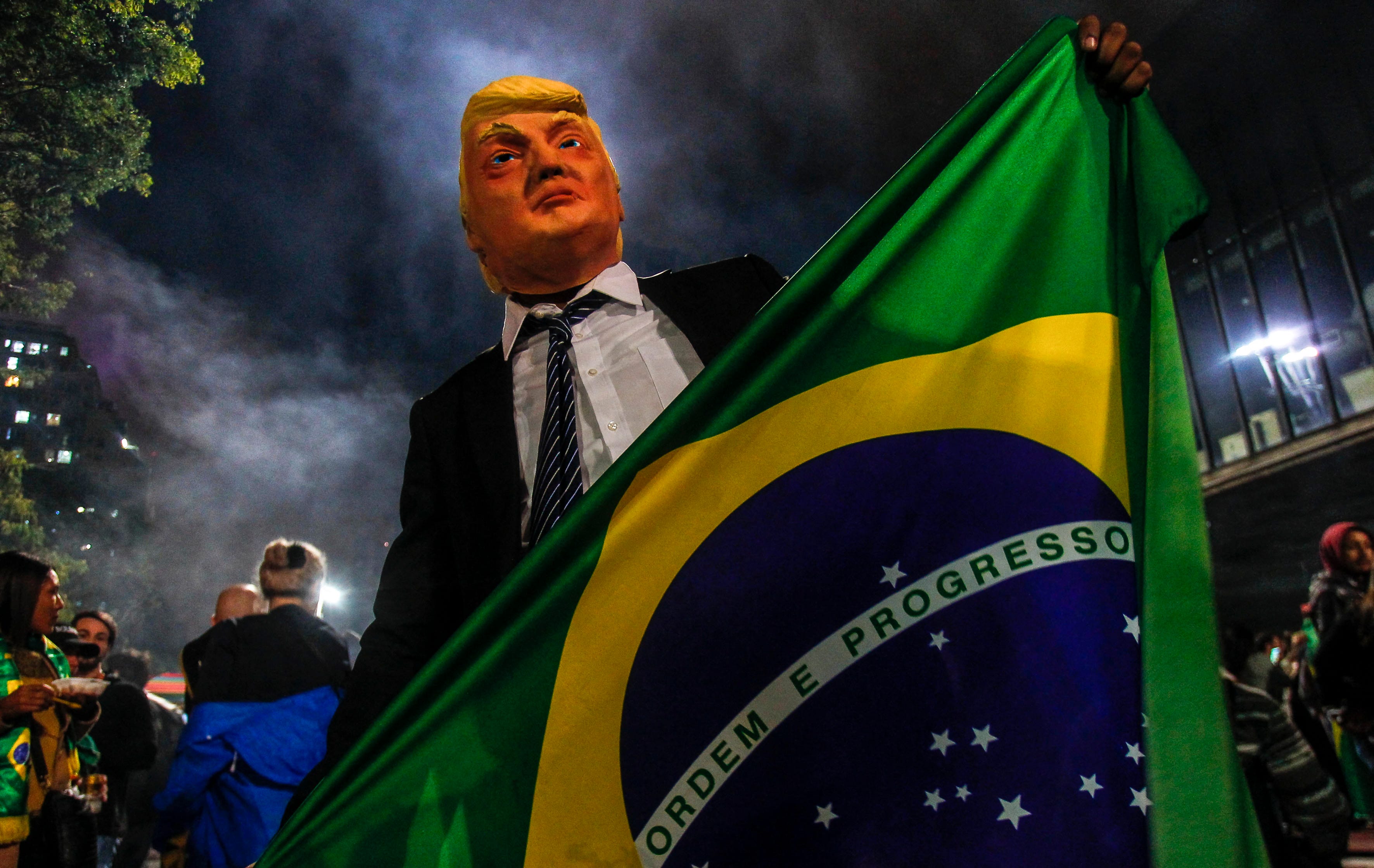
A supporter of Jair Bolsonaro, wears a mask of US President Donald Trump as he celebrates after Bolsonaro won Brazil's presidential election, in Sao Paulo, Brazil, on October 28, 2018. (Miguel SCHINCARIOL / AFP via Getty Images)
Flávio is the son and political heir of the former far-right president Jair Bolsonaro, a close ally of the U.S. president.
In the meeting at the Oval Office in May, Flávio Bolsonaro reportedly asked Trump to designate the Brazilian drug gangs, Primeiro Comando da Capital and the Comando Vermelho, as foreign terrorist organizations.
After the meeting Flávio spoke to press.
“I asked President Trump emphatically to designate as soon as possible the PCC and the Comando Vermelho as foreign terrorist organizations,” he said.
This might not seem like such a big deal, but it is. The United States has sometimes used that designation as the pretext to invade or interfere in foreign countries.
The U.S. placed the Venezuelan gangs Tren de Aragua and the Cartel de los Soles on the list back in 2025, and fighting those alleged terrorists was one of the excuses the United States used for invading Venezuela and kidnapping of president Nicolas Maduro, on January 3rd this year.
In other words, this designation carries weight.
Trump agreed to Flávio’s request.
Just three days after meeting with Flávio Bolsonaro, U.S. Secretary of State Marco Rubio announced that those two Brazilian gangs would be added to the list of foreign terrorist organizations.
Flavio Bolsonaro responded in a letter to Rubio, thanking him for the classification and offering to place his transition team at the disposal of the White House, if he is elected.
For months, the United States has been escalating the pressure on Brazil in the lead-up to the presidential elections, with the goal of helping to lift Flávio Bolsonaro to the top office.
Just a few weeks after the State Department put the Brazilian gangs on the terrorist list, Trump shared an article on Truth Social that said Brazil was his [quote?] next big challenge.
Less than a month later, in July, Trump imposed new 25% tariffs on Brazilian goods.
In August, Trump revoked the U.S. visa of the Brazilian ambassador. An apparent tit for tat, after Brazil denied visas to two U.S. State Department officials who planned to travel to Brazil to meet with former president Jair Bolsonaro.
There is much more.
The point is, as many people have pointed out, is that there isn’t just one thing that Trump is doing to try and sway the vote in favor of Bolsonaro. It’s a whole combination of moves, like a jigsaw puzzle with many pieces. Taken alone, it’s just a random assortment of colors and shapes. But when you start to put the pieces in place, a picture begins to emerge.
Trump allies have won big elections across Latin America. In recent years, right-wing candidates have taken back, or held on to power, in Argentina, Chile, Colombia, Ecuador, Honduras, Bolivia, and Peru.
And they’ve done so with the help of U.S. President Donald Trump, who has thrown his weight around to boost right-wing candidates. And also with the support of bot farms and shady electoral campaign practices linked to Washington and Mar-A-Lago, as we looked at in the last episode.
Many of those countries have now joined forces in Trump’s Shield of the Americas Alliance.
But there are few holdouts.
And Brazil is one of the most important.
“The upcoming election in Brazil is really going to be extremely consequential for the entire region,” said Alexander Main. the director of international policy at the Center for Economic and Policy Research.
“Brazil is the country with the largest economy, biggest population in Latin America and the Caribbean,” said Main. “And it’s also one of the few countries that is still holding out against U.S. pressure to align with the Trump administration’s agenda in the region, its militarized security policies, its foreign policy as well.”
The first round election is on October 4. The runoff will take place three weeks later, on October 25. Bolsonaro is facing off against the long-time Workers’ Party icon, President Luiz Inácio Lula da Silva.
This is the latest episode of the podcast Under the Shadow. You can listen above or wherever you get your podcasts.