


by Michael Fox
In mid August, thousands of supporters of leftist president Luiz Inácio Lula da Silva packed into May 1st Stadium in São Bernardo do Campo for his campaign launch.
A sea of red shirts covered the bleachers and the field. They chanted the president’s name.
Many were ecstatic to be in the crowd.
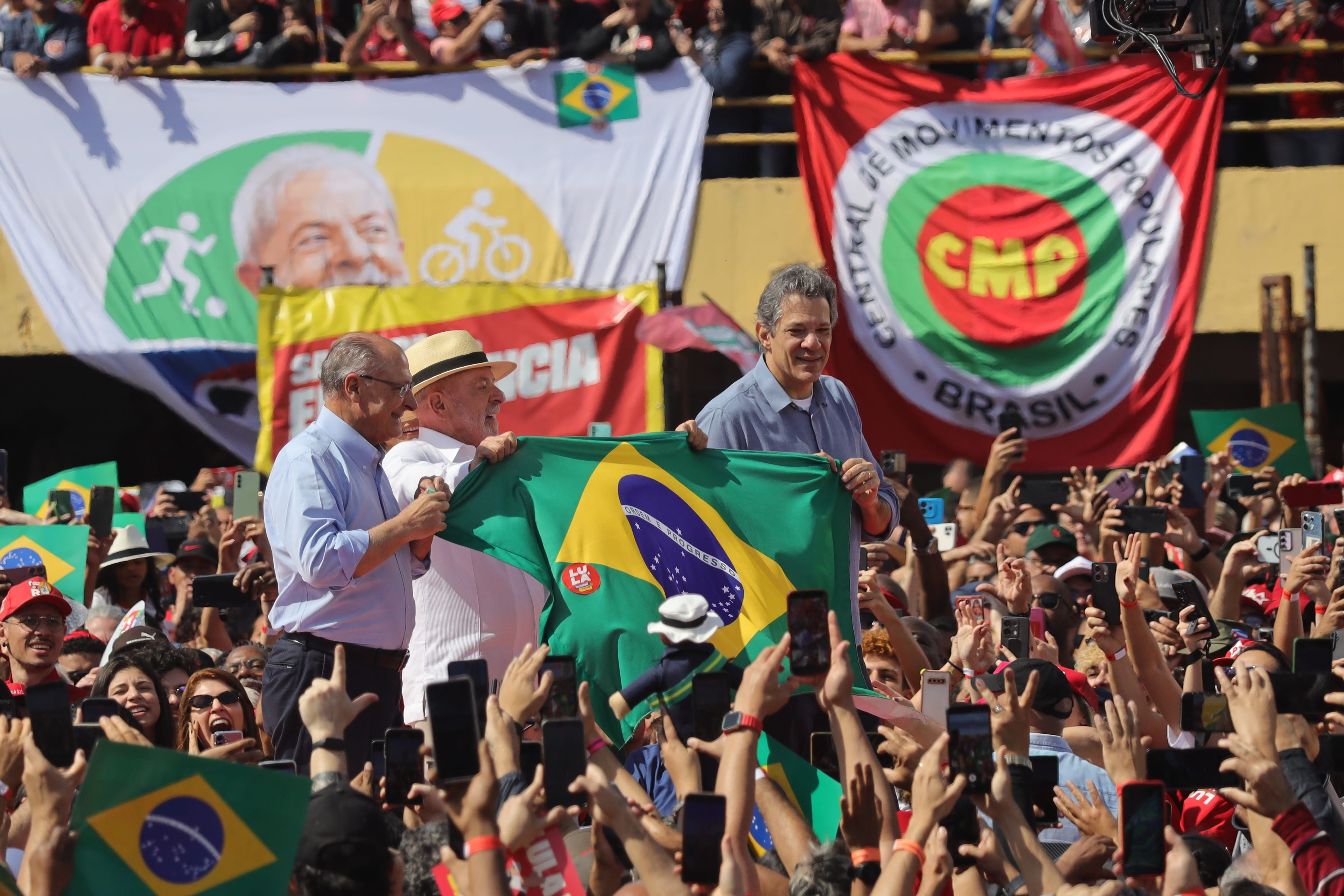
Lula carries a Brazilian flag alongside his running mate Geraldo Alckmin and former São Paulo mayor Fernando Haddad during the launch of his campaign in August. (Michael Fox)
“We came to support Lula, especially in his last election,” said Karen Silva, wearing a red Workers’ Party hat. “And we believe that we are going to win. This is a fact.”
Lula has served three terms as Brazilian president. He ran the country from 2003 until 2010. He was elected again in 2022. Now at the age of 80, he is running in his last reelection.
The Brazilian president is an iconic labor leader who led metal workers' strikes in the late 70s that marked the beginning of the end of the country’s dictatorship. The country returned to democracy in 1985.
May 1st Stadium is where Lula got his start. He held an iconic rally there, in 1979, during the strike that year. People in the crowd remember. And they say Lula has changed their lives.
“Yeah, he changed my life. He changed the life of my whole family,” said Raimunda Silva Santos, a 76-year-old avid Lula fan in a flowered shirt.
During his years in office, he promoted education, health and social programs. He helped to lift millions from poverty. They have not forgotten.
“Wow, this is the greatest joy of my life,” said Silva Santos. “I’m so happy. Lula is coming to stay. He’s an incredible person. He’s helped a lot of people there in the northeast. We owe a lot to Lula.”
They want him back for a fourth and final term. He’s built a broad coalition of political parties and grassroots organizations.
“Lula will win with the strength of social movements,” said Valmir Lima, a member of the Movement of People Affected by Dams. “He’ll win with the Movement of People Affected by Dams, all the social movements that are helping on his campaign. And all of civil society.”
Lula has promised to continue to fight poverty, promote industry, create jobs and invest in Brazil’s future.
“What kind of a future do you want for the Brazilian people if you don’t invest in education?” Lula asked the crowd. “What future do you want for the Brazilian people if you don’t invest in health? What future do you want if you don’t invest in jobs?”
“We need to win these elections,” he said. “To elect our people to Congress so we can do everything we need to do for this country.”
Lula’s challenger is the son of the former far-right president Jair Bolsonaro.
His name is Flávio Bolsonaro. He’s a Senator and he launched his campaign in his hometown of Rio de Janeiro.
“Come with me and rescue our nation,” he told the crowd from the top of a sound truck. “Brazil above all. God above everyone. Brazil above all. God above everyone!”
Flávio is in the race, because his father is under house arrest.
Former president Jair Bolsonaro was first barred from running for spreading lies about the country’s electoral system. Last year, he was convicted of attempting to carry out a coup to return to power.
His son, Flávio, has attacked the left, and promised to fight crime and insecurity, cut bureaucracy, promote private business and privatizations, and develop close ties with the United States
“Let me look you in the eyes and tell you, ‘we will win’,” he told a packed crowd at the U.S. Conservative Political Action Conference in March.
Much of his discourse, and that of his supporters, is wrapped in a religious language of good versus evil.
“You are the son of hope. You are the first born,” preached a man beside Flávio Bolsonaro, on top of the sound truck. You received the legacy of representing your father. And now, for everything that is more sacred on the face of the earth, honor your father. Honor his days on earth.”
That goes over well with his evangelical supporters, who are an important base for Bolsonaro and far-right politicians in Brazil.
Glayson Araujo is a youth pastor at an evangelical church in a working-class neighborhood of São Paulo. He joined others on the streets in mid-August to promote Bolsonaro and other far-right candidates running for local office.
“I believe that Flávio Bolsonaro is the only viable candidate, who can beat Lula and the Workers Party,” he said. “I am a Christian here, I behave as a Christian, but I am also a political activist. Here on the streets to defend my beliefs.”
Flávio Bolsonaro also has powerful support in high places. In particular, from Donald Trump.
The U.S. president is a longtime ally of his father, Jair Bolsonaro.
Last year, Trump imposed 50% tariffs on Brazil, in part, because of the country’s trial against the former president.
In May, Trump met with Flávio Bolsonaro at the White House. He asked Trump to list two Brazilian drug trafficking groups as Foreign Terrorist Organizations.
Trump agreed.
In June, Trump reposted an article on Truth Social that said Brazil was his next big challenge.
In August, Trump imposed new tariffs on the country and revoked the U.S. visa of the Brazilian ambassador.
In September, Brazil's Intelligence Agency warned of a "critical risk” of U.S. interference in the country's elections.
“This is not just about the United States trying to remove the government of a left-wing party, the Workers’ Party, or a left-wing leader, which is Lula,” said Igor Fuser, a professor of foreign relations at Brazil’s ABC Federal University. “It’s about subjecting Brazil to the policies of the United States. And Brazil, being the largest country in Latin America, is precisely the biggest obstacle to the American project of global dominance of the Western Hemisphere.”
Over the last year, Trump has pushed the United States into a new era of dominance over Latin America the likes of which the region has not seen in decades.
Boat strikes in the Caribbean. The U.S. invasion of Venezuela and the kidnapping of president Nicolás Maduro. The oil blockade on Cuba.
And Trump throwing his weight around, and meddling in elections across Latin America.
It is all justified by a renewed Monroe Doctrine.
”President Trump has established the Trump corollary of the Monroe Doctrine, the Donroe Doctrine. And the War Department is implementing it as fast as we can,” said Secretary of War Pete Hegseth, earlier this year.
Brazil is the latest battleground.
“So, it is clear that the United States is doing everything, and will do everything possible to prevent the re-election of Lula in the next elections,” said Fuser.
Meanwhile, Fuser says that if Flávio Bolsonaro wins, he will bow to Trump and the United States. He already has. In a letter to Marco Rubio in June, Flávio Bolsonaro told him that if he won this year’s presidential election, he would place his transition team at Rubio’s disposal.
“Brazil will become a country under the tutelage of the United States, a colony, or almost a colony, of the United States, as it already happens with Argentina, Colombia, Venezuela, and many others,” said Fuser. “And if Lula is victorious in these elections, we will live a very intense period of confrontation between the two countries.”
Lula has accused Trump of trying to influence Brazil’s October election.
Lula’s allies are taking action ahead of the vote, to stand up to Trump and to push for Lula’s reelection.
Brazil has denied visas to U.S. State Department officials whom they feared wanted to travel to Brazil to cast doubt about the country’s electoral system. People are hitting the streets to campaign for Lula, who has long stood against U.S. intervention in Latin America.
Brazil has become the latest battleground for Trump’s agenda in the region.
During Lula’s speech at the UN General Assembly on September 22, Lula told Trump that “Brazil is the backyard of no country.”
Michael Fox is the former editor of the NACLA Report on the Americas and the host of the podcasts Brazil on Fire and Under the Shadow. This article is based on reporting for The Real News. You can watch the full video story here.