


by Gustavo Tapioca
The neofascist U.S. President Donald Trump is in trouble. And when Trump loses strength, the Brazilian far-right loses its shelter. This is no coincidence. It is a chain of command. The same power that embraced the Bolsonaros is the one that interfered directly in the Brazilian election and seeks to turn Latin America into a sphere of U.S. dominance.
The old world shows signs that it is dying, while the new one is being born. In this interregnum, the neo-Nazi fugitive known as Flávio Bolsonaro has nowhere left to run.
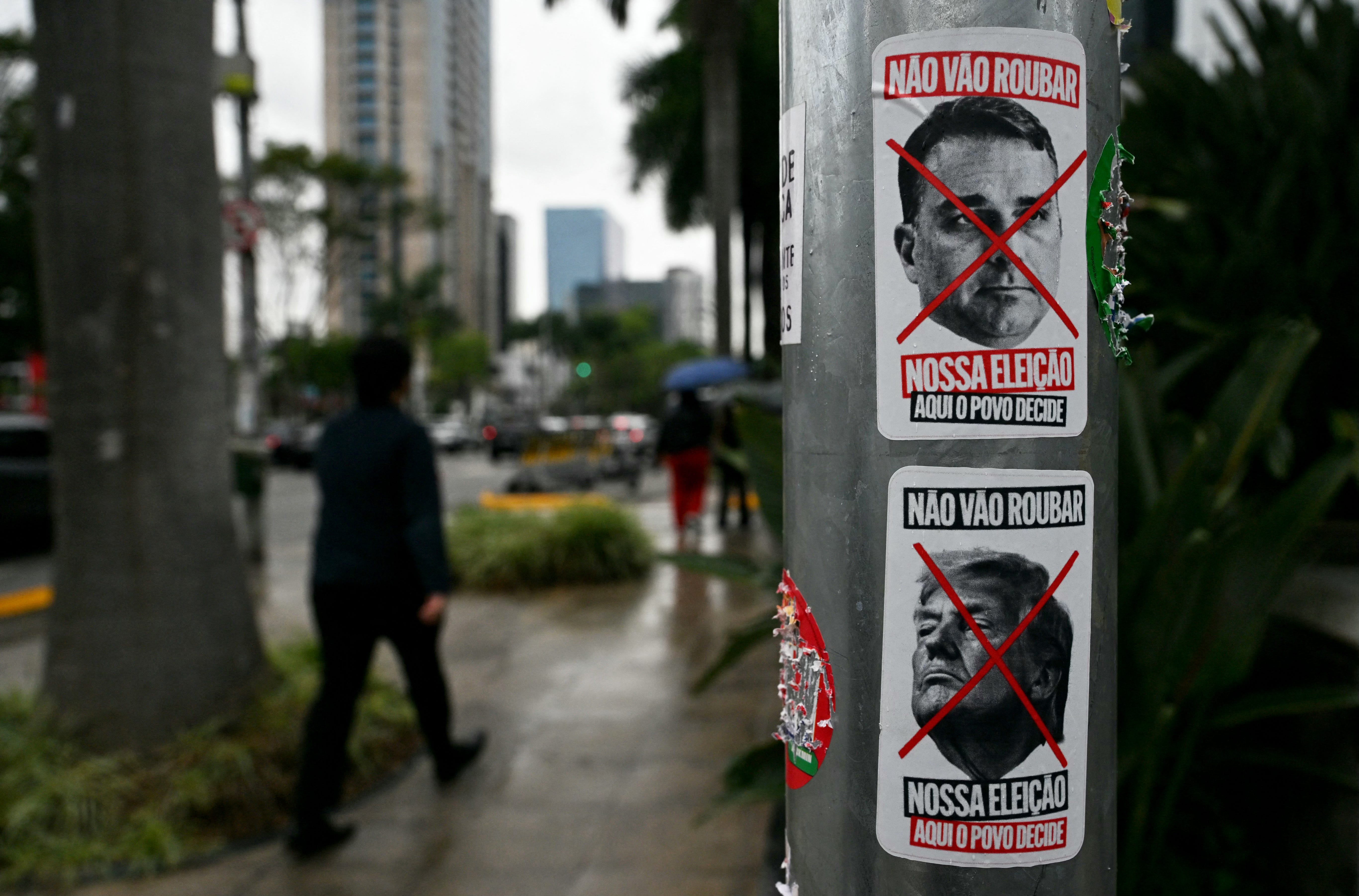
Stickers bearing the images of presidential candidate Flavio Bolsonaro and U.S. President Donald Trump crossed out with an X cover a utility pole in São Paulo, Brazil, two days ahead of Brazil's October 25 presidential election (Photo by Juan Barreto / AFP via Getty Images)
The “Blue Wave” Hits the Master of the Hemisphere
An electoral earthquake has struck the heart of the empire. The tremors from the Republican defeat in the November 3rd elections crossed U.S. borders, shaking the house of cards built by those who banked on Donald Trump’s arrogance to trample upon the sovereignty of nations.
The Democratic victory in both the House and the Senate has ended Republican control over the U.S. Congress. The new majority, taking office in January, will be able to investigate the administration, obstruct its agenda, and subject White House decisions to a level of oversight that its Republican allies had previously helped to contain.
This shockwave is hitting the international neo-fascist far-right and its primary enforcer in Latin America: Secretary of State Marco Rubio.
In Brazil, it has reached the protection afforded to fugitive Flávio Bolsonaro, a candidate defeated at the ballot box who brandished a facade of patriotism while conspiring against his own country. He fled Brazil out of fear of the justice system, the very same system that sentenced his father, Jair, to 27 years and three months for attempting a coup d’état against democracy. Flávio sought shelter in the powerful arms of Trump and Rubio, but a “blue tornado” appeared just days after he reached the apparent safety of Miami, Florida. The shield that once seemed impregnable has now become the target of a potential parliamentary inquiry.
Flávio’s Protection Under Scrutiny
With a majority in the Senate, the Democrats will be able to call hearings, demand documents, and expand investigations into the Trump administration. This does not mean Flávio will be automatically expelled, but it turns his continued presence into a political liability for the White House. For a moment, Flávio felt secure with his Italian passport, but things are not quite that simple.
The Italian Loophole Under Suspicion
In Rome, lawmaker Angelo Bonelli has formally requested an explanation from Giorgia Meloni’s government regarding the granting of citizenship to Flávio, Eduardo, and Carlos Bolsonaro. There is suspicion that they received preferential treatment.
This controversy calls into question the use of citizenship as an escape route and intensifies pressure to ensure that a European passport cannot serve as a “safe conduct” pass to evade rulings by the Brazilian justice system.
Money Laundering
The irony even extends to Dark Horse, the biopic film worshiping former president Jair Bolsonaro. It may never reach theaters, but some of the funds sent to Texas could end up supporting Flávio in the United States.
Flávio requested a “contribution” of $24 million, roughly 134 million Brazilian reais, from his “brother” Daniel Vorcaro, the man at the center of the largest financial scandal in Brazil’s recent history, who is currently in custody awaiting the court’s decision on his fate.
Dark Horse, the project that Flávio used to solicit large sums of money from a criminal source, was announced as a masterpiece worthy of Chaplin or Hitchcock. It became part of an investigation into suspected corruption, money laundering, and currency evasion.
“The Western Hemisphere is Ours.”
The flight to the United States exposes the so-called “Donroe Doctrine”, the Trumpist version of the old Monroe Doctrine.
The message of this revamped doctrine was encapsulated in a statement made by Marco Rubio at the conclusion of the mission that abducted the president of Venezuela and the first lady, snatched from Caracas.
“The Western Hemisphere is ours,” Marco Rubio declared triumphantly.
Nicolás Maduro and Cilia Flores have been held in New York for 10 months.
The core charge of narco-terrorism against Maduro rests on Section 960a of U.S. federal law, established in 2006 through the reauthorization of the USA PATRIOT Act, within the legal and political climate that emerged following the September 11 attacks.
From that point on, Washington possessed a domestic legal category capable of transforming foreign drug traffickers and political adversaries into threats to the national security of the United States.
First, Washington creates the law. Then, it selects who will be charged under it. Finally, it projects its jurisdiction onto the territory of another nation and drags the targeted enemy from their home.
This is the brutal precedent of the “Donroe Doctrine,” championed by Donald Trump and Marco Rubio.
Applause from Allies
The United States invents the crime, selects the accused, invades the territory, abducts the leader, and then offers its own courts as proof of legality.
Another example of Trump-era arrogance in Latin America is the criminal tightening of the embargo against Cuba, which has led to grave consequences, a siege with devastating effects on energy, water, and agriculture, compromising the health and lives of the Cuban people.
All of this has taken place to the applause of the far-right, Trump, Rubio, and their Brazilian neo-fascist counterparts. The latter group was, until recently, led by the candidate defeated by Lula: the fugitive son of Jair Bolsonaro, known as “Zero One,” or Flávio, who fled Brazil in a bizarre, multi-million-dollar operation, seeking the comfort of the powerful embrace of Trump and Rubio.
A Stone in the Middle of the Road
Venezuela and Cuba are just two examples chosen by the world’s greatest military power to signal what it is capable of doing to impose its will on countries in the region that dare to question its “orders.”
In line with their strategy to expand the influence of the right and far-right in Latin America, Trump and Marco Rubio placed their political bets on the victory of yet another Bolsonaro.
But there was a stone in the middle of the road. A stone named Lula.
The Brazilian president confronted domestic adversaries and external pressures, defending national sovereignty against Washington’s ambitions to exert influence over the Western Hemisphere, most notably over the “jewel in the crown”: the Latin American giant known as Brazil.
On October 25, 2026, Lula won reelection, spearheading a “red wave” that swept through Brazil and captured the world’s attention.
Milei, Isolated in his own Pettiness
The electoral gains of the far-right in South America appeared to pave the way for Washington’s tutelage. Yet, ideological affinity often runs up against national interests. Not even right-wing or far-right governments have been willing to simply fall into line.
Evidence of this can be seen in the global recognition of Lula’s victory. In South America, Javier Milei’s Argentina has found itself isolated in its own pettiness. Even El Salvador’s tyrant, Nayib Bukele, whom Flávio Bolsonaro once held up as a model he would emulate if elected, offered his congratulations to President Lula.
Elected for a fourth time, Lula has resumed a decisive role in defending Brazilian sovereignty, fostering coordination across South America, and engaging with a hemisphere that Trump claims as his own.
“Brazil is No One’s Backyard”
In Prison Notebooks, Antonio Gramsci wrote about the phenomena that emerges during an interregnum, a period when the old order is dying, but the new one has yet to be born.
The old world of neo-fascism, of the Trumpist far-right and the Bolsonarista extreme right, has lost ground. Trump’s setbacks in the U.S. Congress, combined with the second consecutive defeat of Bolsonaro’s neo-fascism in Brazil, reflect a backlash from those who have grown weary of foreign tutelage and the imposition of authoritarianism.
In his first live broadcast following his re-election, appearing alongside André Janones, Lula gave voice to this sentiment: “Brazil is no one’s backyard.”
The neo-fascist, Trumpist, and Bolsonarista project sought to govern through shouting, lies, denialism, and violence. It wielded the fabrication of enemies, racism, misogyny, and homophobia as instruments of power. It attacked institutions, disregarded human rights, and exploited religion to secure authority. In Brazil, it even rebranded submission to the interests of the United States as “patriotism.”
A Turning Point in History
The defeats suffered by this authoritarian consortium are no longer merely electoral. They signal a reaction from societies that reject the tutelage of autocrats and the arrogance of empires.
This turning point in history did not begin in Washington. It began in Brazil, through a popular resistance that defeated the largest foreign interference operation ever mounted against a Brazilian election.
The mobilization in the streets and across social media, a revolt by the young men and women of Brazil, with the “Generation 2000” youth joining hands with those from the “Generation of ’68”, has turned the country into a global benchmark. It has also helped corner Trump-style neofascism at the very heart of the empire.
We are not just talking about an ultra-right-wing autocrat or a defeated candidate who is now in trouble and gripped by panic.
We are Witnessing the Beginning of the End of an Era
It is the era of neofascism, an era that imagined it could rule the world through shouting and lies; through fear, resentment, and the fabrication of enemies; through denialism and a hatred of science; through racism, misogyny, and xenophobia; through a cult of weaponry, the glorification of violence, the persecution of minorities, a contempt for human rights, and the destruction of democracy.
In short: With Trump in trouble and the Bolsonaros in panic, we are watching the beginning of the neofascist collapse.
Gustavo Tapioca is a journalist and the director of Jornal da Bahia. This article was originally published by Revista Forum. It was translated by Panamerican Dispatch. You can read the original, in Portuguese, here.