


by Jamil Chade
A few months ago, one case caused a stir among Latin American immigrants in the United States. The Donald Trump administration refused to grant a humanitarian visa to the mother of a U.S. child who was recovering from a rare brain tumor.
The mother, an immigrant, had been deported to Mexico and was hoping for a sign from Washington that would allow her daughter to continue receiving specialized medical treatment.
She waited for ten months, only to receive a negative response. The child was 10 years old when immigration authorities deported her parents, who lacked legal documentation, to Mexico more than a year ago.
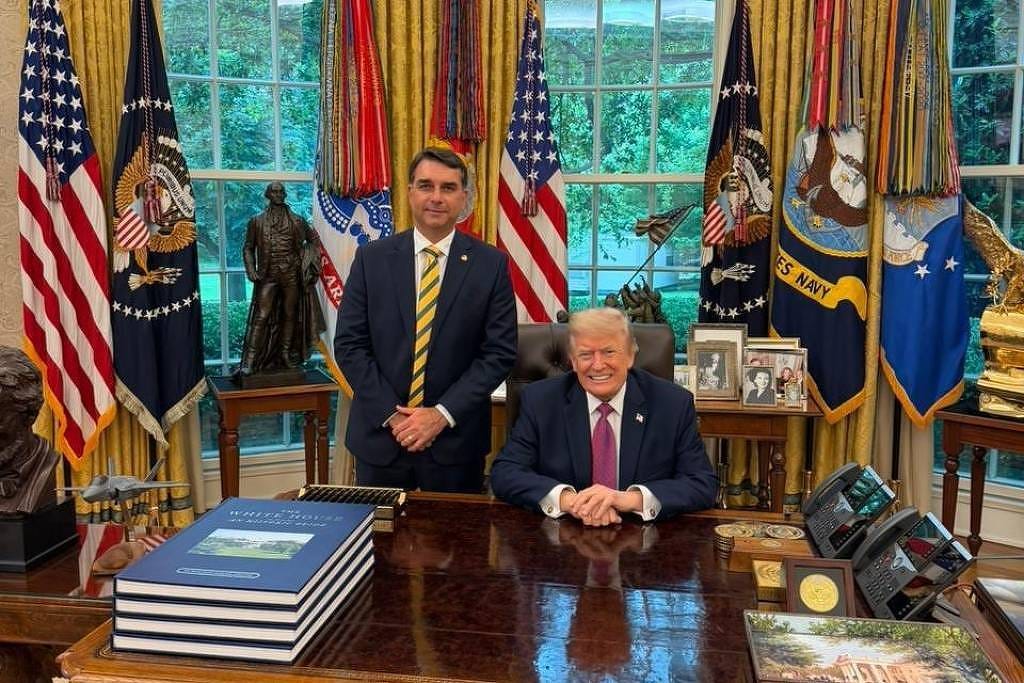
U.S. President Donald Trump and Senator Flavio Bolsonaro smile in the Oval Office after their meeting in Washington in May 2026.
The girl and four of her siblings, three of whom are also U.S. citizens, left along with their parents. Their deportation interrupted months of vital treatment the girl had been receiving in the United States following emergency surgery in 2024 to remove the brain tumor.
Cases like this are part of an endless list of denials issued by the White House.
Beginning in 2025, hundreds of thousands of people who had been protected from deportation lost that protection when a humanitarian relief mechanism known as Temporary Protected Status (TPS) was terminated. 500,000 foreign nationals were affected.
On June 12, 2025, the Department of Homeland Security announced that it had begun sending notifications to people advising them of the termination of their humanitarian status and work authorization in the United States. Those most impacted were Cubans, Haitians, Nicaraguans, and Venezuelans.
Among Haitians alone, the measure affected 350,000 people living in the U.S. In 2026, new countries were added to the list. In total, protections for citizens of 13 countries were suspended, affecting 1 million out of the 1.3 million beneficiaries who held this status.
Yet, this week, Washington broke with precedent and decided that one family deserved this privilege: the family of Flávio Bolsonaro.
The humanitarian pass granted to the senator sparked outrage among lawyers and activists working on U.S. immigration issues, including those representing hundreds of Brazilians currently awaiting deportation.
In 2026, only 16,000 people were granted exile status in the United States. Almost all of them were white South Africans who, according to Trump, were being targeted for “persecution” by the country’s Black population.
By comparison, during the last two fiscal years of the Joe Biden administration, 2023 and 2024, 60,000 and 100,000 people, respectively, entered the country as refugees.
In the 2024 fiscal year, the largest groups of people arrived from the Democratic Republic of the Congo, Afghanistan, Syria, and Venezuela.
This article initially ran in ICL Notícias. It has been translated by Panamerican Dispatch. You can read it in its original Portuguese here.
MAGAts are the most despicable pieces of shit that ever were allowed to breathe air