


by Marcio Pochmann
The 2024 U.S. presidential election left behind a question that reaches beyond that country’s borders. Trump’s victory was significant, but the real story was the Democratic Party’s failure to reproduce its own vote total from four years earlier. In 2020, Joe Biden won 51.3% of the popular vote, against 46.9% for Trump. In 2024, Kamala Harris took 48.3%, while Trump reached 49.8%. That gap looks small, but it produced a decisive shift in the outcome.
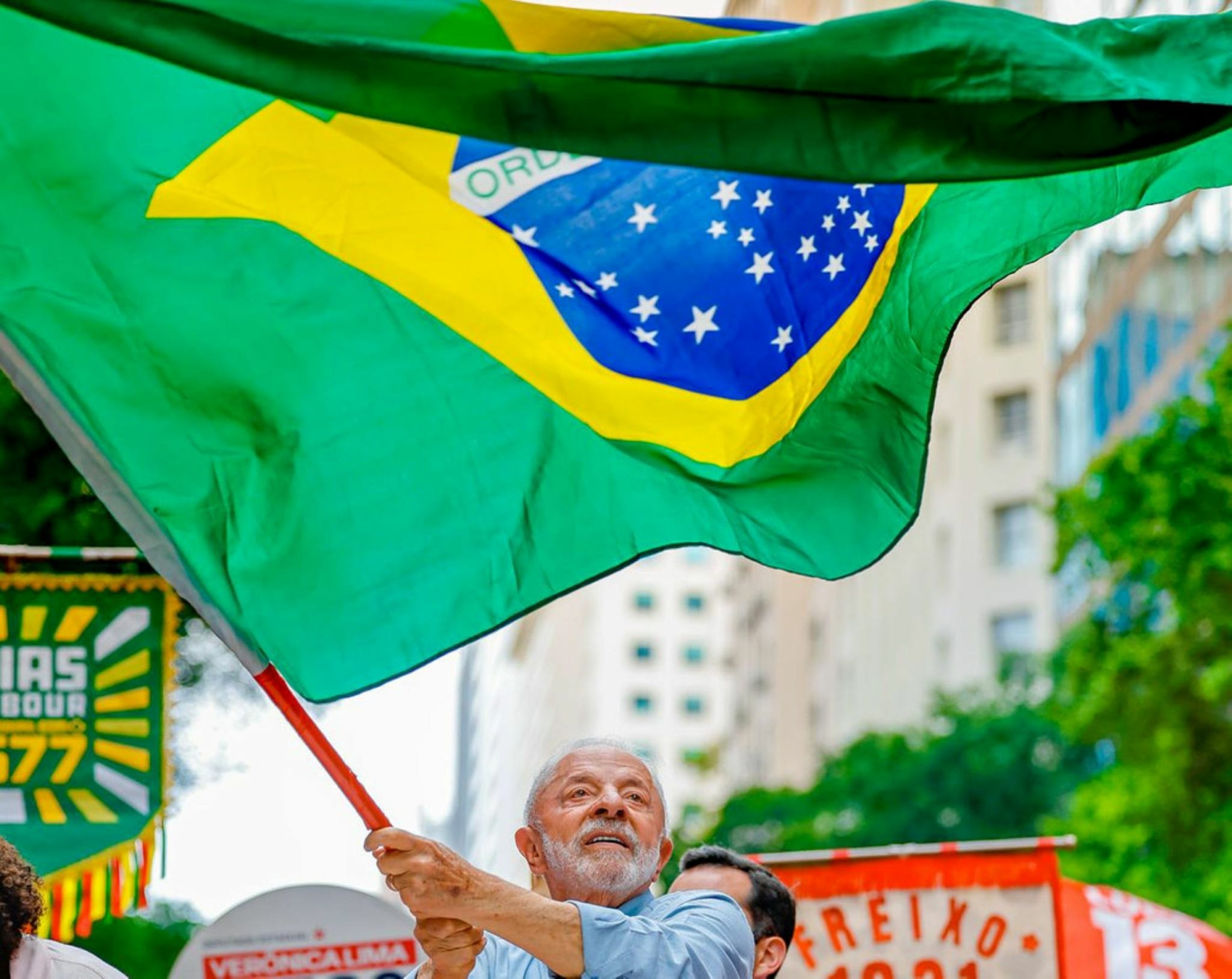
President Luiz Inacio Lula da Silva waves the Brazilian flag. (Ricardo Stuckert)
The most telling figure is voter retention. Among those who had voted for Trump in 2020, 85% did so again in 2024. Among Biden voters, Harris retained 79%. Another 15% stopped voting altogether, and 5% switched to Trump. Trump also had the advantage among voters who had sat out 2020 but returned to the polls in 2024.
In that sense, the Democratic Party lost partly to itself. It couldn’t reproduce the same mobilization and retention that had carried Biden into the presidency. This doesn’t mean a single factor explains the election. It means that in close races, holding onto a given social and electoral base can matter just as much as winning new voters.
The U.S. experience offers a useful lens for looking at Brazil. The first round of the 2026 election in Brazil also shows an important shift from 2022. Lula’s vote total fell from 57.26 million to 53.88 million, a drop of about 3.38 million votes. His share of the valid vote fell from 48.43% to 45.16%. That decline occurred in 25 of Brazil’s 27 states.
The municipal level picture is even more striking. According to an analysis of the vote results, Lula’s share of the valid vote fell in 98% of Brazilian municipalities compared with the first round of 2022. The drop hit cities of different sizes and socioeconomic profiles, though its intensity varied by region.
These numbers alone can’t say where the votes Lula lost actually went. Nor can they be pinned on a single economic, social or political cause. But they do show that an electoral coalition isn’t a permanent structure. It forms under specific historical circumstances, and it can shift as society changes.
That’s exactly where the electoral question meets a much deeper transformation, the changing nature of work itself. For most of the 20th century, it was fairly simple to identify a worker by where they worked. There was the factory, the office, the shop, the government agency, the school, the hospital. The employer was identifiable. The workday had some defined shape. Income was tied to an occupation and, in large part, to rights attached to that job.
That old urban industrial framework is being replaced. Today’s worker might drive for an app in the morning, sell products online in the afternoon, produce content at night, and supplement their income with some activity done from home. They might cook for a delivery platform, provide on-demand services, take part in the gaming economy, sell directly through social media, or combine several income streams at once.
The digital economy is no longer just a sector. It has become an infrastructure that runs through practically every part of the economy. Official statistics still only partly capture this shift. In 2024, for example, about 1.7 million people in Brazil worked through digital service platforms, a number 25.4% higher than in 2022. But that’s only the most directly measurable part of a much larger transformation.
A growing universe of economic activity now runs on digital infrastructure. Content creators, sellers, service providers, app workers, home food producers, and participants in new forms of entertainment and cultural production all fall into this category. Economic activity no longer happens only at a traditional business location. It also happens at home, on the street, on a phone and on a platform.
The location of a business is no longer the sole site of production. The digital domain now fulfills part of that role. This shift also changes the worker’s own condition. A worker may have no visible boss, yet still answer to an algorithm. They may have no formal schedule, yet work most of the day. They may be legally classified as an entrepreneur, even while depending on a platform that controls access to customers, sets the rules for visibility, distributes opportunities, and influences how prices are set.
The old relationship between labor, business and place is growing more complex. And the problem isn’t only about labor rights. It’s also statistical, economic and democratic. Every search, trip, purchase, delivery, payment, interaction or post generates data. That data can be used to predict behavior, organize markets, set prices, target advertising, evaluate workers and build artificial intelligence systems.
A new dimension of economic power is emerging here, built on control of information infrastructure. Whoever controls the platform can know the worker, the consumer and the territory with a depth that often exceeds the state’s own capacity. Society is now generating an extraordinary amount of information about itself, but much of that knowledge stays locked inside private structures.
This is the sense in which “datacracy” needs to be understood. It isn’t just about machines making decisions. It’s about a society in which data increasingly organizes economic, social and political relationships.
That’s why sovereignty in the 21st century also means data sovereignty. Brazil needs to build a public information infrastructure suited to this new reality. That means updating labor and income statistics, identifying new forms of work, understanding economic activity that happens inside homes, and measuring the economy developing across digital spaces.
It’s no longer enough to count the number of traditional jobs while a growing share of income generation happens outside conventional categories. Brazil will also need to rethink social protection, collective representation, professional training, taxation, competition policy, platform regulation, science and technology, and data security. The challenge is making sure technological change is matched by institutions capable of understanding and protecting a rapidly changing society.
But there’s an even deeper question underneath all of this: who will capture the productivity gains that technology makes possible? If artificial intelligence, automation and digital systems let us produce more with less work, the result doesn’t have to be more consumption and more labor. It could also mean more time to live.
A society built around free time is possible to imagine. Productivity gains could be converted into time for care work, education, culture, science, community and creativity, and civic participation. Technology could reduce the time needed to produce what society actually requires, rather than simply freeing up more human time for new tasks.
This discussion matters especially for Brazil, because digital transformation is unfolding across a society marked by deep inequalities in income, geography, technological access and social protection. The challenge isn’t just digitizing the existing economy. It’s deciding what kind of society gets built with these new technological possibilities.
This is where the U.S. and Brazilian elections offer a shared warning. Not because one election automatically explains the other, but because both show that electoral coalitions built under one set of conditions may not hold once social conditions change.
Politics can keep using categories that no longer adequately describe everyday life. A worker who earns income through a platform today may not see themselves in the old occupational categories. A young person who combines digital content creation, gig work and service provision may not have a single occupational identity. A family that turns its own home into a unit of economic production may remain invisible to statistics built around the traditional workplace.
If politics fail to see these transformations, other actors will. The major platforms already know patterns of consumption, movement, work, preference and behavior at an unprecedented scale. The risk is that the private sector ends up with a more sophisticated statistical picture of society than public institutions themselves have.
That’s why any discussion of democracy, labor and technology inevitably runs through a discussion of data. Brazil has social diversity, universities, scientific institutions, and a statistical and geoscientific system capable of producing knowledge about society and territory. That public infrastructure could play a decisive role in understanding the new economy and new forms of work.
Tomorrow’s worker may sit in front of a screen, inside their own home, simultaneously producing labor, income and data. They may move between different activities without any single one of them defining their economic condition on its own.
The question is whether institutions will be capable of seeing that worker clearly. The world can’t afford to lose Brazil, because the country has the rare combination of conditions needed to help build a democratic response to digital transformation. This isn’t a choice between technology and work, or between growth and free time. It’s about deciding how to distribute the gains in productivity, knowledge and information that the new economy produces.
Digital transformation is global. How it gets organized, though, is an institutional and social choice. Whoever controls the data understands the present. Whoever manages to turn public knowledge into the capacity to act helps shape a future that remains very much up for grabs.
Marcio Pochmann is a heterodox economist and author of over 50 books. He currently serves as President of the Brazilian Institute of Geography and Statistics, IBGE, a research institute of Brazil’s Federal Ministry of Planning and Budget which, among other things, coordinates Brazil’s national census.
This article originally ran in Brasil 247. It has been reprinted and translated with permission, by Panamerican Dispatch. It can be read in its original Portuguese here.