

By Rafael R. Ioris
There is a coup underway in Brazil. It is not a traditional coup involving tanks in the streets, nor does it resemble the bizarre invasion and destruction of the National Congress, the Supreme Federal Court, and the presidential palace by supporters of Jair Bolsonaro in January 2023.
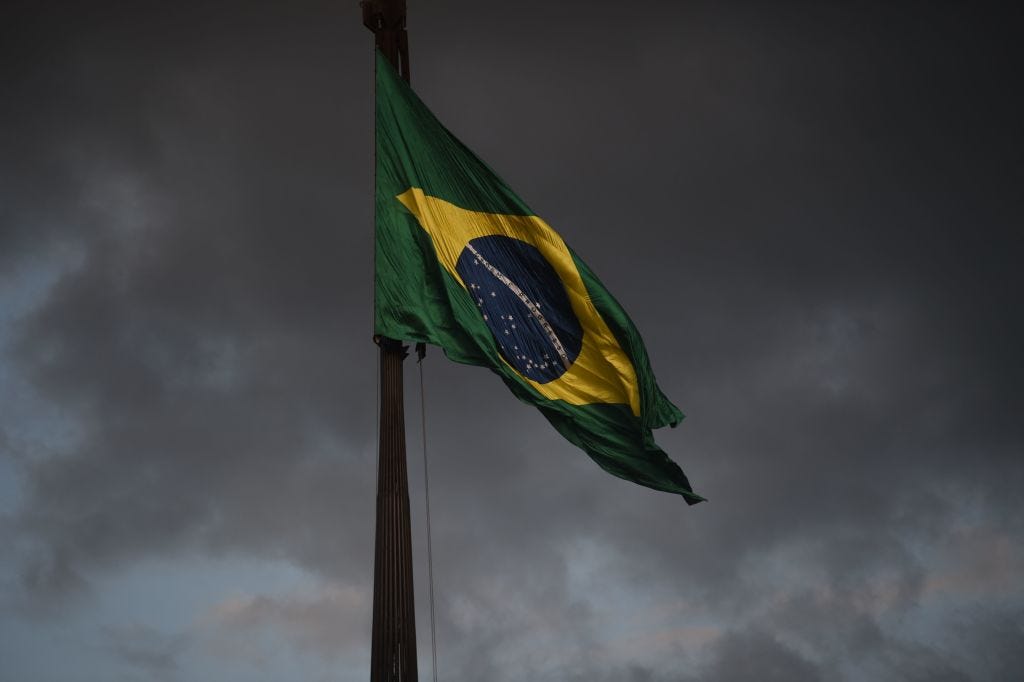
The Brazilian flag flies in Brasilia on January 10, 2023. (CARL DE SOUZA/AFP via Getty Images)
It is, however, a highly orchestrated coup carried out through questionable, yet effective judicial means, with broad media support. Perhaps most concerning is the fact that, even if these maneuvers are fully thwarted, the harmful impact of such actions on the presidential elections in early October will have already occurred.
Here’s a recap of what’s been happening.
André Mendonça is one of the two Supreme Court justices appointed by Jair Bolsonaro. Until recently he was the official overseeing investigations into Banco Master.
Banco Master is a Brazilian financial institution that was shut down and placed into liquidation amid a huge bank fraud investigation.
The ex-president of Banco Master, Daniel Vorcaro, is currently in jail. He has long maintained strong ties with the Bolsonaro family, including financing a film about the life of the former president Jair Bolsonaro.
Last week, Mendonça lifted the classified status of the Federal Police reports about Banco Master. These reports contain messages exchanged between former banker Daniel Vorcaro and Supreme Court Justice Alexandre de Moraes, the lead judge in the trials of those responsible for the January 2023 attack.
Mendonça also removed the head of the Federal Police, claiming he had been subjected to an illegal investigation by the agency.
These actions have triggered a crisis unprecedented in the court’s recent history. All indications suggest this goes beyond mere legal technicalities. Instead, it appears to be a well-orchestrated plan to cast suspicion on the relations of government allies. The apparent goal: to shift focus away from investigations into the proven links between Vorcaro and Flávio Bolsonaro, the current presidential candidate running against Lula.
Mendonça has attacked Alexandre de Moraes, a central figure at the Supreme Court in the fight against fake news. That fight has been a key instrument in the rise of Bolsonarism. Mendonça also removed the Federal Police chief appointed by Lula, just weeks ahead of the October elections. Together, these moves amount to weaponizing the judiciary amid the electoral landscape. They also downplay the gravity of the Bolsonaros’ shady dealings with Vorcaro.
In doing so, he boosts the perceived legitimacy of Flavio Bolsonaro’s campaign, and thus his electoral appeal.
Many legal experts believe André Mendonça’s maneuvers lack a legal basis. Instead they appear aimed at ensuring that future Supreme Court appointments go to individuals closely aligned with the far-right ideology of Bolsonarism. This will happen if Flávio Bolsonaro takes the presidency, because several Supreme Court seats are set to be filled in the coming term.
The actions currently underway in Brazil are legally spurious and part of a political coup that is underway. They aim not only to undermine the integrity of the elections (which is characteristic of anti-democratic political movements like the one led by the Bolsonaro family), weakening the institutional framework of Brazilian democracy, but also to permanently co-opt the country’s highest judicial bodies.
Tragically, recent polls suggest that these actions, even if likely to be reversed, have had a significant and probably lasting impact on the ongoing electoral process.
To understand how this came about, it is worth noting that Brazilian society has long been increasingly influenced by neoliberal logic, wherein collectivist political projects have been suppressed and replaced by the narrative of the “self-made man” and unbridled entrepreneurship.
The country’s religious landscape has significantly propelled this sociological shift. Thirty years ago, evangelicals made up less than 5% of the population. Roughly a third of Brazilians are now evangelical.
Like the Christian Right in the United States, which played a crucial role in the expansion of evangelical churches in Brazil, such denominations tend to hold a conservative worldview. Politics is seen through a prism of individual morality, exercised by applying value judgments with a fundamentalist bent, or even through the profession of faith itself.
In recent years, we have witnessed the progressive hollowing out of the public sphere and the accompanying privatization of politics. So it is hardly surprising that many voters form their judgments and engage in political action driven by individual indignation rooted in a selective moralism of us versus them.
In other words, if corruption is widespread and everyone had illicit ties to the disgraced banker, then my candidate’s crimes seem to lose their significance. And since a collective vision for the country no longer matters, the vote boils down to the candidate’s (alleged and manufactured) ideological alignment with the voter.
It is worth noting that Supreme Court Justice Mendonça is a conservative evangelical pastor whose nomination to the Supreme Court was widely hailed by the evangelical community. It would be naive to think that Mendonça acts without considering, directly or indirectly, the interests of this group.
Many have rightly warned of the risk that external actors might influence Brazil’s upcoming elections. The most obvious scenario involves pressure from the U.S. government to sway the vote or to refuse to recognize a potentially unwanted election outcome. This concern is justified, especially given recent coup-oriented actions by Brazilian actors. But we also run the risk that such external interventions might not even be necessary. After all, national elites have never hesitated to suppress democracy in Brazil, just as long as their rentier interests remain protected.
Today, at least for now, coup-mongering appears to unfold without the use of overt military violence. In other words, without tanks. Instead, it relies on manipulating the existing legal apparatus — Lawfare. Much like during Operation Car Wash, this strategy currently seems to enjoy broad support rooted in the selective moralism of the middle classes, as well as among growing segments of the working class. Both are sectors of the population that are becoming increasingly conservative.
What is at stake in the current election is the very defense of democracy. And without broad mobilization in its defense, this new form of coup-plotting might well succeed in destroying it.
Rafael R. Ioris is a professor of Latin American history at the University of Denver.
This article was originally published in Portuguese at A Terra é Redonda. You can read the original version, here.