

by Tereza Cruvinel
During the September 15 hearing on whether to open an investigation against Minister Alexandre de Moraes, Brazil’s Supreme Court spent a day airing dirty laundry as two groups split the court down the middle, hurling insults at each other. In the hours following the hearing, media pundits announced the death of the judiciary and complained of a supposed complete loss of credibility with society.
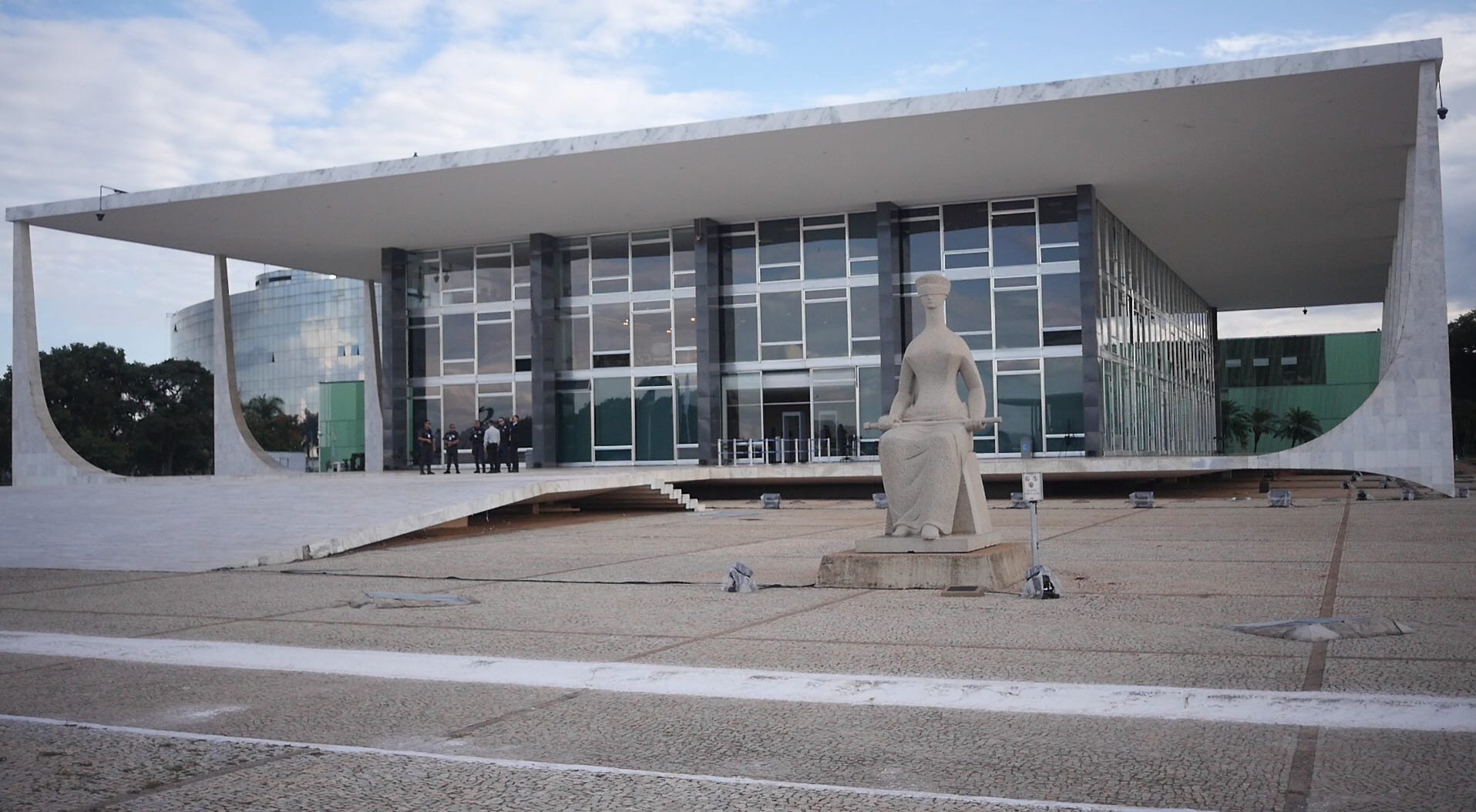
(Brazil's Supreme Court. Credit: Brian Mier)
These are falsehoods, regardless of whether they were made in bad faith. Beating up on institutions and portraying them as destitute always helps the right. But the Supreme Court, as Justice Flavio Dino said, “is greater than any single member who sits on it.” I would add that it is greater than the sum of its members. But the Supreme Court we have known since 1988, designated by the Constituent Assembly as guardian of the promise of a more democratic and just country enshrined in the Constitution, may be living out its final cycle. Just yesterday, President Lula promised to work toward a deep reform of the judiciary.
For nearly four decades, the Supreme Court has honored its promise and rendered enormous service to our democracy, safeguarding the Constitution and its implementation. More recently, it confronted threats of democratic rupture and setback during the Bolsonaro coalition’s failed coup attempt. Ironically, in this most recent case, its great and courageous protagonist was precisely the justice who is now at the center of the internal conflict, Alexandre de Moraes.
We must thank the Supreme Court for progress on many issues that Congress avoided legislating, including the recognition of same sex unions, the criminalization of homophobia and transphobia, permission for abortion in cases of anencephaly, stem cell research, the decriminalization of marijuana for personal use, and the prohibition of nepotism in public service. For this, too, it has faced the wrath of the legislature, accusations of overstepping its authority, the hatred of the far right and, finally, threats of impeachment against justices along with a flood of proposals aimed at reducing the court’s role.
But exhaustion with the Supreme Court’s old format has set in. For some time now, we have watched the political system created by the New Republic break down, a system born of the fight against the dictatorship and shaped by Brazil's own negotiated transition to democracy. Important milestones include the arrival of Jair Bolsonaro and the far right to government in 2018. This weakened the executive branch even as congressional power grew, continually absorbing the federal budget and presidential prerogatives. One highly symbolic moment came with the recent rejection of Jorge Messias’s nomination to the Supreme Court. It was the Senate's first rejection of a Supreme Court nomination in 132 years.
For a time, the Brazilian Supreme Court stood in its corner of Brasilia’s Three Powers Plaza as guardian of that promise. Some even attributed to it a kind of republican “moderating power.” But “perdition”, a word Justice Carmen Lucia borrowed from Clarice Lispector to describe her sadness (“I did not lose myself, but I experienced perdition”), has been creeping into the Supreme Court’s conduct for some time now.
Dilma Rousseff’s impeachment in 2016 lacked a legal basis. Nevertheless, the Supreme Court legitimized it, approving the procedure and presiding over the process in the Senate. Shortly before, Rousseff was barred from appointing Lula as a minister in her last attempt to save the mandate she had won at the ballot box. Later, the Supreme Court denied Lula habeas corpus, keeping him in prison before he was given his final sentence. The Superior Electoral Court disqualified Lula as a candidate in 2018. That move handed the presidency over to Bolsonaro. Then came the indulgences toward Operation Car Wash before the acts of contrition: the annulment of the cases against Lula and the declaration that Judge Sergio Moro had acted with bias.
As president, Bolsonaro declared war on the Supreme Court. He unleashed his violent base against it, and that base vomited its fury in the attack on January 8, 2023. Through four years of constant threats to democracy, no one can forget that it was the Supreme Court that took the bull by the horns and set limits on Bolsonaro.
But where and when did the Supreme Court lose its way? I don’t have that answer. I suspect it happened gradually. I side with those who believe Bolsonaro’s two appointments to the court fed the mill of internal division. Many may have acted, at certain moments, with political or electoral bias. But never with the shamelessness of Justice Andre Mendonça.
In fact, I find myself using that word because I was struck by Supreme Court Justice Gilmar Mendes’s remark about Mendonça: “This man’s shamelessness is astonishing.” After yesterday’s session, coexistence there truly will not be easy. The white-glove Supreme Court sessions of old will be a thing of the past
Every crisis brings a chance for renewal. The internal conflict on the court, its members’ inability to keep it from reaching this point, and the lack of tools to handle certain situations (such as the investigation of one of its own members) may be signaling that it is time for change and reform.
It was no coincidence that, shortly after the session ended, President Lula gave an interview to TV Record. He pledged to propose a deep reform of the judiciary, not just the Supreme Court, if reelected. He pointed to several measures: setting term limits for judges, changing the way they are selected, and establishing strict rules of conduct. “People cannot serve in the judiciary while having a son practicing law, a wife practicing law, a father practicing law. In other words, there needs to be a standard for cleaning up Brazil’s judiciary within the Supreme Court itself .”
It was a jab at Alexandre de Moraes, without a doubt. But he also took one at Mendonça. “Let everything be investigated with full rigor. Let everyone’s phone records be unsealed. What Andre Mendonça kept as a state secret, releasing only what suited him, now needs to be opened to all of society, so people can see who was lying about it,” he said.
Some say Lula stands to lose more than Flavio Bolsonaro from yesterday’s uproar in the Supreme Court. But it is Flavio, not Lula, who has a $12 million gift from Daniel Vorcaro hanging over his head. Lula’s campaign needs to continually remind voters of this, and replay the audio of that conversation in which they refer to each other as “brothers”.
*Due to her role in the Liga Operaria democratic resistance group during the national student strikes of 1977, Tereza Cruvinel spent years underground in Rio’s Baixada Fluminense. As the US-backed dictatorship came to an end, she embarked on a career as a journalist, writing the Panorama Politico column on page two of Brazil’s largest daily newspaper, O Globo, for 21 years. Later, she became the founder and first director of Brazil’s national public broadcast network, EBC/TV Brasil. She currently works as a political analyst and writer for Brasil 247.
Read this article in its original Portuguese here.