

by Roberto Amaral
The 1964 coup gave us a 21-year dictatorship, harmful as every dictatorship is. It had been planned for years and first failed in 1954, when it was thwarted only by the suicide of President Getúlio Vargas. The military then took power but kept up appearances. They swore in Vice President Café Filho, who earned the job by betraying the president who had elected him. He was a president in name only, not unlike the figure the United States recently installed to run a Venezuela that has been reduced to a protectorate.
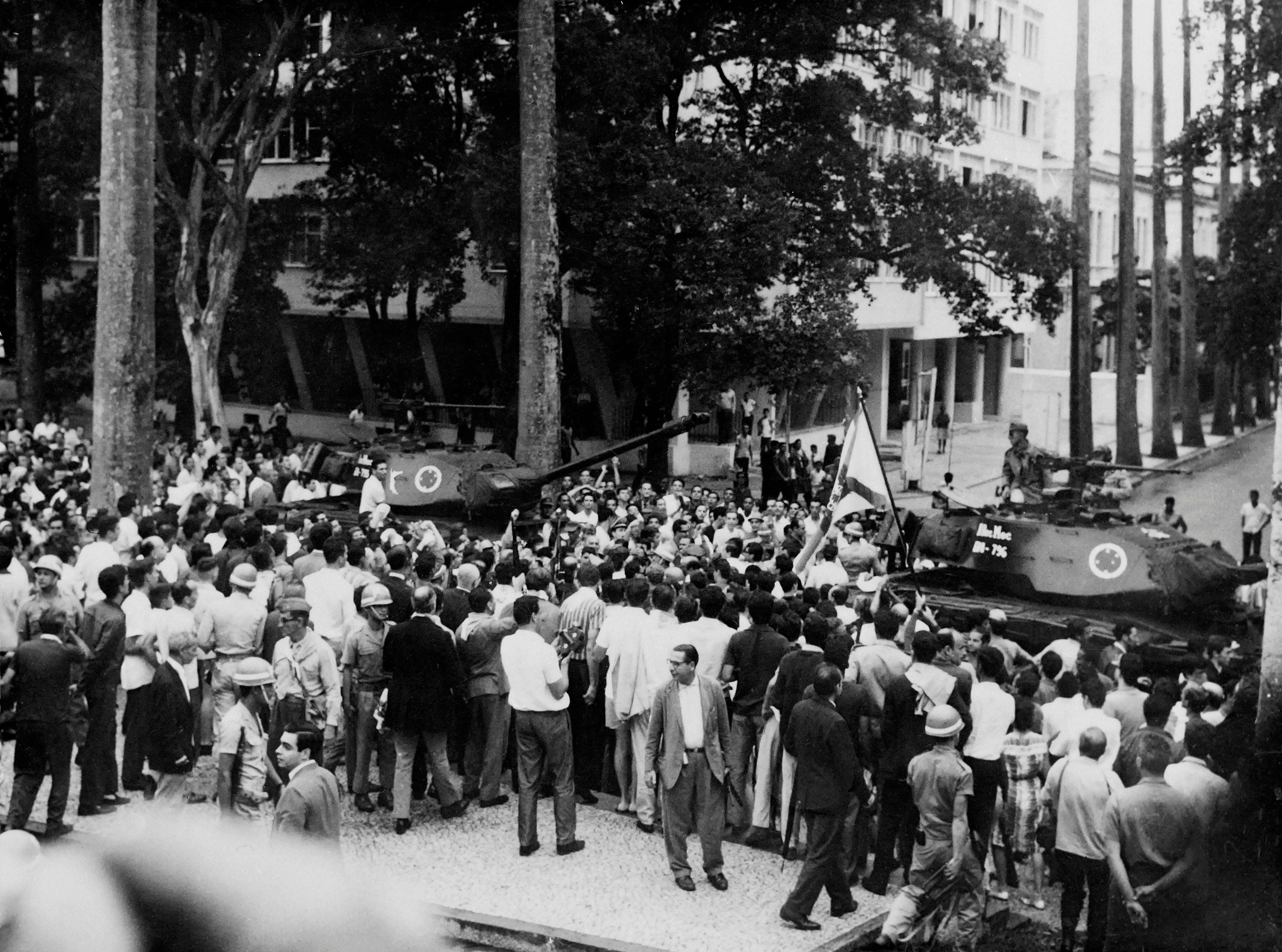
Brazilian army tanks arrive at Guanabara Palace, on April 1, 1964, during the military coup that led to the overthrow of President João Goulart. (AFP via Getty Images)
The military took control of the country in August 1954. By November 1955, they were already plotting a new coup, this one meant to block Juscelino Kubitschek from taking office. Kubitschek had won the October election. Critics claimed he had communist backing. Worse still, in their eyes, his vice president would be João Goulart, heir to Vargas and to the labor movement.
That coup fell apart. Brazilian history is full of such twists, and this one turned on the dissent of the Minister of War, Henrique Teixeira Lott. Lott led a coup of his own, a counter-coup if you like, to restore legality. Congress blessed it. On Jan. 1, 1956, Kubitschek and Goulart were sworn in at Catete Palace. History remembers the operation that blocked the coup as “The Eleventh of November.” The coup had failed, but the appetite for coups had not. Kubitschek served out his full term, but not without cost. He faced a hostile Congress, a hostile press (the same press we see today), endless impeachment attempts and two military uprisings, in Aragarças and Jacareacanga.
In 1961, Brazil saw a new cycle play out: a coup attempt, a parliamentary counter-coup, a military uprising, popular resistance and finally a parliamentary coup.
President Jânio Quadros resigned in a maneuver aimed to facilitate a military coup. The majority of the national deputies executed a counter-coup by accepting his resignation and swearing in the leader of Congress as acting president (as Vice President João Goulart was on a diplomatic visit to China). This was followed by an attempted military coup, which was vetoed by Goulart’s three Military chiefs of staff. There was a popular uprising in support of the president initiated by Rio Grande do Sul governor Leonel Brizola and finally, a parliamentary coup. In a matter of hours, Congress transformed the political system from the presidentialism, under which Goulart took power, into a kind of dysfunctional parliamentarism. Under the circumstances, however, this no longer mattered. The coup was negotiated between the military conspirators and Congress. Its real aim was to block Goulart’s inauguration. But when the popular reaction made that impossible, the goal was to reduce his powers.
The cycle that began in 1954 was still underway. One task remained: removing a president who championed basic reforms, who had mobilized the country around a national literacy campaign for adults and who, worst of all in his critics’ eyes, defended agrarian reform.
His ouster brought a dictatorship with it. Supreme Court justices were forced into retirement. Congress was shut down. Elected officials lost their mandates. Public servants were fired. The courts came under direct interference. The constitutional order itself was revoked. Kidnappings, imprisonments, torture, exile and killings followed. To this day, no one knows the full body count. This was the military coup of April 1, 1964. It had the open support of the mainstream press, the conservative forces and, of course, the United States. The U.S. stationed warships off the Brazilian coast. Washington called it Operation Brother Sam.
I revisit these familiar facts to show the engineering behind the process. Nothing here happened by accident. A careful observer should never be caught off guard.
The 1930 uprising was born of necessity: the First Republic, flawed from the start, had reached exhaustion. Brazil’s Estado Novo (New State), which ran from 1937 to 1945, followed the collapse of the 1934 constitution, much as the fall of the Weimar Republic in Germany cleared the way for Hitler’s rise in 1933. Even before Hitler, fascism had already taken hold in Europe. Benito Mussolini seized power in Italy in 1922. The continent, still reeling from World War I, then endured the Great Depression of 1929. Dictatorships spread well beyond Italy and Germany: to Hungary, Spain (first under Primo de Rivera, then Franco), Albania, Poland, Portugal, Lithuania, Yugoslavia, Bulgaria, Estonia, Greece, Latvia and Romania.
Latin America followed the same authoritarian drift. Brazil and Argentina led a list of 16 dictatorships that also included Bolivia, Chile, Cuba, the Dominican Republic, Ecuador, El Salvador, Guatemala, Honduras, Nicaragua, Paraguay, Peru, Uruguay and Venezuela.
That was the world on the eve of World War II. The Cold War followed and ended in 1991 with the suicide of the Soviet Union. The United States, having defeated its great rival without firing a shot, became the world’s uncontested superpower. That lasted until the rise of Eurasia under Chinese leadership restored a balance of power and opened what might be called a New Cold War.
One thing has changed, and it matters. In World War II, the United States led a world that dreamed of the freedoms that fascism was trying to smother. Even through the Cold War, Washington claimed the mantle of defender of democracy. Today, it makes no such claim. Without disguise, the United States now leads something closer to a neofascist international, radiating out from the White House. It still commands enormous economic and military power, and it uses all of it: open warfare, hybrid warfare, the threat of invasion, kidnapping, plunder and punishing tariffs. It has joined with Zionism in the genocide of Palestinians and in aggression against Iran. It has floated annexing Canada and Greenland outright and revived old claims on Cuba. In its shadow, right-wing governments are gaining ground across Europe. Neo-Nazism just won a striking victory at the polls in Germany. NATO members, joined by a long submissive Japan, are following Washington’s lead and doubling their military budgets. This, we should remember, is exactly how the world looked just before World War II.
The rise of the far right concerns Brazil directly. One of its clearest goals, nearly achieved already, is total control of South America. So far, most of that control has come through elections. Brazil and Uruguay remain the only two democracies on the continent not yet under far-right rule. Venezuela, reduced to a protectorate and stripped for its resources, will not be the last casualty. Brazil is different: its territory, its stockpiles of strategic minerals, its population and its level of development make it the last real point of resistance, the one that has to be removed. That is why Brazil’s immediate future rests, quite literally, on the next presidential election.
Today’s threat echoes the years before 1964, when Washington leaned hard on the Brazilian government. But the two moments are not identical. Back then, the labor movement was strong. Popular forces had real organization and turned out in force. The student movement was a genuine mass movement. Congress leaned progressive, so much so that the dictatorship later had to destroy and rebuild it. The armed forces had nationalist and progressive factions within their own ranks, so much so that hundreds of officers were later purged. Ordinary Brazilians defended basic reforms and democracy itself in the streets, at rallies and in marches. That resistance is precisely why the dictatorship needed a coup to take hold at all.
Today, the threat can advance through the ballot box instead. The signs are already there.
Fascism rose this way in Italy. Nazism rose this way in Germany. Democracies across our continent are eroding this way right now. In Brazil, the setback could arrive without an open break in legality, paved instead by institutions already in crisis: a judiciary that has been weakened and compromised, not immune to foreign interference, and a Congress that has grown reactionary and detached from the national interest.
We need to act now, and without hesitation.
Roberto Amaral, 86, is a journalist. He is the former President of the Socialist Party of Brazil and former Brazilian Minister of Science and Technology.
This article was translated from Portuguese and can be read in its original form at Brasil 247, here.