


by Alberto Maresca and Gabriel Dib Daud De Vuono
In Latin America, the diversification of foreign relations is often framed as a choice between partners. Whether to align more closely with the United States, China, Europe, or other global powers.
Yet, there is a more fundamental question: what capabilities does the region actually possess to negotiate with these actors?
Without regional coordination, individual countries are left to confront economic asymmetries, geopolitical pressures, and cross-border challenges in isolation. Autonomy is not about swapping one form of dependency for another. Rather, it is about expanding the range of available options.
Within this context, integration is once again a vital strategic tool.
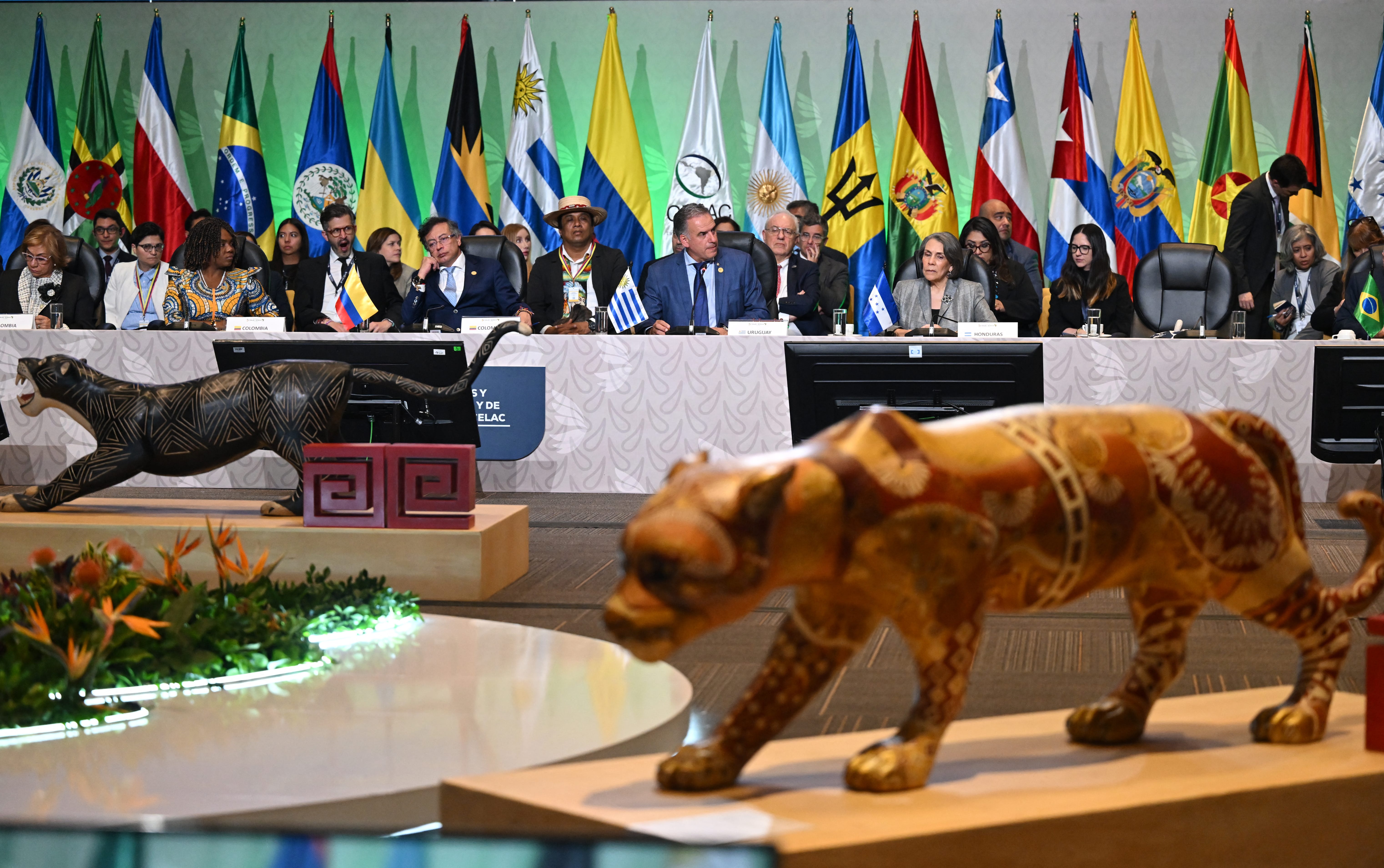
Uruguay’s President Yamandu Orsi speaks after receiving the pro tempore presidency from Colombia’s President Gustavo Petro during the X Summit of Heads of State and Government, within the framework of the CELAC-Africa High-Level Forum, in Bogota on March 21, 2026. (Photo by Raul ARBOLEDA / AFP via Getty Images)
It is worth noting, as Argentine socialist Juan Gabriel Tokatlian recently argued, that the concepts of integration and sovereignty seem to have lost their standing in Latin American politics. This is partly due to the effects of Trump’s “Donroe Doctrine”. Meanwhile, the ineffectiveness of regional organizations like CELAC and the OAS, compounded by the crisis between Brazil and Argentina that threatens Mercosur, suggests that Latin American integration may well be at its lowest historical point.
Integration is not about building a closed bloc, nor does it require all governments to share the same vision. Latin America is politically diverse. Changes in government frequently lead to shifts in priorities and alliances. Attempting to erase these differences would be unrealistic. The challenge lies in identifying areas where cooperation remains beneficial, even when there is no consensus on every issue, such as in infrastructure, public health, human mobility, energy, environmental protection, or disaster response.
At present, it appears that unilateral initiatives led by the United States, such as the “Shield of the Americas”, are the only forms of regional cooperation capable of capturing the interest of Latin American governments. However, indiscriminate military attacks intended to contain the security emergency in the region violate national sovereignty, while also exacerbating a cycle of violence that fails to address the root of the problem.
As demonstrated by the arrival of Salvadoran troops in Haiti, the dilemmas facing the region are increasingly being addressed through unilateral, military-style measures that appear to emulate the model proposed by Washington. The response to the security crisis in Haiti highlights a dilemma that Latin America can no longer afford to view as external: how can a country in crisis be supported without normalizing unilateral interventions or undermining its sovereignty?
While the deployment of foreign forces may offer an immediate response, it also raises critical questions: who defines the mandate, what are the limits on the use of force, and how is accountability ensured? If decisions are made outside of shared frameworks, an urgent measure risks becoming a precedent.
The region does not need a unified position on every aspect of the crisis in order to take action. Instead, it could agree on fundamental principles: support for Haitian institutions, a clear and verifiable mandate, the protection of the civilian population, and regional and international oversight. Organizations such as CELAC and the OAS could convene consultations, coordinate humanitarian aid, and support a political resolution, in dialogue with the Caribbean and with Haitian stakeholders themselves.
This does not replace the need for urgent action. But instead, it helps provide such action with legitimacy and clear objectives. The challenge lies in moving from declarations to practical mechanisms. A coordinated regional response would allow for the sharing of responsibilities and the monitoring of outcomes, preventing individual governments from acting on their own. In the context of Haiti, Latin American autonomy is not measured by one’s distance from Washington, but by the capacity to contribute to a legitimate, effective solution. A solution built in collaboration with those living through the crisis.
If the goal is to revitalize regional organizations to prevent the normalization of unilateralism over multilateralism in Latin American affairs, it is also necessary to look outward. Regional organizations do not merely manage internal matters. They can coordinate positions within multilateral bodies, negotiate agreements with other regions, and contribute to debates on trade, security, and global governance. This external projection remains understudied in Latin America. Integration is frequently evaluated based on its internal challenges, while less attention is paid to what countries and their institutions can achieve together on the international stage.
A diversification strategy requires precisely this dimension. Ties with Asia, Africa, and the Middle East can open markets, expand scientific cooperation, and create alternative financing options. For instance, the presence of observers such as Angola, India, and Türkiye at the most recent summit of the Ibero-American General Secretariat, held in Madrid, demonstrates that Latin America continues to attract the attention of significant actors on the international stage.
However, multiplying partners does not guarantee better outcomes. Without regional objectives, technical capacity, and transparent rules, countries may end up competing against one another for investments or negotiating from a position of weakness. Diversification works best when it complements a homegrown development agenda and when regional institutions help sustain it beyond political cycles. This requires acknowledging the limitations of existing integration processes. A lack of continuity, the overlapping of various bodies, and the gap between declarations and their actual implementation have eroded public trust. Restoring this trust requires prioritizing concrete goals, evaluating results, and maintaining spaces for cooperation that can survive political transitions. While not all countries need to advance at the same pace, they can agree on common objectives and flexible mechanisms to achieve them.
Research must also move beyond a perspective focused almost exclusively on the European experience. Comparing Latin America with other regions makes it possible to identify which institutions work, under what conditions, and at what cost. In São Paulo, the hub proposed by the United Nations University Institute on Comparative Regional Integration Studies and the Memorial Foundation of Latin America aims to examine the international reach of Latin American regional organizations and their ties to other regions.
The most important question is not how to replicate a model, but rather how to learn from diverse experiences to address specific, local challenges. Latin American integration will not, on its own, resolve the tensions within the global order. But without regional cooperation, individual countries will have fewer tools to confront them. Diversifying external relations and strengthening integration are not mutually exclusive goals. They are, in fact, interdependent. Autonomy begins when countries are able to make choices, negotiate, and cooperate from a more solid position. In an interdependent world, such capacity is difficult to build in isolation.
Gabriel Dib Daud De Vuono is the Director of the Brazilian Center for Latin American Studies at the Memorial Foundation of Latin America.
Alberto Maresca is a doctoral researcher at the United Nations University Institute on Comparative Regional Integration Studies.
This article was originally published by Le Monde Diplomatique Brasil. It was translated by Panamerican Dispatch. You can read the original, in Portuguese, here.