


by Bruno Malheiro
Bolsonarismo wasn’t born at the ballot box. Before it became an electoral force, it had already been taking shape along the frontiers of Brazilian capitalism, through the expansion of a territorial logic that subordinated land, nature and social relations to private accumulation. That logic legitimized the destruction of common resources and delegitimized other ways of organizing life. In 2018, maps of soy production, cattle ranching and mining overlapped with the maps showing where Jair Bolsonaro won his strongest electoral results. That wasn’t a cartographic coincidence. These frontiers were tied to political and cultural circuits, ranging from agribusiness fairs to shooting clubs to religious networks, that spread an unrestricted defense of private property, the promise of prosperity and the ideology of individual entrepreneurship. As commodity production homogenized landscapes, it also homogenized behavior and social narratives, weakening people’s ties to the land, to memory and to collective life. In the end, “agro” became “pop,” taking a central place in how meaning gets produced in Brazil.
(William Luque / Getty Images)
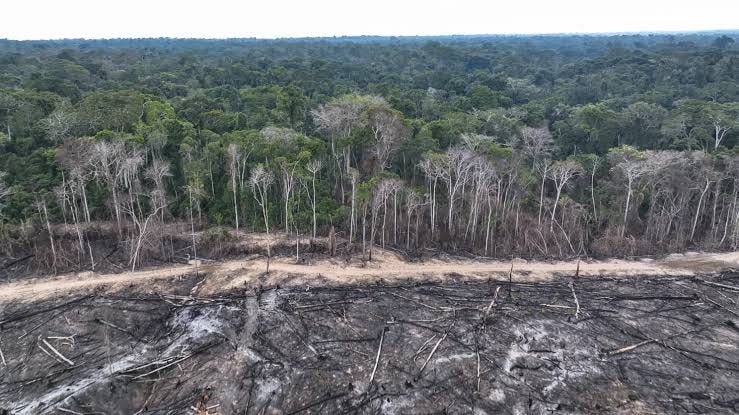
The destruction of the Amazon is the most brutal expression of this territorial logic. Felled forests, poisoned rivers, invaded territories, and people driven out or killed: none of this is a side effect of development. These are the direct results of processes that subordinate life to private accumulation and delegitimize other ways of organizing territory. These processes sustain power relations that have expanded the far right’s strength, reach and legitimacy, and the 2018 election gave it a path into the Brazilian state.
The Bolsonaro Government and the Destruction of the Amazon as State Policy
Between 2019 and 2022, these geographies scaled up to the level of state policy, turning the Amazon into a laboratory for authoritarian experimentation. Relaxed environmental regulations, weakened enforcement, attacks on territorial rights, and the legitimization of violence in defense of private property all expanded the conditions for destruction. During this period, accumulated deforestation in the Legal Amazon reached 45,612 square kilometers, according to Brazil’s National Institute for Space Research (Inpe) and its Amazon deforestation monitoring program, known as Prodes, in 2022. The Bolsonaro administration’s agricultural policy encouraged bringing more land into the market and drove land re-concentration, while Funai, Ibama and ICMBio, Brazil’s Indigenous affairs, environmental protection and biodiversity conservation agencies, were all weakened, and environmental policy became increasingly militarized. Illegal mining expanded into Indigenous territories, linked to organized crime and enabled by the state’s tolerance. The Yanomami crisis captured this policy in its starkest form: more than 20,000 illegal miners invaded Yanomami territory, worsening river contamination and spreading disease, hunger and death, all while the government looked away.
In the Amazon, this offensive brought together sectors of traditional oligarchies with new political actors tied to predatory economic interests, including illegal ones connected to organized crime. These actors converted their economic interests into electoral power under the banner of bolsonarismo. Brazil’s so called secret budget strengthened local groups and leaders, expanding the far right’s reach across the region’s interior. This consolidation also relied on political violence, attacks on the press and the intimidation of opponents, all of which restricted critical thought and made it harder for left wing forces to organize. The Amazonian experience shows how the Bolsonaro project reshaped Brazilian patrimonialism, brought private interests closer to an authoritarian agenda and narrowed the conditions under which democracy could function.
The Lula Government, the Amazon and the Persistence of Bolsonarismo
Lula won the 2022 election by a narrow margin. His government rebuilt institutions, restored public policies, rebuilt state capacity and put Amazon protection back on the federal agenda. Brazil also regained ground in multilateral diplomacy, working to defend its interests across different blocs without aligning itself with a single center of power, a significant stance in an international landscape marked by wars and geopolitical disputes. In the Amazon, deforestation fell from 9,064 square kilometers in 2023 to 5,731 square kilometers in 2025, according to Inpe and Prodes data from 2025. Environmental enforcement resumed, operations to remove illegal occupiers confronted invasions of Indigenous lands, and territorial rights returned to the public agenda. Ibama, ICMBio and Funai also went through institutional rebuilding. Destruction, in other words, was slowed.
Despite this progress in protecting the Amazon, the first round of the 2026 election made clear that bolsonarismo‘s electoral and territorial strength has persisted. In both 2018 and 2022, the areas expanding soy production, cattle ranching, mining and deforestation overlapped geographically with the areas where Jair Bolsonaro won the most votes. In the Amazon in 2022, he won in counties that together accounted for 70% of the deforested land from the previous three decades. In 2026, separate studies once again identified these same geographies of bolsonarismo. Marcela Vecchione and Rafaella Pinto linked land concentration, properties larger than 1,000 hectares, to a drop in Lula’s vote share compared with 2022, especially along soy’s expanding frontiers. Marco Antônio Faganello, meanwhile, found sharper losses for Lula in smaller municipalities, where agribusiness carries more economic weight. Together, these studies reinforce an understanding of bolsonarismo as an electoral force sustained by a territorial logic that remains active in Brazilian society.
The rebuilding of institutions and environmental protection policies under the Lula government showed that slowing the Amazon’s destruction is possible. But this progress hasn’t dissolved the territorial foundations that sustain bolsonarismo. The 2026 election puts the country at a territorial, geopolitical and climate crossroads. The possible return of a political project that made destroying the Amazon a form of governance threatens the forest and its peoples, threatens national sovereignty given the risk of subordination to the United States, and threatens the planet’s climate balance, which the Amazon helps regulate through key biogeochemical cycles.
This election is decisive in preventing bolsonarismo from tightening its grip on the Brazilian state. Recent mobilizations by students and workers, in the streets and online, have signaled a new political force, one that needs to outlast this election’s urgency and become a lasting collective force. In the Amazon and in other biomes affected by environmental destruction, peoples and communities continue confronting the territorial forces that sustain bolsonarismo. It’s in the convergence of these different forms of mobilization that resistance to the far right can grow stronger, confronting both its territorial base and the mindset that sustains it.
Bolsonarismo turned the destruction of the Amazon into a tool for exercising power and organizing the state. But Indigenous, Quilombola, peasant, riverine and extractivist struggles, in dialogue with broader movements for rights and democracy, point toward other ways of conceiving the state, politics and our relationship with the world. It’s through the territorial experience of these forms of resistance that we can do more than confront the geographies of death that sustain bolsonarismo. We can also find geographies capable of imagining other worlds, and keep open the horizons we still need to build.
Bruno Malheiro is a geography professor at Para Federal University. Among his many publications he is the author of Geografias do Bolsonarismo: Entre a expansão das commodities do negacionismo e da fé evangélica no Brasil (Geographies of Bolsonarismo: between the expansion of commodities of negationism and evangelical faith in Brazil)
This article originally appeared in LeMonde Diplomatique Brasil, and has been translated by Panamerican Dispatch with express authorization of the editor-in-chief. Read it in its original Portuguese here.