


by Luciano Alencar Barros and Miguel Henriques de Carvalho
Now that Lula’s historic electoral comeback is behind us, the fight over the future of his fourth term has begun. On one side is the old orthodox fiscal dogma. On the other is continuation of the project of growth with income distribution, backed by the streets and the ballot box. Looking to ground that project, different schools of thought disagree on economic policy recommendations, especially on how expansionary fiscal and monetary policy should be.
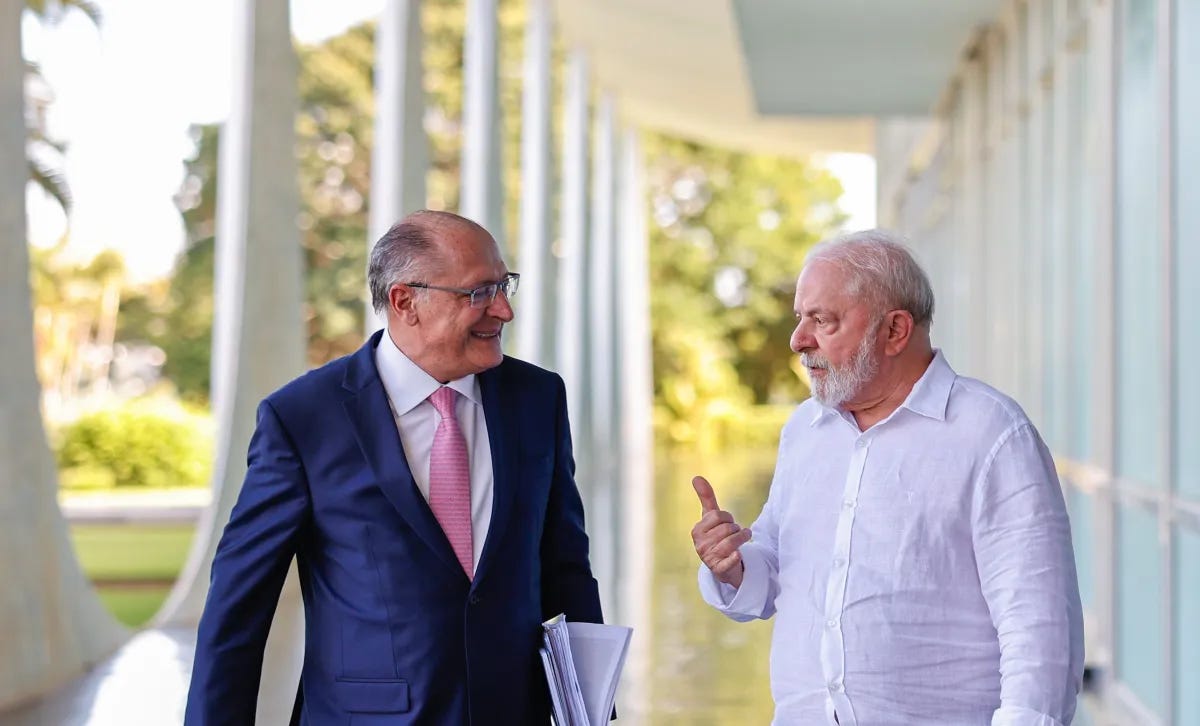
Vice President and Minister of Industry, Development, Commerce and Services, Geraldo Alckmin and President Lula. In 2024, their announcement of a $247 billion investment for reindustrialization was frowned on by orthodox economists but led to increased GDP growth
The orthodox camp offers the same diagnosis as always: the government spends too much and spends inefficiently, which puts pressure on inflation and interest rates and hurts families and businesses. The solution, as always, would be to rein in spending, end the guaranteed budget floors for mandatory social spending (on health, education, social assistance and so on) and freeze the minimum wage in real terms. This approach is socially perverse. Voters rejected it at the polls, and it is out of touch with reality.
According to IMF data, Brazil’s primary deficit, which leaves out interest payments on public debt, will average 1.2% of GDP between 2023 and 2026. That is below the average for middle income emerging economies (1.4%) and advanced economies (2.7%). Inflation as measured by the IPCA, Brazil’s consumer price index, has averaged about 4.6% since 2023, the lowest rate for a presidential term since the index was first calculated in 1979. That brings up a central issue: high interest rates.
Brazil has one of the world’s highest real interest rates, and that carries a heavy fiscal cost. According to IMF data, interest payments on public debt averaged 7.0% of GDP between 2023 and 2026. High rates also hurt economic growth, especially through their effect on consumer and home loans, and they increase income concentration.
High interest rates, on the other hand, push prices down. They attract capital, which strengthens the currency, makes imported inputs and goods cheaper and offsets pressure from abroad, such as the surge in international food and fuel prices.
Very low interest rates, in turn, shrink the gap with foreign assets seen as safer. That drives capital out and weakens the currency, which feeds into inflation. It is exactly what happened in 2021, when very low rates were followed by a surge in the exchange rate and in prices. This is why proposals calling for very sharp cuts in interest rates, such as the one from André Lara Resende, should be examined with great caution.
To debate how much room there is for rates to fall, we need to look at whether the current Inflation Targeting Regime fits Brazil’s economy today. Since the regime was adopted in 1999, annual IPCA inflation has averaged 6.3%. The current 3.0% target, with a tolerance band of 1.5 percentage points above and below, can therefore be considered excessively rigid. It requires even higher interest rates than a 4.5% target with a band of 2.0 percentage points, for example. Intervening in the currency market beyond spot dollar sales (through swaps, line auctions and similar tools) and regulating capital flows more tightly could also create more room for rates to fall.
With monetary and currency policy covered, we can turn to fiscal policy. The progressive camp has a virtual consensus on the need to make taxes fairer, by raising taxes on the wealthy and easing the load on the poor, and on expanding spending on public investment and social benefits. There are also enormous disagreements, though, over the limits of that fiscal expansion.
Some economists argue for a kind of “heterodox fiscal conservatism,” either because public spending is hard to finance and capital could flee, or because rising public debt has distributional effects. Economists from the Political Economy Group at the Federal University of Rio de Janeiro (UFRJ) and the Institute of Functional Finance for Development (IFFD) argue for an even bigger expansion of public spending.
The idea behind this school is that the state faces no limit in financing itself in the currency it issues; that international capital flows are not tied to fiscal indicators of debt in domestic currency; and that the rise in income concentration linked to public debt comes not directly from its size but from the high interest rate charged on it. So the government can and should speed up its spending, as long as certain conditions are met.
First, the country must have import capacity, meaning no shortage of foreign currency (dollars). More spending leads to more production and more imports, which require foreign currency. That condition is easily met today, given the abundance of liquidity in the world and the country’s comfortable external accounts, which include large international reserves.
Second, productive resources must be available, meaning labor and capital such as machines and equipment. On labor, the unemployment rate stands at a historic low of 5.2% (July to September 2026). Still, data from the Brazilian Institute of Geography and Statistics (IBGE) for the second quarter show that the labor force participation rate, at 62.1%, could rise, while the underutilization rate (12.9%) and the informality rate (37.4%) have room to fall. Capital, for its part, is produced in the production process itself and/or imported, and its accumulation follows the trend of effective demand, which public spending stimulates.
Beyond giving society fundamental public goods (such as infrastructure, health and education) and transferring income to those most in need (such as retirees, people with disabilities and the poorest families), fiscal expansion directly raises demand, and with it production, productive capacity, income and tax revenue. Public investment in particular plays a fundamental role in expanding the economy’s supply capacity, which directly increases its long term growth capacity.
In the first decade of the 21st century, spending grew steadily, which contributed to growth, raised tax revenue and reduced public debt as a share of GDP. The following decade saw the opposite: slowing spending, growth and revenue, with fiscal indicators deteriorating, especially from 2015, when a severe adjustment of public accounts cut federal primary spending.
Lula’s third term shows the same thing. The return of growth owes largely to higher public spending, thanks to the Transition Amendment, which covered 2023, and to the exclusion of several categories of spending from the New Fiscal Framework, in force since 2024. These include court ordered payments (precatórios), disaster aid to Rio Grande do Sul, state company investment, relief for companies hit by the tariff hike, and defense spending. Starting in 2025, as the framework restricted spending, growth slowed, a trend reinforced by high interest rates. And that is without counting the difficulty expected in the coming years of meeting constitutional rights within the framework’s limits. It is therefore essential to revise it.
The path the government chooses will determine not only macroeconomic performance in the coming years, but also the political viability of the progressive project. In that sense, loosening the Inflation Targeting Regime is essential to allow lower interest rates, which are needed for fiscal, distributional and growth reasons. Revising the New Fiscal Framework is even more crucial for speeding up spending, both to meet social demands and to stimulate the economy, and so to make possible, in fact, the continuation of the project of growth with income distribution that voters chose at the polls.
Luciano Alencar Barros is a professor at the Institute of Economics at UFRJ and a researcher at the Institute of Social and Political Studies at the State University of Rio de Janeiro (UERJ).
Miguel Henriques de Carvalho is a professor in the Department of Economic Sciences at the Institute of Applied Social Sciences at the Federal Rural University of Rio de Janeiro (UFRRJ).
This article first appeared in LeMonde Diplomatique Brasil, was translated with express authorization from its editor-in-chief, and can be read in its original Portuguese here.