

By Marcelo Zero
Fourteen Latin American and Caribbean countries have just announced their support for the so-called “Shield of the Americas.” All 14 have governments that serve Trump’s imperial interests with doglike devotion. The initiative is supposedly meant to combat “narcoterrorism” on our continent. It is tragicomic.
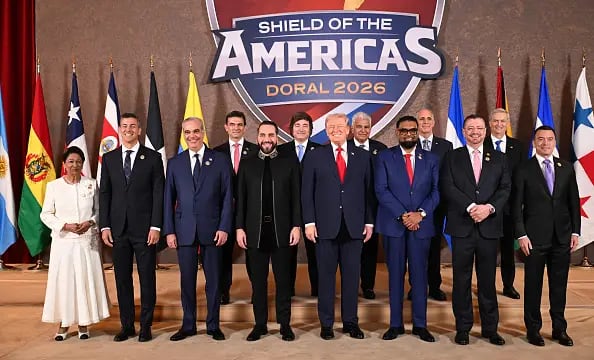
Shield of the Americas nation leaders cluster around their leader, US President Donald Trump. (Roberto Schmidt/Getty Images)
In truth, the initiative is above all a “reheating” of a very old, indigestible dish. All the diners who were forced to eat it got violently ill. I am referring, of course, to the infamous “war on drugs.”
Richard Nixon declared war on drugs 55 years ago on June 17, 1971. Two years later, in 1973, he created the Drug Enforcement Administration, a special police force set up to fight the use and smuggling of illegal drugs in the United States.
Ronald Reagan stepped up the war with passage of the Anti-Drug Abuse Act of 1986. This federal law set aside $1.7 billion for police forces to wage the “war”. It also established much harsher mandatory minimum sentences for crimes involving illicit substances.
Even President Bill Clinton did his part to harden the war on drugs. He signed the 1994 crime bill, which funded 125,000 new cells in state prisons. It created new life sentences and added 60 new crimes punishable by death.
The U.S. government is estimated to have spent well over $1 trillion on this farce.
But what were the actual results?
In the United States, the main consequence was a surge in the prison population. Since the war began, that population has grown by more than 500 percent. The United States now has the largest prison population in the world.
About 2 million people are incarcerated. Nearly half of them (47 percent) are behind bars for nonviolent crimes tied to drug trafficking.
Mass incarceration falls far more heavily on Black and Latino communities. Black adults are imprisoned at about five times the rate of white adults. Black people make up only 13 percent of the U.S. population but nearly 40 percent of U.S. inmates. They also receive sentences 20 percent longer than white people convicted of similar crimes.
Heavy policing of low-income urban neighborhoods, meant to crack down on drug trafficking, has broken up families and created intergenerational cycles of poverty. After release, people lose their right to vote and their job prospects.
Data from the Bureau of Justice Statistics indicate that about 26.6 percent of Black American men will serve time in a state or federal prison by age 40. For white men, the figure is 3.5 percent. Their lives, and their families’ lives, will be marked forever.
Did the war at least achieve its intended goals?
No.
Today, experts on the subject nearly all agree that the war on drugs was a monumental failure. It created a grave social problem and widened racial disparities in the United States. It also did not significantly reduce illicit drug use.
In fact, overdose deaths have soared since synthetic opioids entered the U.S. market. Those drugs came, it bears stressing, from the country’s own pharmaceutical industry.
And in Latin America?
Our region was forced into this “war,” and the consequences were even worse. Here, the war on drugs has meant more criminal violence, mass incarceration and deep political corruption. In countries such as Mexico and Colombia, the corruption has reached the armed forces. That has seriously damaged national sovereignty.
Experts say that criminalizing drug markets raised profit margins. That gave rise to more powerful and violent cartels, just as Prohibition did in the United States. The result was a massive rise in homicides in producer and transit countries such as Mexico, Colombia, Peru, Ecuador and Brazil.
State militarization and armed repression have led to tens of thousands of deaths and disappearances. Entire regions have become zones of conflict and dispute.
Note that the cartels, strengthened by this disastrous policy, easily get around interdiction efforts. They bribe or threaten local police, military forces and politicians. That undermines public trust in democratic institutions.
Given all this, will it make any difference to label ordinary criminal organizations, especially drug traffickers, as “terrorist organizations”?
If it does, it will only be for the worse.
The first consequence will be to make cooperation between Latin American countries and the United States on this issue harder. The designation will make technical cooperation more difficult and complicated. On the U.S. side, the CIA, other intelligence agencies and the military will now run it. These bodies tend to operate in secret and with extreme violence. Cooperation will no longer go through the Justice Department, the traditional legal channel.
Todd Robinson, a former assistant secretary of state for international narcotics and law enforcement affairs under President Joe Biden, criticized equating ordinary criminal organizations with terrorism. The former State Department official argued that the fight against drug trafficking should rely on police, financial and judicial tools. That means tracing money, building evidence, filing charges and holding people criminally accountable within the rule of law.
However, I believe the Trump administration knows the Shield of the Americas will fail to meet its publicly stated goals. In reality, the Shield has far more to do with geopolitical control of our region, under the new “Donroe Doctrine,” than with any real fight against drugs.
It is important to understand that U.S. antiterrorism laws reach beyond U.S. borders. That is, they allow the United States to act inside other countries without going through cooperation mechanisms. Washington can decide to do this entirely on its own.
Executive Order 13224, issued right after Sept. 11, 2001, is especially severe. Under these laws, the United States is empowered to do many things. It can freeze the assets of Brazilian financial institutions and sovereign funds. It can bar Brazilian institutions from financial transactions on the international system. It can impose new trade and economic sanctions. It can carry out deportations, arrests, intelligence operations and covert operations on another country’s soil. It can run hybrid operations to destabilize governments that are supposedly “negligent” in fighting terrorism, and so on.
Companies, banks, individuals, nongovernmental organizations and others can be pulled into this macabre dance. In Venezuela, even innocent small-scale fishermen sank fatally into terrorism’s mass grave. In Cuba, even doctors were swept in.
Labeling an ordinary criminal organization “terrorist” usually serves only a political need. Washington wants legal tools and pretexts to intervene in countries or governments that do not align with the current U.S. administration’s interests. It is simply a very useful geopolitical tool.
Ultimately, even what happened in Venezuela could happen in our countries. A military intervention could kidnap the president and bring him before a U.S. court. As in the case of Venezuela, the false claim would be that the head of state is a dangerous “narcoterrorist.”
It all depends on the political mood of extremely reactionary and misinformed people such as Secretary of State Marco Rubio. Perhaps even an intervention in Guanabara Bay, as Sen. Flávio Bolsonaro candidly suggested.
What is actually known is that highly destructive military drones are being moved into our region. Special forces are reportedly already operating quietly in Mexico, a sovereign country that did not join the “Shield.” Aircraft carriers may soon return. Trump recently said, in fact, that he could send an aircraft carrier to Cuba, a country that does not export a single gram of drugs.
It is also known that the Shield of the Americas has an operational arm, the Americas Coalition Against Cartels. Together, they aim to unite regional governments in the Western Hemisphere. Their stated goals are to dismantle transnational drug cartels, fight narcoterrorism, stop mass illegal migration and contain foreign interference. That last goal applies to a region the United States has historically regarded as its “backyard.”
That goal appears to be the Shield’s true and ultimate purpose.
Even the fairly conservative The Wall Street Journal acknowledges that Trump’s “Donroe Doctrine” “aims to dominate the Americas.”
The ideological and geopolitical nature of this U.S. initiative is obvious and shameless.
According to Pete Hegseth, the U.S. “secretary of war,” the Shield’s member countries are “descendants of Western civilization,” united by “our heritage, our history and geography in this new world.” The challenge, he said, is whether “our nations will be and remain Western nations with distinct characteristics, Christian nations under God, proud of our shared heritage, with strong borders and prosperous peoples, governed … by law, order and common sense.” The alternative, he said, is to succumb to “radical narcocommunism (!) and narcotyranny, which threaten our people, our borders and sovereign lands in the name of a false sovereignty or a false peace.”
That says it all, doesn’t it?
This is an election year in Brazil. Obviously, the Trump administration will try to favor Flávio Bolsonaro’s candidacy and make trouble for the candidacy of President Luiz Inácio Lula da Silva.
For this very reason, Brazil’s far right has been betraying the country’s interests. For a long time, it has shamelessly sought to draw a preposterous link between the Lula government and crime and “narcoterrorism.”
I repeat: If it considers it necessary or convenient, the U.S. government will do as it pleases in these “sad tropics.” It will use this flimsy excuse, one that has failed throughout history.
No one knows what could happen in Brazil after this decision.
When the attack on Venezuela took place, U.N. Secretary-General António Guterres issued the following statement:
“The secretary-general is deeply alarmed by the recent escalation in Venezuela, which culminated in the military action by the United States in the country today. It has potentially worrying implications for the region.
“Regardless of the situation in Venezuela, these developments constitute a dangerous precedent. The secretary-general continues to stress the importance of full respect — by all — for international law, including the U.N. Charter.”
At a press briefing on Dec. 1 of last year, the White House reiterated that “the president has made it very clear that if narcoterrorists are trafficking illegal drugs into the United States, he has the authority to kill them.”
The danger of some U.S. military intervention in Brazil is therefore real. This is so even though the Primeiro Comando do Capital (PCC) and the Comando Vermelho (CV) do not export drugs to the United States. Those criminal organizations export mainly to Africa and Europe. It should also be stressed that Brazilian authorities have always cooperated actively with the United States and other countries against drug trafficking and other international crimes.
But Trump is capable of anything. He has complete contempt for other countries’ sovereignty and for the most basic rules of international law. Only a fool would doubt it.
If the Trump administration decides that Brazil is “not doing enough,” it will act unilaterally, as usual. It could act openly or covertly. It could act even during an election period, or, better put, preferably during one. Disinformation is part of the Shield’s diverse arsenal.
Bolsonaro supporters, of course, will applaud. That is the nature of traitors.
Marcelo Zero is a sociologist and political analyst. This article was submitted directly by the author, and translated to English by Panamerican Dispatch