


By Jamil Chade
The G7 foreign ministers’ meeting in Paris this week carries an irony typical of France’s centuries of diplomatic experience. When the hosts arranged the table, they seated the foreign ministers of Brazil and the United States side by side to debate the biggest issues on the planet.
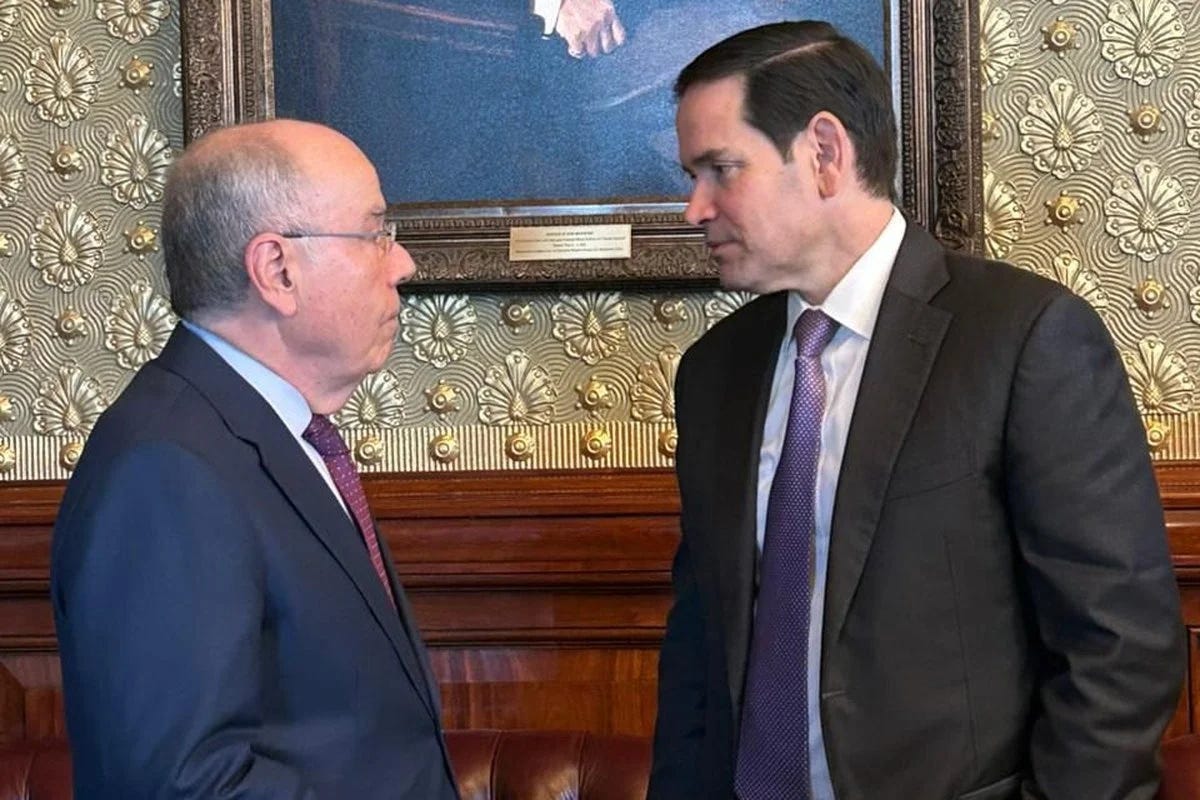
Brazil’s Foreign Chancellor Mauro Viera and US Secretary of State Marco Rubio at the G7 meeting in France. (photo: Brazilian Ministry of Foreign Relations)
Today and tomorrow, Secretary of State Marco Rubio must share space with Foreign Minister Mauro Vieira. Vieira is one of the few ministers from outside the bloc of the world’s richest economies invited to the event.
Rubio spent months working against President Luiz Inácio Lula da Silva. He welcomed the Bolsonaro family, imposed sanctions on Brazil and took an aggressive tone in public posts. Lula did not let it pass. He hit back, warning that Rubio was acting against Brazil, even openly saying that he doesn’t like Brazil.
On Monday, for the traditional family photo, the French again placed Rubio and Vieira shoulder to shoulder. Rubio did not hide his discomfort.
The two may hold a bilateral meeting, but it is not yet confirmed.
Officially, Rubio and the Trump administration haves not congratulated Lula on his victory, while almost every other country in the World has, with foreign ministers at international meetings having sought out Vieira to personally express their satisfaction with the election result. Meanwhile, the Trump administration is accused of helping Sen. Flávio Bolsonaro flee.
Lula’s government hopes for room to normalize relations with the United States, and it is approaching the effort with pragmatism. It believes the harassment of Brazil was meant to influence the outcome of the election. Now that the election is over and Lula has won, it hopes the two countries can reach an accommodation.
First test: visas and ambassadors
The first test of normalization would be restoring the flow of officials, ambassadors and ministers between the two countries. At a possible meeting this week, the first gesture is expected to be a review of the approval of Daniel Perez, the U.S. ambassador to Brazil.
Planalto Palace had frozen Perez’s move to Brasília. It said no new ambassador would be authorized during the election process. With the vote over, the issue is back under review. Lula’s government insists that the “visa Cold War” must end.
That means the U.S. government must end its sanctions against Maria Luiza Viotti, Brazil’s ambassador in Washington. It must also restore visas for Brazilian ministers and officials. Brazil’s goal is unimpeded access for its officials and ministers.
For normalization to proceed and ambassadors to move again, Lula’s government also expects Trump to stop questioning the results of Lula’s election. Brasília says his doubts complicate the effort to restore relations. Brazil does not expect Trump to retract anything. It only wants him to stop talking about it. If he does, the path to normalization is open.
Members of Lula’s government see a contradiction. The White House has not yet recognized Lula’s victory. At the same time, it is asking for authorization to send its ambassador to Lula’s government.
Trade deal
Another step toward normalization would be resuming the trade agreement with the United States and redefining tariffs. Brazil is waiting for a draft of a deal. It hopes Trump will soften his trade barriers, given their impact on the cost of living for Americans.
Brazil will not accept just any deal. Lula’s government will insist on a balanced agreement. If there is no room for negotiation, Brazilian diplomacy does not rule out waiting two years for a possible new U.S. administration.
This article originally appeared in ICL Notícias, was translated with express authorization of the editor by Panamerican Dispatch, and can be read in its original Portuguese here.