


By Cleber Lourenço
Brazil’s Superior Electoral Court has unanimously found that Meta defied court orders and made it harder to monitor how political content was distributed during the 2026 presidential election. The November 10 ruling answers a complaint filed by President Lula’s campaign coalition, which denounced differences in how the platforms treated the candidates. Meta, the owner of Facebook, Instagram and WhatsApp, was ordered to pay a fine of R$ 7,5 million (about $1.46 million).
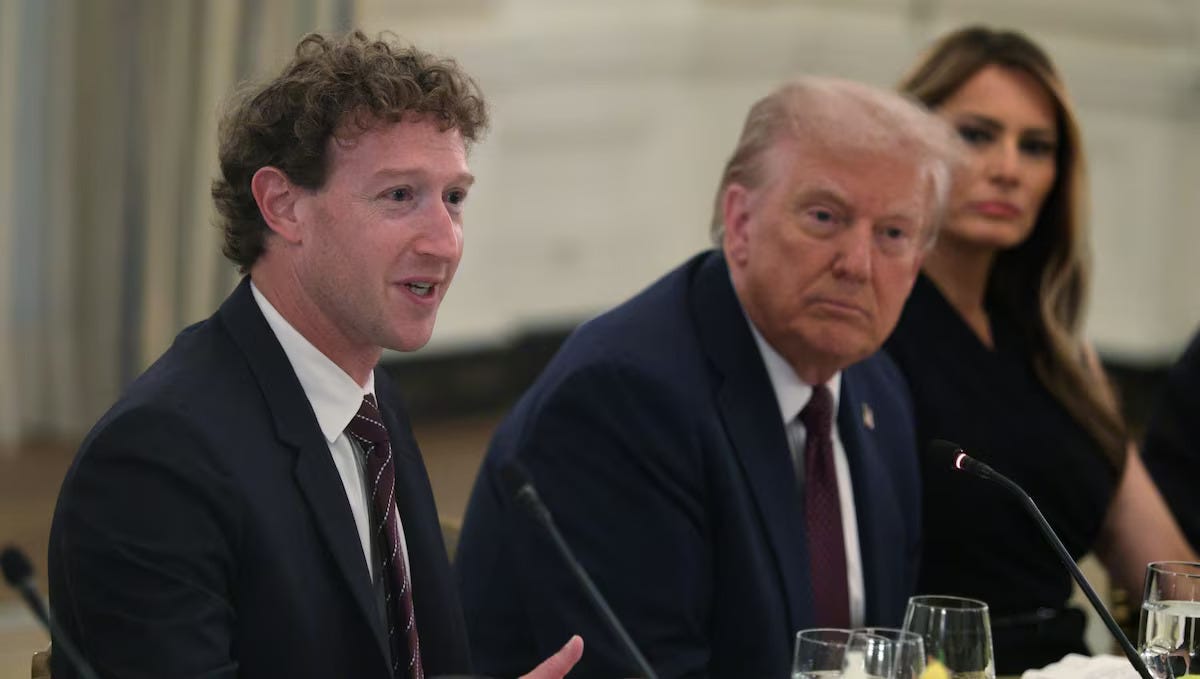
Meta owner Mark Zuckerberg with Donald and Melania Trump (Alex Wong/GettyImages)
The ruling came the same day that Brazil’s Federal Police opened an investigation into suspected foreign interference in the election, responding to an order by Supreme Court Justice Flávio Dino. It will look at possible manipulation of platform algorithms to help or hurt candidacies, including suspicions involving Meta.
The court found that Meta missed deadlines set by the electoral court, provided incomplete information and made it harder to verify how its systems distributed political posts during the runoff. According to Justice Marco Aurélio Bellizze, who wrote the ruling, Meta even replaced the court’s deadlines with ones of its own, and some of the information the court requested arrived in pieces, in a foreign language or as generic answers.
The fine covers three days of penalties of about $97,000 a day, from October 17 to 19, and six more days of about $194,000 a day, from October 20 to 25, reflecting all the violations the court identified.
The complaint, filed by the O Brasil Pronto Para Mais! (Brazil Ready for More!) coalition, pointed to limits on how posts were delivered, activity by accounts believed to be fake, failures to label content made with artificial intelligence, and possible differences in how the platform’s tools worked.
According to the electoral court’s campaign finance filings, Meta received about $101 million in declared spending from Brazil’s 2026 campaigns. The fine amounts to roughly 1.44% of that total, or $1.44 for every $100 the platform took in during the race.
Federal Police Investigates Suspicions of Foreign Interference
Dino ordered the Federal Police investigation on October 27, after filings from Lula’s campaign and from Renan Santos, then a presidential candidate for the Missão party. Finding points where the complaints overlap, he called for an inquiry into possible irregularities involving foreign money and the way digital platforms operated during the race.
One line of the investigation looks directly at “intentional asymmetries and algorithmic manipulation by internet companies, aimed at helping or hurting candidacies in Brazil’s election.”
The Federal Police must also investigate suspected foreign financing of Sen. Flávio Bolsonaro’s campaign, including possible dealings between Rockbridge Network, a U.S. conservative organization, and Brazilian businessmen. The suspicions include the use of foreign money, services or other economic benefits to help candidates, as well as the purchase of campaign ads by accounts based outside Brazil.
The electoral court’s ruling adds to this picture, since it found that Meta failed to follow orders meant to explain how its tools worked during the presidential race. The two proceedings have different goals, however. The electoral court punished the company for ignoring court orders, while the Federal Police must determine whether algorithms were deliberately manipulated or whether there was any other form of foreign interference in the election.
Meta Admitted Flaws but Did Not Show They Were Fixed
One of the ruling’s central points is that Meta itself admitted technical flaws in its tools. Even so, the court found that the information the company provided did not let it check whether those problems had actually been fixed.
“Although the defendant took steps to correct the tool’s flaws, the information it provided amounts to generic statements of equal treatment, which are not enough to ensure substantial compliance with the order,” Bellizze said.
The court did not conclude that Meta acted on purpose to favor any candidacy. According to Bellizze, that question would require stronger evidence, produced in a proper proceeding.
The justices also ordered that Lula’s coalition get access to the documents Meta submitted to show it followed the court’s decisions. Technical information about Meta AI filters and the tools that detect synthetic content will stay confidential, since the court considers it a trade secret.
Meta denies favoring any candidacy. In an earlier statement, the company said it does not interfere in elections and called the accusations of political favoritism false and baseless.
Court Points to Algorithms’ Power Over Election Debate
The trial also raised a broader question about how much influence digital platforms have in shaping public opinion. In his opinion, Bellizze said tech companies are no longer just middlemen for communication but now have a direct say in which information reaches users.
“After all, it is not enough to guarantee citizens the right to choose. We must also ensure conditions for that choice to be formed freely, especially in a digital environment where the tools that select and distribute information are not very transparent and are hard to monitor,” he said.
In Bellizze’s view, using algorithms to select, rank and amplify political messages calls for special attention from the electoral courts, because platform decisions can affect how visible candidates are and the conditions under which public debate takes place. He also stressed that technological progress cannot create spaces beyond the reach of Brazilian authorities.
Lula’s Lawyer Points to International Precedent
Angelo Ferraro, the lawyer who coordinated the legal team for Lula’s presidential campaign, called the ruling historic and said it marks a shift in how large technology companies are held accountable.
“Democracy has definitively entered the age of algorithms,” Ferraro said in an official statement. “It is not enough to guarantee that candidates can post content. We must guarantee transparency about the mechanisms that determine what actually reaches voters.”
Ferraro also praised the coalition’s legal team, which presented technical evidence and identified contradictions in Meta’s explanations. In his view, the ruling reaches beyond Brazil’s borders and sets a precedent for overseeing digital platforms in future elections.
“No digital platform is above the law. No algorithm can be beyond the reach of oversight. And no company, regardless of its size or international influence, can ignore the decisions of an electoral court with impunity,” he said.
All of the electoral court’s justices backed the ruling. The Federal Police investigation will continue under the Supreme Federal Court’s supervision and must determine whether the suspicions of manipulated digital systems and foreign interference are backed by evidence.
This article originally appeared in ICL Notícias, was translated with express authorization from the editor by Panamerican Dispatch, and can be read in its original Portuguese here.