


by Ivan Longo
The strategy that helped President Luiz Inácio Lula da Silva defeat Flávio Bolsonaro in the 2026 presidential election is crossing borders. In France, Spain, and Argentina, groups inspired by the Brazilian experience are already replicating the methods used during the Workers’ Party campaign.
Federal Deputy André Janones, from Minas Gerais, created and ran the “Lula’s Army” WhatsApp group. He has become an international benchmark for digital organizing among leftist movements seeking to counter the rise of the right and the far right.
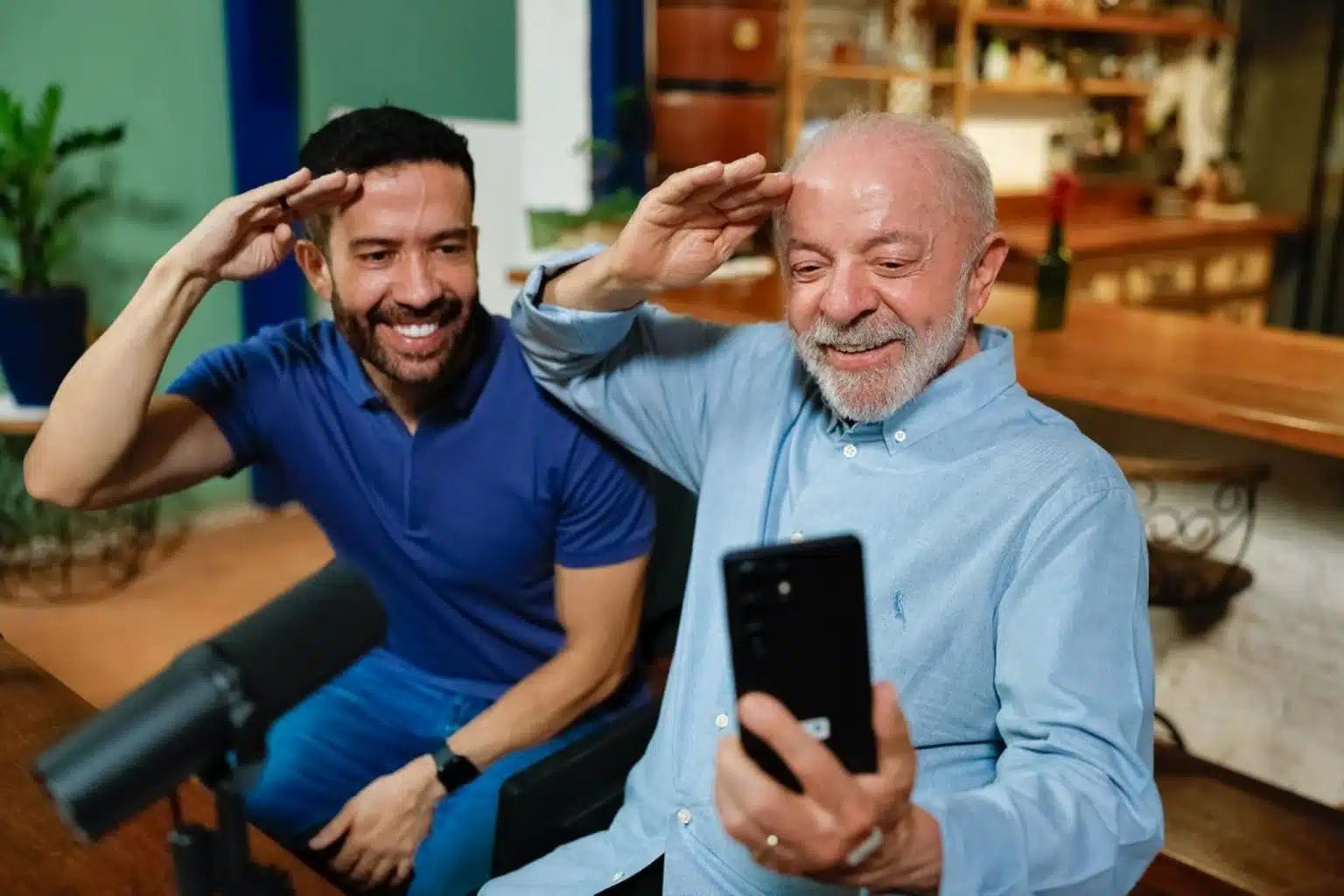
President Luiz Inacio Lula da Silva sits beside Federal Deputy André Janones who created and ran the “Lula’s Army” WhatsApp group (Ricardo Stuckert)
The impact extends beyond social media. Janones has gained prominence in the international press. According to reports published in recent days, he has received invitations to collaborate with the campaign of Spanish Prime Minister Pedro Sánchez and to visit Mexico at the invitation of President Claudia Sheinbaum.
Interest in the Brazilian model grew following Lula’s victory in the runoff election held on Sunday, October 25. The turnaround came after Lula had finished the first round of the race trailing Flávio Bolsonaro. It caught the attention of progressive leaders, coming at a time when conservative and far-right forces are gaining ground globally.
The Janones Model: Mobilizing Millions via WhatsApp
The approach now inspiring international movements reached an unprecedented scale during the runoff of the 2026 Brazilian election. Under Janones’ leadership, the “Lula’s Army” channel surpassed 10 million followers on WhatsApp, nearing 11 million by the final stretch of the campaign.
The strategy transformed supporters into active agents of electoral communication. Instead of merely receiving content, participants were tasked with completing daily “missions”: sharing videos, boosting posts, promoting hashtags, inviting new members, and expanding the reach of messages favorable to Lula.
Another directive was to avoid interacting with pro-Bolsonaro posts, including leaving comments, so as not to feed the algorithms or increase the visibility of opponents. The mobilization also involved coordinated actions at specific times, aimed at pushing progressive content beyond the traditional left-wing echo chambers.
The model drew attention for its ability to organize millions of people around simple tasks, using direct, accessible language underscored by a sense of urgency.
The impact was such that the Spanish newspaper El País published a report this Tuesday, October 27, dedicated to the Brazilian lawmaker, describing him as the “WhatsApp general” who played a key role in Lula’s electoral turnaround. Janones’ efforts were also the subject of coverage by Al Jazeera and other international media outlets.
France: Mélenchon’s Left-wing Movement Creates Own Digital Army
In France, the Brazilian experience inspired the emergence of “Les Soldats Insoumis” (“Unsubmissive Soldiers”), an independent group formed by supporters of Jean-Luc Mélenchon’s party, La France Insoumise (LFI—France Unsubmissive).
According to Radio France Internationale, the initiative had amassed more than 15,000 participants on WhatsApp as of Tuesday, October 27, and has since expanded to Telegram and other social media platforms. As in Brazil, members receive instructions to share content, boost hashtags, and recruit new participants.
The mobilization gained enough momentum that LFI itself created an official channel, dubbed “L’équipe de Mélenchon officielle” (“Mélenchon’s Official Team”).
French MP Antoine Léaument referenced the Brazilian experience when he called on supporters to join the new initiative.
“We saw clearly what happened in Brazil, and don’t worry, we are going to apply a method that works,” he said, according to Radio France Internationale.
This development comes amid preparations for the 2027 French presidential elections, scheduled for April and May. Marine Le Pen, a prominent leader of the European far-right, is currently leading in the polls.
Spain: Pedro Sánchez’s Supporters Adopt Janones’ rules
The Brazilian experience is also spreading to Spain. Supporters of Prime Minister Pedro Sánchez, of Spain’s Socialist Workers’ Party, PSOE, have created a channel called “La fuerza de la gente” (“The Strength of the People”), dedicated to digital organizing in favor of the socialist leader.
In addition to sharing speeches, videos, and posts by Sánchez, participants circulate images of President Lula and materials featuring what are known as the “Six rules of Janones’s digital strategy.”
The initiative comes at a decisive moment for the Spanish government. Sánchez, who has held office since 2018, has called for early general elections to be held on November 29, 2026, and is seeking to broaden support for the left in the face of rising conservative and far-right forces.
The Spanish Prime Minister himself has pointed to Lula’s victory as an example that it is possible to turn around unfavorable electoral prospects. The Brazilian strategy has gained particular relevance in the context of the digital battle against the Spanish right and the far-right party Vox.
Argentina: Kirchnerists create the “Peronism Army”
In Argentina, supporters of Kirchnerism have also begun to replicate the Brazilian experience. The group “Ejército del Peronismo” (Peronism Army) has united supporters from the youth and left wings of the Peronist movement, the primary opposition force to President Javier Milei.
As of Tuesday, October 27, the group’s WhatsApp channel had already reached over 32,000 followers, according to Radio France Internationale. The Argentine organizing follows the same dynamic as “Lula’s Army,” with missions that include sharing posts, inviting new members, and expanding the reach of political messaging.
References to Brazil appear frequently. Videos, images, and posts regarding Lula’s victory serve as inspiration for organizing supporters as they prepare for Argentina’s 2027 presidential elections.
The expansion of these initiatives is taking place against a backdrop of a strengthening right wing in South America: seven heads of state in the region are aligned with the right, while five are identified with the left.
Janones Receives Invitations from Spain and Mexico
International recognition of Janones’ strategy has also opened doors for engagement with political leaders abroad.
The Brazilian congressman has been invited to collaborate on Pedro Sánchez’s election campaign in Spain. The potential participation has drawn attention in the Spanish press, though there is no confirmation yet of a formal agreement or that the lawmaker has accepted the invitation.
On Tuesday, October 27, Janones also received an invitation from Mexican President Claudia Sheinbaum to visit the country and discuss joint initiatives to strengthen the political left.
The outreach was conveyed by Efraín Guadarrama, who identified himself as the chief of staff to the Mexican foreign minister. No date has been set for a possible trip.
Having helped the Brazilian left compete with “Bolsonarism” for space on social media, Janones is seeing his strategy observed and adapted by movements facing similar challenges in other countries. This phenomenon represents a shift in perspective. Rather than merely following the digital strategies of the far right, segments of the international left have begun to draw inspiration from a model developed in Brazil.
This article initially ran in Revista Forum. It has been translated by Panamerican Dispatch. You can read it in its original Portuguese here.