


By Congresswoman Benedita da Silva
President Lula’s runoff comeback was so powerful and so surprising that it will be remembered forever in our history. The vote for Lula in the first round was different from the vote in the second. In the first round, voters were guided more by the government’s accomplishments, and many of our supporters expected to win then and there.
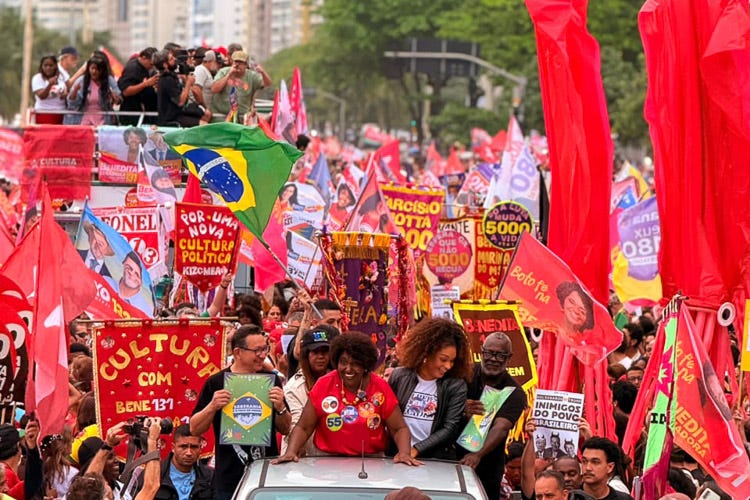
Benedita da Silva at a campaign rally for Lula and PT’s lawmakers in September, 2026 (Photo: PT)
In the runoff, driven by the immediate reaction of student demonstrations across the country and by effective use of social media, a large part of society woke up to the threat a far right victory would pose to democracy itself. Above all, people realized that Lula’s election was the only guarantee of defending democracy and social rights.
The reaction to Lula’s comeback in the progressive world was enormous, and it helped strengthen democratic forces in other countries. Examples include the defeat of the authoritarian President Trump in the U.S. midterm elections, the electoral fight against fascism in Spain and the struggle of the Argentine people against Milei’s oppressive government.
I want to highlight the words of a young African-American woman who voted against Trump’s republicans and who best captured what the vote for Lula in the runoff meant: “It was more than a vote. It was the people refusing to give up their future. The people refusing to give up democracy.”
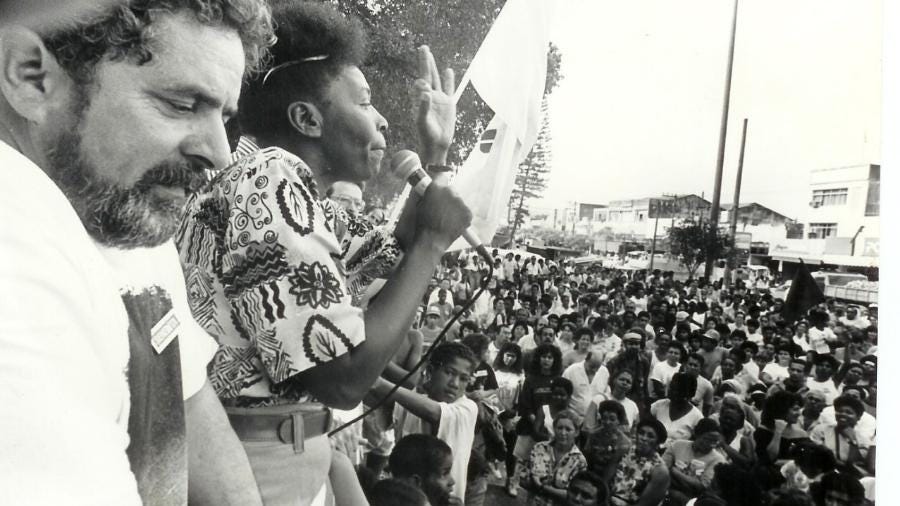
Benedita da Silva and Lula in the 1990s (Photo: PT)
The gigantic national mobilizations leading up to the runoff, with or without Lula present, were certainly the largest in our history. Add the push on social media, where we outdid the far right’s engagement through “Lula’s Army,” created by Rep. André Janones and now more than 10 million followers strong, carried out at the ballot box. We can say that what happened in Brazil was a true democratic peoples’ revolution.
It had enough force to defeat several powerful enemies of our democracy at once: the intervention of Trump and the Big Tech companies, financial capital and its media outlets, the far right’s fake news industry and the biased rulings of the president of the Superior Electoral Court.
Lula’s historic comeback rested mainly on these pillars: the mobilization of young people and women, the moving participation of senior citizens, and the majority vote of Northeasterners, the Black population and workers who earn up to three minimum wages who backed the end of the 6 day work week.
That vote to defend democracy and rights produced a surge of people power in the runoff so strong that it went well beyond ordinary electoral politics. This huge mobilization, reaching far beyond the influence of the Workers’ Party and the left, created a new dynamic of participation and public pressure in politics.
Even before the election, the country had felt the force of social pressure in the large demonstrations against the so called banditry ammendment and for the end of the 6 day work week and online betting platforms.
Now we have seen all of that amplified by Lula’s Army and by the president’s statement that the government will use digital communication to reach the public. This fixes an old weakness of the Workers’ Party, one that waves of far right fake news had been exploiting. On that front the contest was even, and we are making progress in mobilizing the streets.
All of this gives us a more favorable balance of social forces than in the past. It helps us carry out the structural reforms promised in the campaign, and it lets Lula face the far right’s strength, won in the first round in the elections for Congress and for state governments in the South and Southeast.
The country needs to consolidate and build on its gains in education and public health, in racial and gender equality policies, in the fight against femicide, and in the federal coordination of the fight against organized crime, from the foot soldiers to the crime bosses. President Lula will have to withstand financial capital’s pressure to keep the abnormally high interest rates in place. The New Industry Brazil program also needs to continue, since beyond technological innovation it creates higher skilled jobs.
Finally, we must defend our rare earth minerals, our Amazon rainforest, the planet’s climate and our sovereignty, because powerful foreign interests will keep pressing against our country.
The great grassroots mobilization made it possible to govern with social backing. But the unfavorable first round results now require President Lula to build alliances with the center right so he can govern in Congress as well. The government’s political future will depend on how well these two kinds of support balance out.
That is why, as the country’s largest left party, the Workers’ Party carries the greatest responsibility for turning the mobilization of ordinary people and young people into an organized force. The aim is to keep up the social pressure for progress seen in the runoff, and to give it the strength to face the counteroffensive of the far right, which lost the presidential election but is still present in society and in Congress.
Renewing the party, and opening it to the young activists who were decisive in President Lula’s election, is its main task for the immediate future. The election of young and Black lawmakers, who relied mainly on social media, points to the change we need.
The greatest symbol of that change is the election of Ana Elisa, a young Black woman from Minas Gerais, who is only 21, with an impressive 524,000 votes. Because she was elected by the Workers’ Party and, above all, because she is a politically conscious young Black woman, Ana Elisa has been the target of discrimination campaigns and death threats from the far right. She deserves all our solidarity and the federal government’s protection.
The far right’s weight can be felt especially in the state of Rio de Janeiro, where the democratic front failed to elect its candidates for the Senate or for governor, though the Supreme Court has yet to decide whether a runoff will be held. In Rio de Janeiro we can see in full how the militias control the votes of residents in the territories they dominate, and how much influence conservative churches allied with the Bolsonaro movement hold over many communities.
Even under these adverse conditions for the progressive camp, Lula flipped the vote in the runoff in the city of Rio de Janeiro and in several towns in the state’s interior. That shows there are political openings the Workers’ Party can use to build democratic and patriotic awareness among the many people still influenced by denialist, reactionary conservatism.
Benedita da Silva, 84, emerged as a national favela residents’ rights leader in the 1970s. Elected to Rio de Janeiro city council in 1982 for the Workers Party (PT), she became the first Afro-Brazilian woman ever elected Senator in 1995, and, in 2002, Brazil’s first Afro-Brazilian governor. The introduction to the English version of her 1997 autobiography, Benedita Da Silva: An Afro Brazilian Woman’s Story of Politics and Love, was written by Jesse Jackson.
This article first appeared in Brasil 247, was translated with express authorization of its editor-in-chief, and can be read in its original Portuguese here.
https://substack.com/@aaronruby/note/p-223659375?r=7jhui4