

By Marcelo Zero
As Brazil approaches high-stakes elections, Brazilian sociologist Marcelo Zero analyzes U.S. demands on Brazil and looks at how far-right presidential candidate Flávio Bolsonaro is a proxy for his father, Jair Bolsonaro and U.S. President Donald Trump. -PD
Flávio Bolsonaro is nothing but a proxy for his father, Jair Bolsonaro. Had he been born into a different family with a different surname, he would not even qualify as head of a street vendors’ association in one of Rio de Janeiro's favelas controlled by paramilitary militias. At the Kopenhagen chocolate store he allegedly used for money laundering while serving as Rio de Janeiro state lawmaker, he would be nothing more than a salesman. Because of his well-known intellectual, ethical and political shortcomings, this man is in no way fit to be president of Brazil.
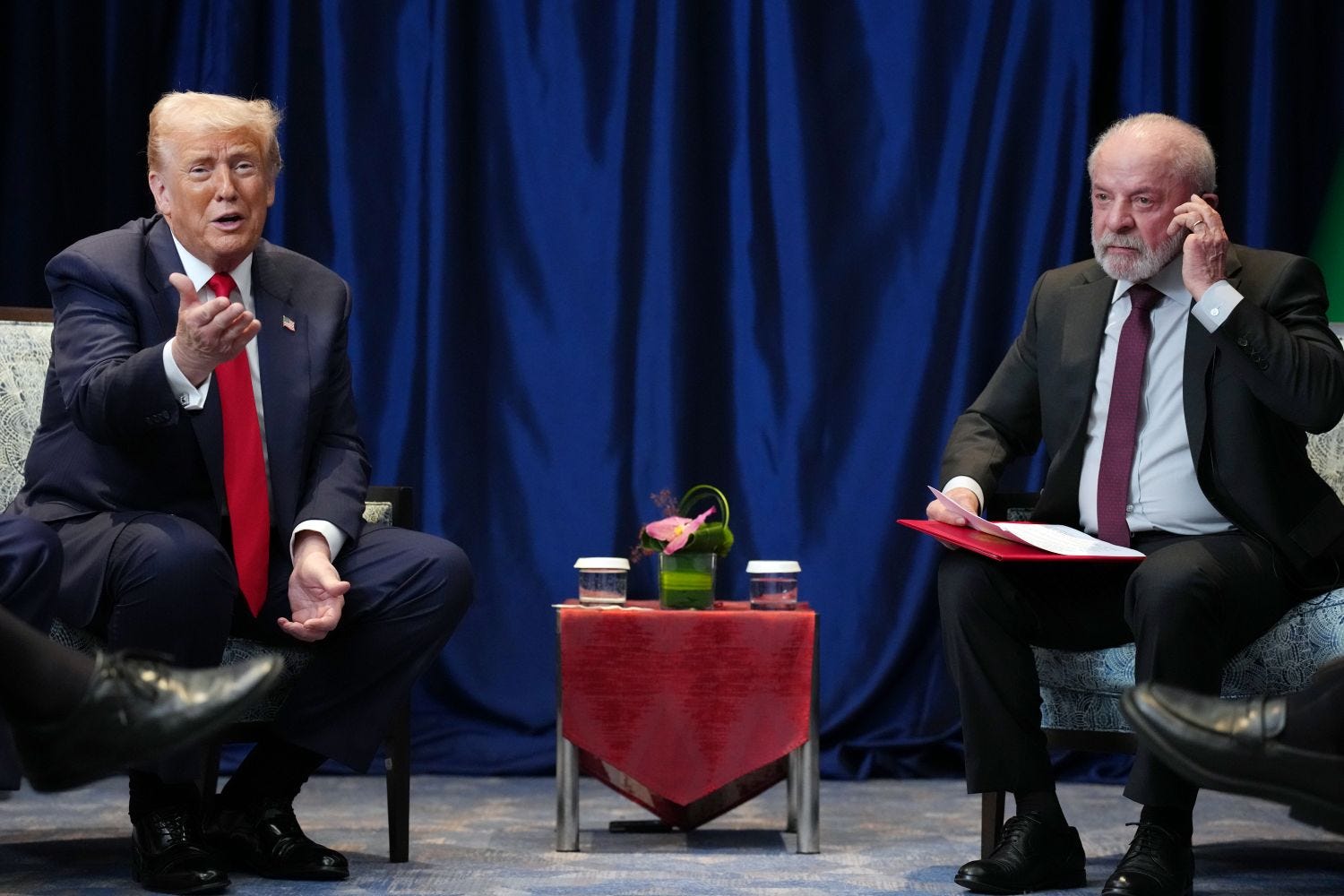
Friendlier days: U.S. President Donald Trump and Brazilian President Luiz Inácio Lula da Silva meet in 2025. (Andrew Harnik/Getty Images)
If Flávio Bolsonaro wins Brazil's presidential election, it would mean the return to power of former President Jair Bolsonaro. He is a man convicted of attempting a coup, an admirer of dictatorships, an ally of the militias and the main person responsible for the deaths of 700,000 Brazilians during the pandemic. Essentially, it would mean re-electing the worst president in the country’s history.
Jair Bolsonaro only rose to prominence in national politics through the Lava Jato era and the wave of anti-politics, anti-Workers’ Party and anti-left sentiment that swept the country after the coup against President Dilma Rousseff. A coup that was backed by the American far right. Had that not occurred, Jair Bolsonaro's dim political shine would have remained, ad aeternum, confined to the corrupt inner workings of Congress’ lower ranks and to his dangerous ties with Rio de Janeiro’s militias. That is his real measure. The measure of a bad military man, as Brazilian Dictator Ernesto Geisel once defined it, and the tiny stature of the worst possible kind of politician.
But Jair himself, within the current political context, is merely a proxy for Trump. In other words, we have two proxies for the real candidate for power in Brazil: Donald Trump. One might call him a candidate for emperor, and his vision of that position is draconian and extremist. He is far removed from the moderation of someone like Brazilian emperor Dom Pedro II. Instead, his concept of empire seems more closely related to that of infamous figures from history like Nero or Caligula.
Revelations that recently came to light show the demands Trump made to the Brazilian government in October 2025. His goal was to negotiate an easing of the political tariffs unjustly imposed on the country at the Bolsonaro clan's suggestion. These revelations show the scope and depth of the agenda of vassalage that the aspiring emperor of Brazil intends to impose on the country.
In all, Trump made 21 demands to the Lula administration. They were promptly ignored before economic pressure forced him to lift the tariffs anyway. Today, they read like a blueprint for what we can expect if he gets his way to transform Brazil into a U.S. protectorate. Here is a brief look at 12 of those demands.
Brazil commits not to place or maintain any restrictions on imports of remanufactured goods.
This is simply an unbelievable demand. Brazilian regulation, in line with WTO rules, prohibits the import of remanufactured consumer goods. It only allows the import of some re-manufactured capital goods under certain conditions. It’s worth noting that about 25% of remanufactured goods by the United States go abroad, mainly to Canada and Mexico, under the United States-Mexico-Canada Agreement (USMCA). These goods include items such as auto parts, electronics and heavy machinery. Opening the Brazilian market to these cheaper U.S. remanufactured goods would obviously cause extensive damage to Brazilian industry.
Brazil shall eliminate tariffs on ethanol, chemical products, machinery, automotive products and high-technology goods from the United States.
This is another U.S. demand that, if met, would cause severe economic damage to Brazilian industry and to important sectors of agribusiness, such as ethanol. It should be noted that in the document that was leaked this month, the United States does not commit at any point to the principle of reciprocity. It only promises to reduce additional tariffs on Brazilian products yet to be specified.
The United States and Brazil agree that taxes on digital services are counterproductive to the transformative potential of digital trade, to deepening economic cooperation, to increasing competitiveness and to promoting economic growth in both economies. Brazil shall refrain from imposing taxes on digital services, or similar taxes that discriminate against U.S. companies. Brazil shall commit to recognizing the United States as a country or jurisdiction that provides adequate data protection under Brazilian law.
Brazil currently imposes taxes on so called e-commerce as well as on digital services. In the case of the latter, import taxes can reach 50%. The United States is highly competitive in exporting digital services, which account for about $700 billion of American exports. It is obviously in the interest of U.S. Big Tech companies for Brazil to open this market completely.
Brazil shall adhere to the principle of competitive neutrality regarding the role of its central bank, both as regulator and supervisor of payment arrangements and as operator of the domestic payment system.
This is, of course, Trump’s anti-Pix clause. Pix, Brazil’s tariff-free, government-managed electronic payment system, deeply displeases the major U.S. credit card companies and American digital payment systems, such as PayPal.
Brazil shall refrain from imposing customs duties on electronic transmissions, including electronically transmitted content, and shall support the multilateral adoption, immediately and without conditions, of a permanent moratorium on customs duties applicable to electronic transmissions at the World Trade Organization.
This demand moves in the same direction as demand 3, already discussed above. This time, however, Brazil is required to support specific U.S. interests at the multilateral level, at the WTO. It is a shamefully cynical demand, since the United States has practically destroyed the WTO and the multilateral rules of trade.
Brazil shall commit to a free and fair presidential election in 2026 and shall not arbitrarily detain, arrest or otherwise limit the participation of political dissidents in the electoral process.
This is a political demand meant to serve the interests of the Bolsonaro clan and it represents a serious affront to Brazil’s national sovereignty and its justice system. Brazil has no political dissidents. It has criminals, who were arrested for attacking the country’s democratic institutions. The Bolsonaro clan and its supporters nevertheless continue to demand that Trump define what is fair or not on our own territory.
Brazil shall not extraterritorially apply fines, impose asset freezes, detain, arrest or otherwise punish U.S. citizens, legal U.S. residents or U.S. companies for conduct protected by the First Amendment of the U.S. Constitution.
This is, again, a political demand with a clear target. It aims to shield members of the Bolsonaro coalition currently residing as fugitives of justice in the United States, who keep acting against national sovereignty while the U.S. ignores their extradition orders. As Eduardo Bolsonaro was sentenced to 4 years and 2 months in prison this June, for lobbying against national economic interests with a foreign government, it could be called the Eduardo Bolsonaro clause.
Brazil shall inform the United States in advance of potential asset transfers before a sale in the critical minerals and mining sector and shall provide U.S. companies the opportunity to participate in a fair bidding process before granting Brazilian regulatory approval.
This demand, along with demand number 9 which follows it, clearly aims to give the United States free access to rare earth minerals, of which Brazil holds the world’s second largest reserves. This demand also aims to block access to these strategic resources by companies from so-called countries of concern, meaning places like China and Russia. Note that under the Mercosur-EU agreement, Brazil committed to developing a technological partnership on this matter with countries from that bloc. In addition, it has already developed its own policy on critical and rare earth minerals that places appropriate emphasis on domestic processing and on their use for the development of national industry.
Brazil shall adopt effective measures to limit investments by foreign entities considered to be of concern in its mining sector and in other industrial sectors.
See the previous comment.
Brazil shall commit to providing U.S. digital service providers with adequate advance notice and the opportunity to comment on, or appeal proposed or final decisions, penalties or fines related to social media posts, as well as to developing clear rules for content removal and civil liability.
This demand reinforces the absurd idea that U.S. legal standards should prevail over Brazil’s own national laws regarding the essential regulation of social media.
Brazilian airlines must commit to purchasing U.S.-made commercial aircraft, including announcing their intention to buy Boeing planes.
This demand applies to both commercial and executive jets manufactured by Boeing. Trump and Bolsonaro want Brazilian airlines to buy only jets from the American company Boeing, which has been in serious crisis since the disasters involving the Boeing 737 MAX and recurring problems with its currently poor product quality control. Gol is the only Brazilian airline that currently relies primarily on Boeing aircraft. Latam prefers Airbus. Azul uses Embraer jets for domestic and Airbus international flights. Obviously, the Brazilian government cannot force private companies to purchase Boeing aircraft.
Brazil will align with international standards in relevant sectors to facilitate trade. It will also allow U.S. goods to enter the country without additional conformity assessment requirements, as long as those goods meet applicable U.S. or international standards, technical regulations or conformity assessment procedures.
This is yet another unreasonable demand meant to impose the technical, sanitary and phytosanitary standards prevalent in the U.S. at the expense of the rules in force in Brazil. Our country would thus have to accept certificates issued in the U.S. without subjecting American made products and goods to national, sovereign oversight. This would effectively nullify Brazil’s technical trade defenses which would incur serious danger.
The Lula government rejected these U.S. demands because they undermined national sovereignty, both politically and economically. Furthermore, the Lula administration persisted in defending national interests even after some of these outlandish demands were softened.
After all, there is no such thing as half sovereignty. Either a country is sovereign or it isn’t.
There is no doubt about it: Trump and Marco Rubio want to turn Brazil into the geopolitical target of the moment, with the eager and obsequious assistance of the Bolsonaro clan and its allies, spread across the media, other political parties and sectors of the submissive traditional oligarchies.
They want to turn Brazil into a vassal state, a kind of protectorate. They know that the country’s geopolitical submission is vital for the United States to impose the so-called Donroe Doctrine across the entire continent. Our country carries great weight in this neo-imperial strategy.
Even Brazil’s intelligence agency, ABIN, already knows that Emperor Trump is intervening in the Brazilian electoral process in order to benefit his proxies, Jair and Flávio Bolsonaro.
Is there anyone left anywhere who doesn’t doubt it?
Trump has the NSA, the CIA and the major Big Tech companies at his disposal. It is a political and communications arsenal of extreme power, already tested on numerous occasions around the world in regime-change operations.
Was the recent political shift of almost all of South America toward the right and toward geopolitical vassalage really spontaneous? Did it happen solely because of internal factors?
Did the recent crisis in our Supreme Court, so convenient for certain electoral interests, happen automatically and naturally, like mushrooms growing after the rain?
Was the decision to bring sophisticated attack drones to South America intended solely for the innocent purpose of fighting criminals?
Everyone has the right to believe whatever they want, but no one has the right, at a crucial moment like this, to be stupid or naive.
Everyone has a duty to protect Brazil, its sovereignty, its democracy and its people.
Sometimes it is not the economy, or perceptions of the economy, or poor communication, or a supposed lack of proposals.
The real problem may lie elsewhere. It’s geopolitics, stupid!
Marcelo Zero is a Brazilian sociologist.
This article was submitted directly to Panamerican Dispatch (among other news outlets), in Portuguese. It can be read in its original form here.