


by Jamil Chade
President Luiz Inácio Lula da Silva said Brazil has gone looking for alternatives to the American market in the face of the tariffs imposed on the country. Wrapping up his trip to Asia, he highlighted Brazil’s closer ties with new economies, set out his conditions for developing rare earth minerals and signaled a trade deal with Canada in the coming months.
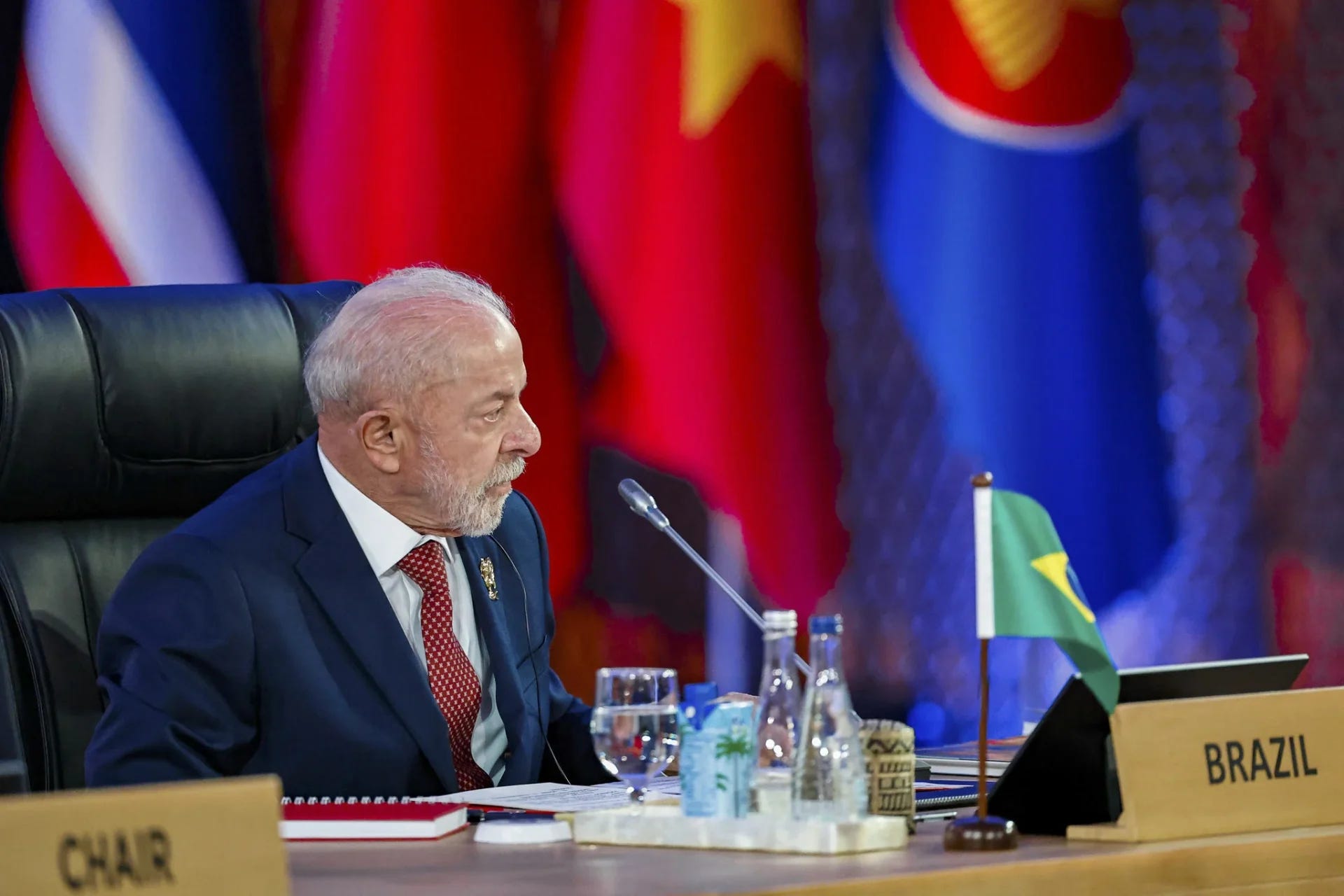
Lula at the 49th ASEAN Summit in Manila, Philippines (photo: Ricardo Stuckert)
“Instead of crying or begging the American government to take pity on Brazil, we decided to look for other partners to sell to and buy from,” he said.
Lula said that as a result of this policy, trade with the United States now makes up just 9.2% of Brazil’s total. “But while it fell with the United States, our trade grew nearly 20% with China, 15% with Indonesia, 15.8% with Germany and 13% with Vietnam. Across 50 countries, our trade grew an average of 10.5%. So the result is that we, who had a surplus of about $9.7 billion, now have a surplus of about $15.5 billion,” he said.
Lula and Trump had tried to arrange their schedules so the summit could host a meeting between the two. It did not happen.
Part of the strategy is also to close new trade deals. “We went out to prove that multilateralism works better than unilateralism. That policy led us to take action and work more closely with ASEAN, taking trade from $3 billion in 2003 to about $7.4 billion in 2026, which is small given the size of the potential,” he said.
Lula said he wants Brazil to be “permanent partners of ASEAN, so we can double our trade, in both sales and purchases, and not depend on a single country.”
On Sunday, Lula met with Canadian Prime Minister Mark Carney, who also took part in the summit. Carney pledged $400 million to the Tropical Forests Fund, which Brazil created, and committed “to work toward concluding a trade agreement between Mercosur and Canada in the coming months.”
“They agreed to hold bilateral visits in 2027, accompanied by large business delegations. The prime minister committed to visiting Brazil in the first quarter of next year,” a Brazilian government statement said.
Canada, like Brazil, has been trying to reduce its dependence on the American market.
Rare Earths
Lula also took another jab at Trump over rare earth minerals. The president said he has invited several governments to send missions to Brazil. “We are inviting every country in the world, without distinction, that wants to join us in the exploration, processing and industrialization of rare earths,” he said. But he was firm:
“I don’t want to sell the raw materials. I want to make the batteries in Brazil.”
In the negotiations, the Trump administration pushed for near exclusive access to Brazil’s rare earths and even set conditions on the country’s exports to other markets. Brazilian negotiators did not accept the terms of the proposal.
Earlier, in his official speech at the summit, Lula also laid out conditions for rare earth development in Brazil. “We are open to cooperation and investment in this sector, but we will not allow extraction without adding value on national territory,” he said.
Throughout the trip, Lula insisted that Brazil needs to make a “leap in quality” and stop being only a commodity exporter. “Brazil must leave the list of countries that are forever developing and become a developed country,” he said.
Attack on Big Tech
Earlier on Sunday, in his speech at the Association of Southeast Asian Nations summit, Lula criticized the power of large digital companies and called for states’ sovereignty to be protected against the advance of Big Tech.
Lula is courting the Asian market. For the second year in a row, he was invited to join the ASEAN meeting, held this time in the Philippines.
He used his speech to call for a regulatory response to a digital reality being imposed on governments. “Excessive concentration of technological power is a growing threat to our societies,” he said. “The designs of big technology companies cannot override the sovereignty of states and the rights of citizens,” he warned.
He noted that Indonesia, Malaysia and the Philippines have made progress in protecting minors online. “Brazil shares this concern and this year passed the Digital Statute for Children and Adolescents,” he said.
Defense of Multilateralism
In his speech, the president also asked governments to use “multilateralism as a compass,” a message aimed at Donald Trump and at countries betting on dismantling international bodies.
“Another front of this battle is defending the United Nations charter and its principles. ASEAN and Brazil share the conviction that a multipolar world, based on multilateralism, is more conducive to peace and prosperity,” he said.
“Citizens of the Global South pay the price for unfair tariffs and irresponsible vetoes. The wars in Ukraine and the Middle East affect every corner of the globe. The shock to energy and fertilizer prices is paralyzing industries in Asia, worsening food insecurity in Africa and pushing up the cost of living in Latin America,” he warned.
This article first appeared in ICL Notícias, was translated with express authorization by its editor, and can be read in its original Portuguese here.