


by Gésio Passos
On Thursday, November 19, President Luiz Inácio Lula da Silva signed a decree officially demarcating the Kapôt Nhĩnore Indigenous Territory.
The land is the birthplace of Chief Raoni Metuktire, who has long advocated internationally in defense of the forest and for the rights of Indigenous peoples.
The 894,521-acre territory is now officially recognized as the Mebêngôkre Kayapó people's land. It comes after decades of struggle.
The land is located between the states of Pará and Mato Grosso. Roughly 83% of the area still retains its original forest cover.
Lula signed the decree in the city of Peixoto de Azevedo, Mato Grosso, Brazil. Prior to the ceremony, he visited 94-year-old Chief Raoni, who is receiving palliative care due to cancer.
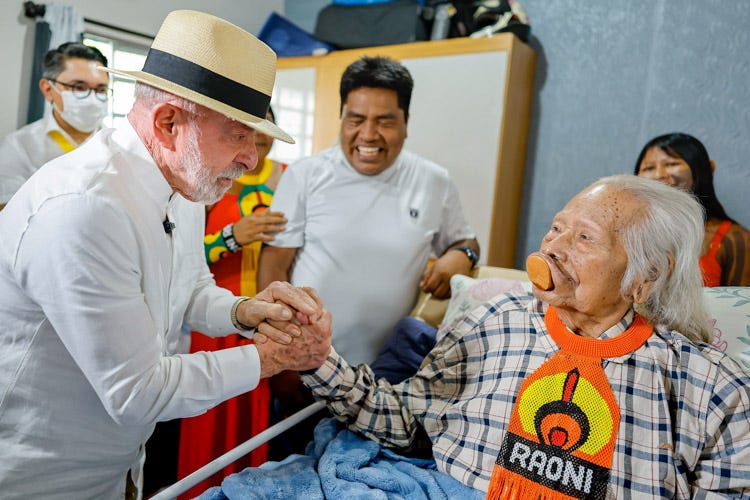
President Lula visits Chief Raoni, where he is receiving care. (Ricardo Stuckert/PR)
“I am very happy to have been able to come here and visit Chief Raoni,” Lula said. “I am aware of the severity of his illness, but I thank God for giving me the chance to speak with him while he is still alive, to tell him: ‘We are legalizing your land.’ This is something for which I thank God. Raoni is the Indigenous person alive today who best represents the Indigenous traditions of this country.”
Chief Megaron Txucarramãe, Raoni’s nephew, thanked the president for the demarcation of the territory.
“On behalf of all of us Indigenous people, and on behalf of my own people, the Mebêngôkre Kayapó, I would like to thank the president for visiting our uncle, Raoni,” he said. “He also brought news regarding the demarcation of the Kapôt Nhĩnore Indigenous Territory. Furthermore, President Lula and Chief Raoni are set to hand over a ferry, built at Piaraçu, to the Xingu Indigenous people. For all of this, I thank you, Mr. President.”
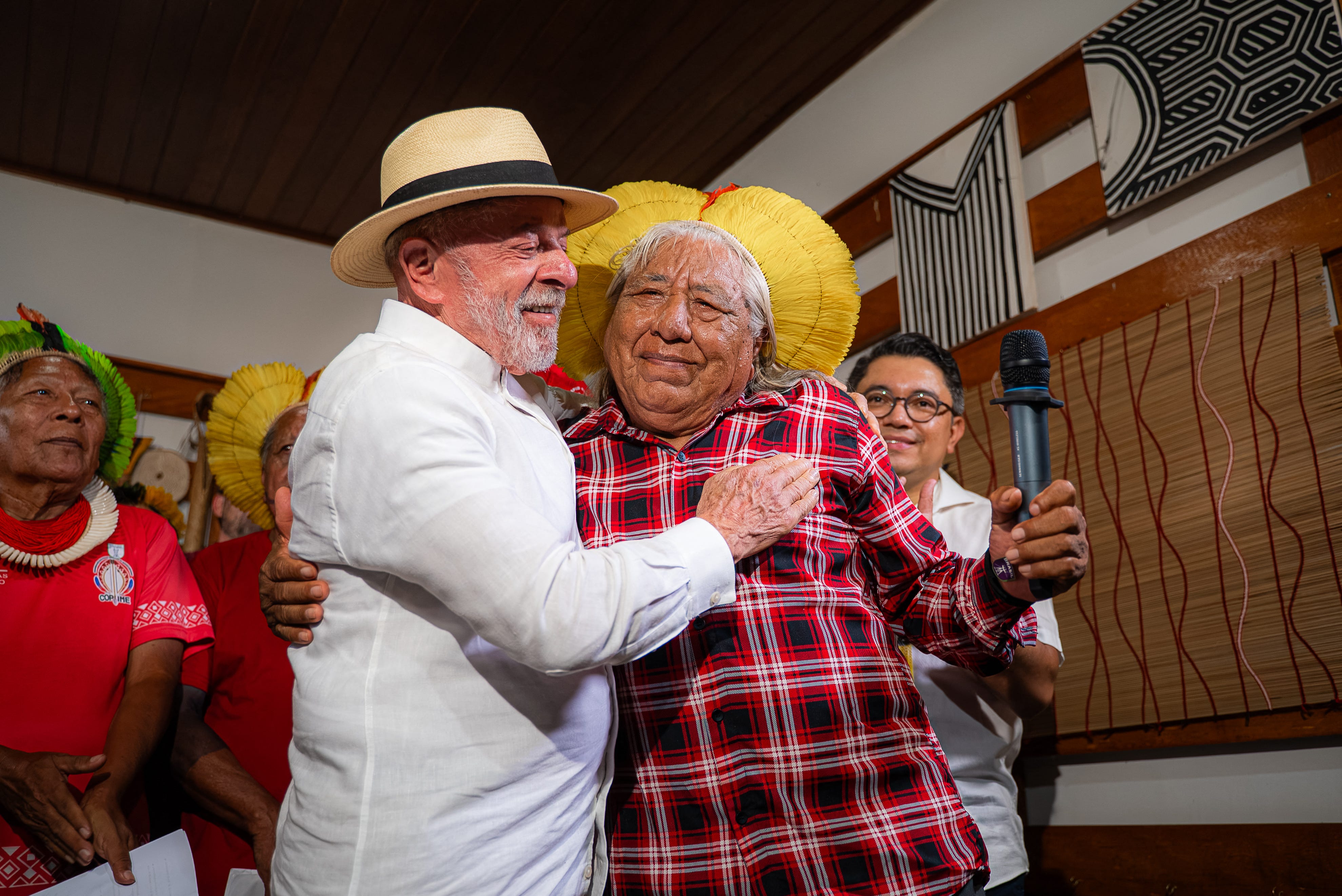
Brazilian President Luiz Inácio Lula da Silva embraces Chief Megaron Txucarramae, nephew of Indigenous leader Chief Raoni Metuktire, during the signing ceremony for the decree establishing the boundaries of the Kapot Nhinore Indigenous Territory on November 19, 2026. (Photo by Pablo SILVA / AFP via Getty Images)
Demarcation
The process of demarcating the Kapôt Nhĩnore Indigenous Territory resumed in 2012, following a court ruling against the federal government for delays in the recognition process. The approval of the territory faced several legal challenges. It was not until October 6 of this year that the Federal Court unanimously validated the legitimacy of all studies conducted by the National Indigenous People Foundation, Funai.
After Lula’s decree, there are still several steps in the demarcation process, including the physical demarcation of the area, a presidential ratification of the territory, official land registration, and the removal of non-Indigenous occupants.
The Minister of Indigenous Peoples, Eloy Terena, highlighted that with this declaration, the government has reached a milestone of protecting over 37 million acres of land over the last four years.
That is an area roughly the size of the U.S. state of Illinois.
“You were the first president in the history of this country who did not view us, Indigenous peoples, as wards of the state or legally incapable,” he said. “Instead, you had the courage to place the pen in the hands of Indigenous peoples, allowing us to define our own policies and implement public policies for Indigenous peoples. So, today, we are truly living out and realizing a dream held by our leaders.”
Chief Raoni
Chief Raoni is internationally recognized for his advocacy for the rights of Indigenous peoples.
Throughout his life, he has been nominated multiple times for the Nobel Peace Prize. The demarcation of the Kapôt Nhĩnore Indigenous Territory represents a victory for his people.
This article was originally published by Agencia Brasil. It was translated by Panamerican Dispatch. You can read the original, in Portuguese, here.
Good.
That's very good news 🙏♥️