


by Jose Reinaldo
Brazilian President Luiz Inácio Lula da Silva, of the Workers’ Party, said Sunday that he has never seen such an outpouring of support as in this campaign. He spoke to the press before heading to São Bernardo do Campo, in greater São Paulo, where he cast his vote at 9:30 AM.
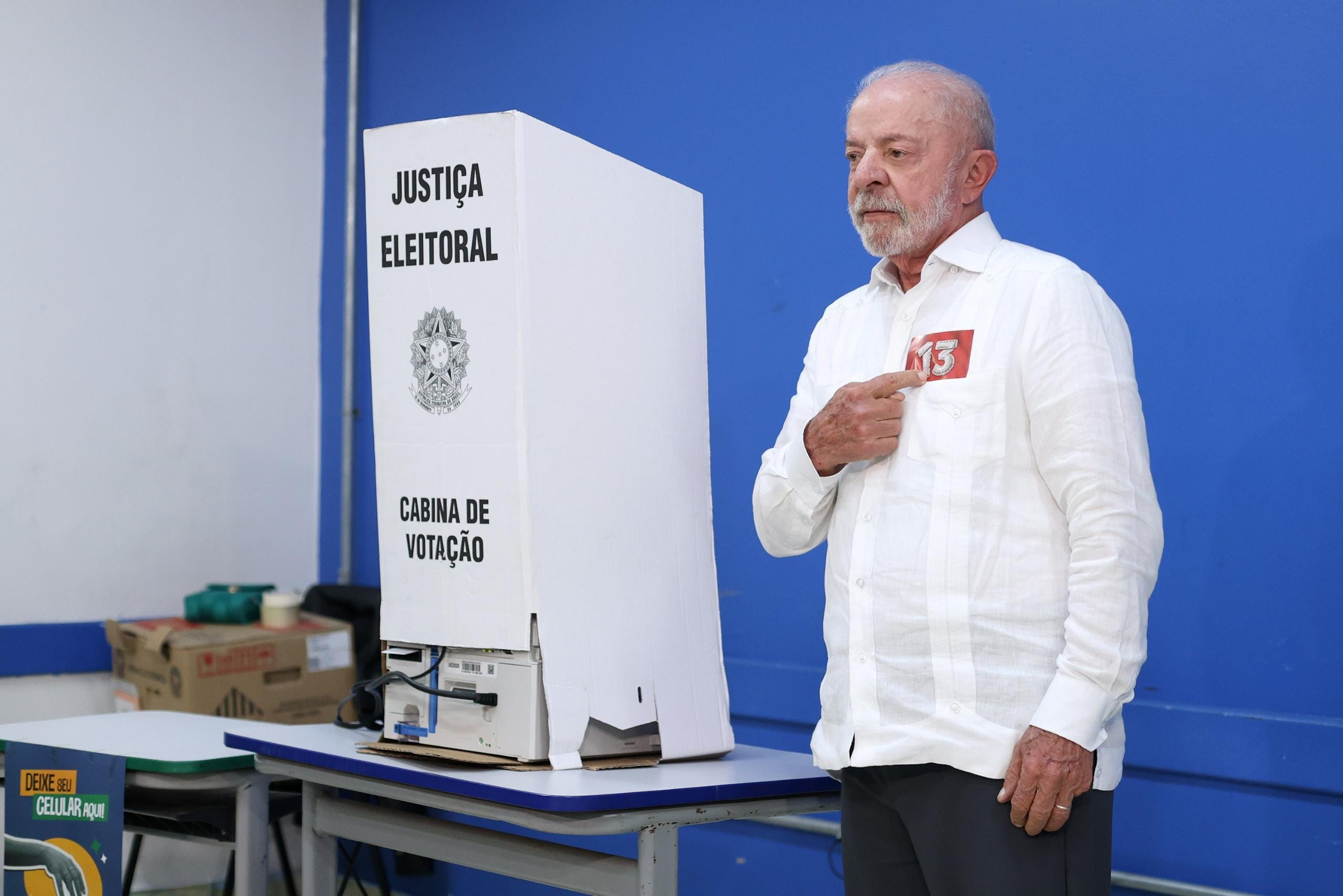
resident Lula cast his vote this morning in his home town, the industrial satellite city of S. Bernardo do Campo (Ricard Moreira: Getty)
Lula thanked voters for their show of support and called his opponent in the presidential race, Sen. Flávio Bolsonaro of the Liberal Party, a liar.
Lula, 80, drew on his long career to put the enthusiasm in perspective. He said that after five decades in politics, he is struck by the reception he has gotten on the streets.
“I’m 80 years old and have been in politics for 50 years. I took part in the 1989 campaign and in every presidential campaign since. Honestly, I have never seen anything like this,” he said.
He pointed to rallies in Bahia, Pernambuco, Maranhão, Pará and Minas Gerais, and to Saturday’s event on Avenida Paulista in São Paulo, which he said drew an exceptional crowd.
“I think Avenida Paulista has never had a crowd that big at a public event,” he said.
Emotional, Lula said he would head to the polls grateful for the welcome he has received during the campaign.
“I’m going to vote grateful. I can never repay what the Brazilian people have done for me these days. There has been so much generosity, so much affection, so much love. I will be forever grateful,” he said.
Lula then turned on Bolsonaro, accusing him of lying. “We are running against a man named Lie. He cannot tell the truth,” he said. “That is why I think the people will not elect a liar.”
Brazilians are voting this Sunday for their next president. Polls are open from 8 a.m. to 5 p.m. Brasília time.
Two polls released Saturday, by Quaest and Datafolha, showed the same result: 51% of valid votes for Bolsonaro and 49% for Lula. That gap is within the margin of error, a statistical tie.
The race went to a runoff after Bolsonaro finished the first round 1.87 percentage points ahead, with 47.03% of valid votes to Lula’s 45.16%, according to Superior Electoral Court data.
The result prompted Lula’s campaign to regroup. After the first round, Lula said it was the most disorganized campaign he had ever taken part in. He brought three political leaders from the Northeast into the national campaign leadership: Sen. Camilo Santana of Ceará state, Sen.-elect Rui Costa of Bahia state and Gov. Rafael Fonteles of Piauí state, who won reelection. All three belong to the Workers’ Party.
The campaign also changed its digital strategy. Lula met with influencers and newly elected lawmakers who are active on social media, including Rep.-elect Ana Elisa of Minas Gerais state, also of the Workers’ Party.
Lula had resisted using a cellphone and taking selfies. He has since begun recording selfie videos and sending voice messages to supporters. Another front is a WhatsApp channel called “Lula’s Army,” run by Rep. André Janones, of the Sustainability Network (REDE) party in Minas Gerais state. The channel has more than 10 million followers and assigns tasks to mobilize supporters online.
The campaign also touted the Senate’s approval of a proposed constitutional amendment that would end the 6×1 work schedule, under which employees work six days for every day off. The measure would guarantee two days of rest a week with no cut in pay. The government has also cut gasoline taxes, announced a package forgiving about $2.4 billion in tax debt owed by individual microentrepreneurs, and promised to expand the Pé-de-Meia (Nest Egg) student savings program to university students.
Lula, who won the presidency in 2002, 2006 and 2022, is seeking a fourth term. A win would put him at 16 years in office by the end of that term.
This article first ran in Brasil 247, has been translated by Panamerican Dispatch with express authorization from the editor-in-chief, and can be read in its original Portuguese here.