


by Rodrigo Vianna
On Sunday, Lula drew the largest progressive demonstration São Paulo has seen since the Diretas Já movement, all the way back in 1985. Not even the rallies of his unforgettable 1989 presidential campaign, nor the resistance marches against the 2016 coup that ousted Dilma Rousseff, brought out this many people. I know, because I covered all of them, both as a journalist and as a citizen.
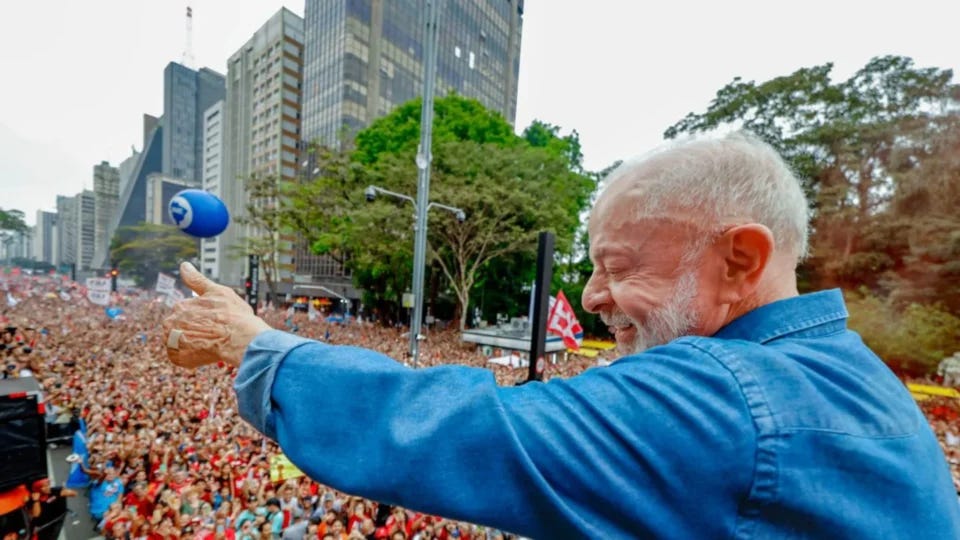
Organizers went as far as claiming 1 million people showed up on Paulista Avenue. That’s certainly an exaggeration. Toward the end of this piece, I’ll offer a more realistic estimate. What matters most is that young people came back out into the streets. This runoff’s largest demonstration marked a generational handoff. Older people like me got to watch our own children join us on the avenue, defending not just Lula’s candidacy, but the idea of a democratic country with social programs built to reduce our historic inequality.
After this resounding Sunday in São Paulo, the real question isn’t exactly how many people showed up on Paulista Avenue. It’s answering two other questions:
Can the “Lula wave” in this runoff, initially driven by students and then amplified in the streets of São Paulo, Rio, Recife and dozens of other cities, actually translate into a real shift in votes on October 25?
And what’s the best strategy to turn the race around in just two weeks?
Yes, Lula can still win, even though Flávio remains the favorite. The Liberal Party candidate, for that matter, has gotten ahead of himself. He’s already negotiating names for his future cabinet. He sat in the chair before winning it, a serious mistake that could end up demobilizing his own base.
On Lula’s side, the best path to closing the 2.2 million vote gap is, in my view, concentrating efforts in the territories where the president is already strong. There’s no time left to change the game in the country’s interior, where Flávio built his advantage, especially in areas dominated by agribusiness and evangelical ultraconservatism.
Lula needs to widen his margin in the Northeast, in the city of São Paulo, and in northern Minas Gerais.
In the Northeast, Lula led by just over 11 million votes in the first round. He needs to expand that margin to more than 12 million, relying especially on the Workers’ Party’s vote getting machine in Bahia and Ceará. He needs to make clear the risks of a bolsonarista government, which would likely cut back social programs essential to the Northeast’s development.
Sunday’s spectacular turnout on Paulista Avenue suggests it’s also possible to grow Lula’s margin in the city of São Paulo and its metropolitan area, where the Workers’ Party and its allies have strong grassroots organizing and powerful legislative representation. Lula won the city of São Paulo by 300,000 votes in the first round. He needs to open up a lead of at least 700,000 in the runoff.
Education, including defending universities and the national network of federal technical institutes, is key to widening Lula’s lead in Northeastern state capitals and narrowing Flávio’s margin in mid sized cities across the Southeast, South, North and Midwest.
Ending the 6 day work week meanwhile, resonates across the entire country, but it’s a particularly powerful driver for the campaign in São Paulo and its metropolitan region. If Lula widens his margins in the Northeast and in the city of São Paulo, he would close more than half of the 2.2 million vote gap Flávio opened up in the first round.
The rest would have to come from Minas Gerais, and that’s where things get difficult: the Workers’ Party simply lacks a strong political machine there. That looks like a dangerous Achilles’ heel. Religion might make a difference here, since Minas is Brazil’s most Catholic state outside the Northeast.
Lula can also count on another factor that’s gotten less attention: with most states no longer holding runoffs for governor, the influence of conservative political machines is somewhat reduced. The alliance between small town mayors and right wing lawmakers, long greased by secret budget earmarks, will carry less weight now that the congressional races are already settled. It’s no coincidence that Flávio met with mayors this Sunday to ask for help mobilizing voters in the runoff. He knows abstention could rise among his own supporters, not the ideologically committed bolsonaristas, but conservative voters less active on social media who were mobilized through old school pork barrel politics.
With the secret earmark machine running at a slower pace, it’s entirely reasonable to expect Flávio’s advantage over Lula to shrink somewhat in the Midwest, the North and even the South.
Below are the numbers behind the gains Lula needs, and can realistically achieve, to win the runoff, broken down region by region. The first figure is the actual margin the winning candidate secured in each region, based on the first round results from the Superior Electoral Court. The second figure shows how much that margin would need to grow, in the Northeast, or shrink everywhere else, for Lula to pull off a historic comeback.
Northeast: Lula’s margin needs to grow
+11,095,611 (first round)
+12,200,000 (runoff target)
Southeast: Flávio’s margin needs to shrink
+5,662,211 (first round)
+4,800,000 (runoff target)
South: Flávio’s margin needs to shrink
+5,042,624 (first round)
+4,900,000 (runoff target)
Center-West: Flávio’s margin needs to shrink
+2,170,393 (first round)
+2,000,000 (runoff target)
North: Flávio’s margin needs to shrink
+458,835 (first round)
+400,000 (runoff target)
In simpler terms: Lula would need to increase his margin by around 10%, about 1.1 million additional votes, in the Northeast. He would need to cut Flávio’s margin by around 15%, about 800,000 votes, in the Southeast, focusing on greater São Paulo and northern Minas Gerais. And he would also need to narrow the gap in the Midwest, South and North, counting on the secret earmark machine being less active in the runoff.
If Lula manages to pull off these shifts among voters, he could win by a razor thin margin, under 200,000 votes.
This isn’t a simple operation. But if anyone in Brazil has what it takes to pull off a comeback like this, it’s Lula. What matters is that this comeback is genuinely possible. The votes are there to be won, as long as the mobilization we saw in the runoff’s first week, in the streets and online, is sustained or expanded.
How Many People Were on Paulista Avenue?
For my estimate of how many people gathered on Paulista Avenue on October 11, I worked from the area the crowd actually covered. Seven full blocks of Paulista Avenue, between Haddock Lobo and Pamplona streets, were completely packed. That’s 1,200 meters long by 47 meters wide, or 56,400 square meters of densely occupied space. At six people per square meter, that comes to about 338,000 people in the most crowded section.
The two ends of the avenue, toward Consolação Street and the Paraíso neighborhood, were also crowded, though less densely. Estimating 1,500 meters of length across both ends, at 47 meters wide, that’s 70,500 square meters. At two people per square meter, rather than six, in these less crowded sections, that adds roughly another 141,000 people.
Based on this, my estimate is that somewhere between 450,000 and 500,000 people gathered for this pro-Lula, pro-democracy demonstration. As I said, it was the largest progressive demonstration in São Paulo since the Diretas Já movement. The equivalent of 10 full Corinthians stadiums took to the streets to push Lula forward and block the return of an extremist government that would gut education, health care and social programs, and hand Brazil over to Donald Trump.
This article originally appeared in ICL Notícias, was translated by Panamerican Dispatch under its express permission and can be read in its original Portuguese here.