


By Emir Sader
The Workers’ Party is not rising to meet today’s advances and challenges. The major advances are due to Lula’s leadership. But the party itself has not matched them with its own participation, apart from a few leaders, particularly governors in the Northeast.
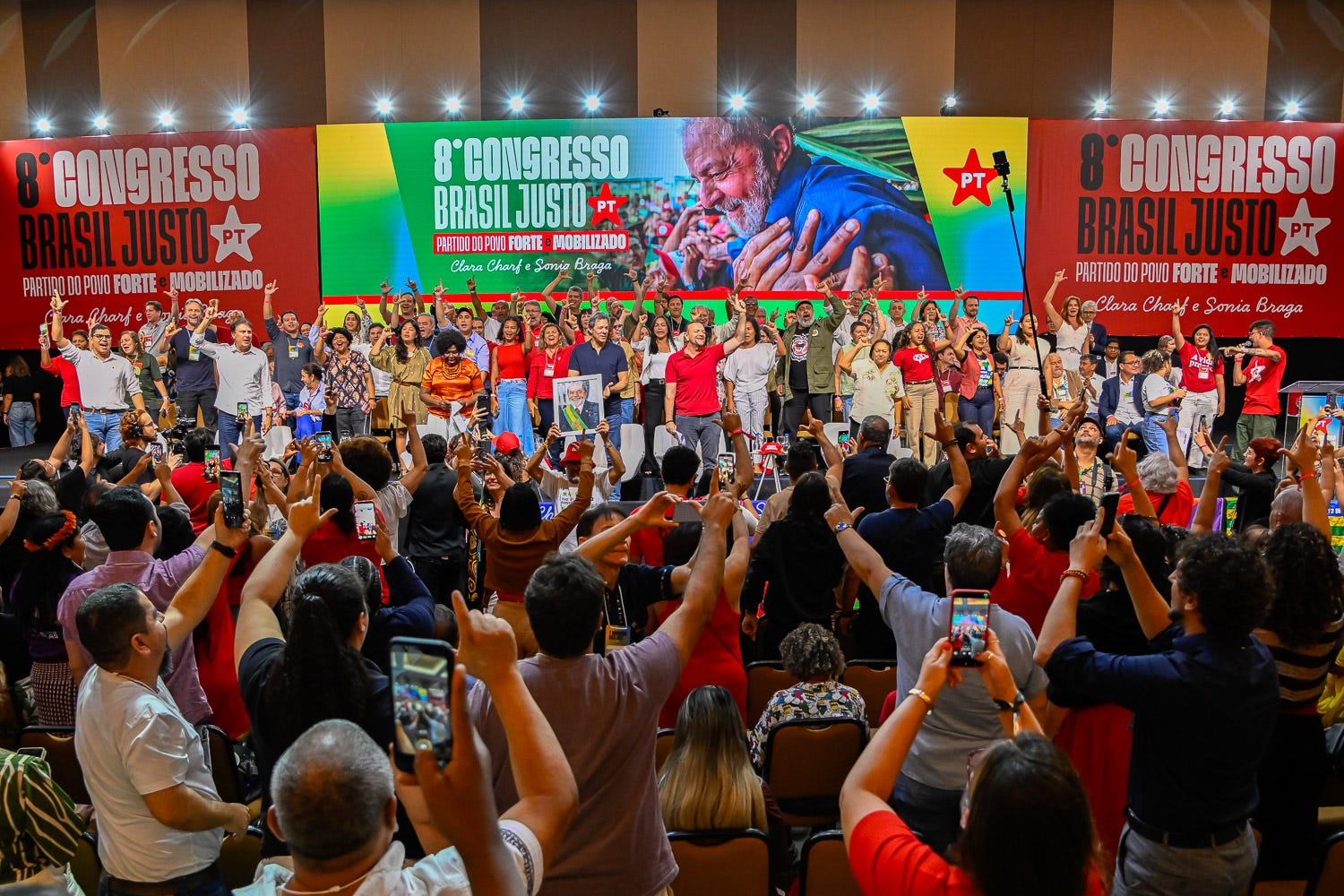
The Workers’ Party’s 8th National Congress, in April, 2026 (Photo: Workers’ Party)
The biggest news in this election was the emergence of new generations of party members. Lula was forced to remove the leadership of his campaign, which was part of the reason the first round election results fell short. It was a bureaucratic committee made up of representatives of the party’s elected bodies which left out essential strategists including Zé Dirceu.
Still, the rise of young leaders like Congresswoman-elect Ana Elisa shows the vitality of the new youth movement. That movement was fundamentally responsible for the turnaround that won Lula the election. Young activists like Ana Elisa drew Lula’s attention to the central role of the fight against inequality on social media. These types of actions, with an important contribution from Andre Janones with his “Lula’s Army” Whatsapp group, helped make the turnaround possible. Together, it amounted to a true Democratic Revolution in Brazil.
Now this process must reach the party itself. The party cannot stay on the sidelines of this enormous democratization of Brazil. It should call a major assembly . The event should include an analysis of the new world of the 21st century and of the Democratic Revolution in Brazil. It should also take up the new way of governing the country that Lula has announced, with direct participation from young people. And it should call for a radical renewal of the party, so that it rises to the challenges and the fundamental circumstances Brazil is living through.
Lula will have a new term of four years. He will probably be able to name his successor again, especially given his opponent’s defeat and shameful flight. We have a historic chance to govern Brazil for a fairly long period. But we have no project for Brazil’s future. What kind of Brazil do we want? What kind of state? What kind of society? What kind of culture? We cannot waste this historic opportunity.
The left, Brazil’s democratic movement, youth movements, women’s movements, older adults, the Workers’ Party, the Unified Workers’ Central (CUT), the Landless Rural Workers’ Movement (MST) and all social movements must meet the challenge. They must also meet favorable global circumstances, which include the decline of American hegemony, the rise of the BRICS and Lula’s own global leadership, among the new factors of this century.
Author of 35 books and founding organizer of the World Social Forum, Emir Sader is one of Brazil’s most prominent Marxist sociologists.
This opinion piece, which does not necessarily reflect the editorial opinion of Panamerican Dispatch, first appeared in Brasil 247, was translated with express authorization from the editor-in-chief by Panamerican Dispatch, and can be read in its original Portuguese here.