


by Natalia Fingermann and Rafael Ioris
Following the results of the first round of the 2026 elections, most journalists commented on the errors in Lula’s campaign, while numerous influencers proposed better strategies for amplifying the voice of the left on social media. Although these points are significant and should be taken into account by the Workers’ Party campaign team (supporting the candidacy of President Luiz Inácio Lula da Silva), they overlook the fact that the elections took place within an environment of institutional abnormality. This is because, for the first time since the end of the Cold War, the United States has an explicit strategy to interfere in Latin American elections, based on the “Donroe Doctrine.”
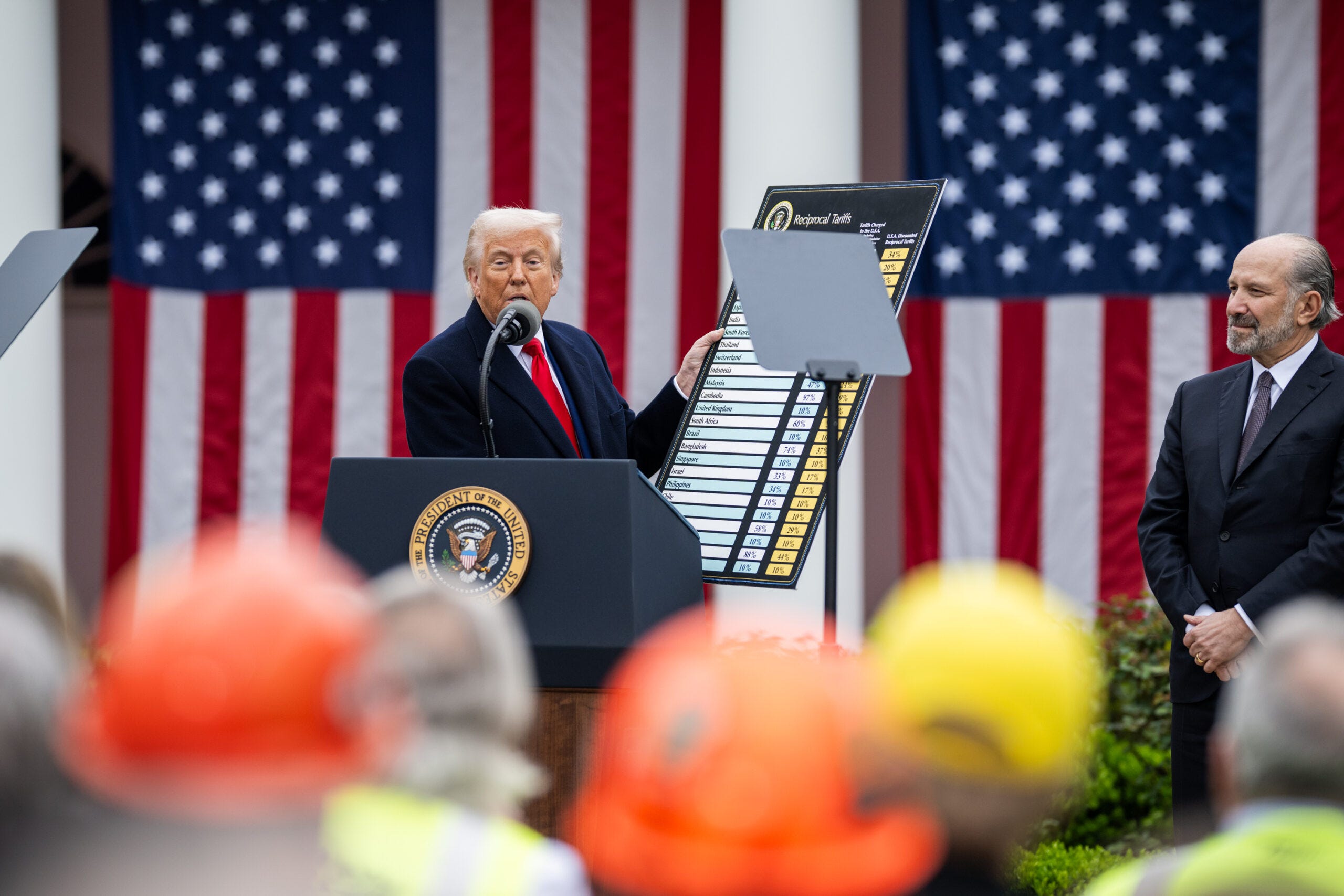
President Trump announcing new tariffs at the White House. (The White House/Wikimedia Commons)
This approach to foreign policy is rooted in tactics commonly employed in “hybrid warfare” schemes. The first tactic is the most visible, utilizing various forms of coercion, often to divert attention from what is actually occurring. The second is less conspicuous, relying on intermediate channels to disseminate disinformation. The third tactic is nearly invisible, targeting disinformation specifically at individuals susceptible to changing their behavior at the ballot box. Today, that process largely takes place through digital means.
1 - Explicit Pressure
The first tactic was most clearly demonstrated with the imposition of new customs tariffs in July, 2025, as a form of retaliation for the conviction of Jair Bolsonaro for attempting a coup d’état. According to the narrative the United States sought to impose, the “government of Brazil has unfairly accused Bolsonaro of multiple crimes related to the second round of the 2022 elections, and the Supreme Court of Brazil has erroneously decided that he should stand trial on baseless criminal charges.”
It didn’t turn out the way the White House expected; the Lula administration managed to counter the narrative domestically, demonstrating that the United States was infringing upon Brazilian sovereignty. Consequently, the State Department was forced to rethink its strategy and develop new tactics along the same lines, shifting from the economic to the political sphere, with an explicit focus on the Supreme Court, notably through the application of the Magnitsky Act against Justice Alexandre de Moraes.
Subsequently, the Donald Trump administration intensified this line of attack when the State Department designated criminal organizations, such as the PCC and the Comando Vermelho, as terrorist groups capable of threatening the United States. This move was arguably more astute, as it did not openly challenge economic policy or question the autonomy of the national judiciary. Furthermore, it resonated directly with the Brazilian public, who view violence and public security as the country’s most pressing problem. Although not explicitly stated, this decision signaled support for Flávio Bolsonaro’s campaign, with the implication that the White House stood ready to assist a potential administration led by him in combating crime in Brazil, and in that way, masking what was, in reality, a clear instance of external interference.
In addition, the United States has targeted Brazil’s primary payment processor, Pix—launched by the Central Bank of Brazil in 2020. Since then, Pix has become the most popular payment method in the country, surpassing even cash. The U.S. government alleges that Pix is involved in unfair business practices, arguing that U.S. payment processors are suffering financial losses due to the platform’s popularity.
More recently, the U.S. State Department reinforced the narrative of an unchecked terrorist threat in Brazil by deciding to close its embassy and consulates on the eve of the first round of elections. This move, which lacked any basis in reality, received support from Australia and sowed psychological terror, fueling speculation that the United States might sever ties should Lula be re-elected. While unprecedented, such a development, however dramatic, would echo the revocation of the visa held by the Brazilian ambassador in Washington, Maria Luiza Viotti, in August, 2026. In short, the United States currently appears prepared to employ various measures to ensure that a government aligned with its interests in Latin America is elected in Brazil.
2 - Actions with a Lower Degree of Visibility
The second tactic the United States has employed to impose its interests in Brazilian elections is less visible, operating through indirect channels, specifically, the funding of non-governmental organizations aimed at destabilizing the country. This approach involves two notable instances, as recently detailed by the Brazilian newspaper Folha de S.Paulo and the British newspaper The Guardian.
The first report concerns the allocation of financial resources to the conservative NGO “Rockbridge Network,” co-founded by Vice President JD Vance and businessman Chris Buskirk. According to the report, Rockbridge’s mission was to establish operations in Brazil to train far-right youth leaders, develop media outlets, and influence legislative activity. The second report addresses another classic case of hybrid warfare: the channeling of funds to an unidentified organization tasked with destabilizing the Supreme Court. While precise details remain scarce, it is known that the “Banco Master” scandal was directed against key members of the Supreme Court during the election month of September, effectively diverting attention away from any potential involvement by Flávio Bolsonaro in what was the country’s largest corruption case.
The policy of institutional destabilization targeting the Supreme Court proved effective, even though the process was abruptly halted once it began to directly implicate Bolsonaro’s allies, individuals who currently hold the positions of president and vice-president of the Superior Electoral Court: Kassio Nunes and André Mendonça. Following this period of political attrition, internal criticism within the Court regarding changes to polling station locations during the first and second rounds of voting, as well as the sluggish response to the spread of “fake news,” was effectively silenced. This even led to a softening in the stance of Justice Alexandre de Moraes, whose own family had been directly implicated in the scandal.
3 - The Invisible, Predictable, and Effective Tactic of Algorithms
The third and final tactic involves the targeted dissemination of fake news, specifically crafted for user profiles identified by algorithms, aimed at swaying individuals who are undecided about which candidate to support, or even whether to show up to vote on election day. Following the unjustified suspension of accounts belonging to left-leaning media outlets and influencers, the temporary blocking of President Lula’s and his allies’ pages, the removal of truthful posts, and the use of “shadowbanning,” which reduces the visibility of an account or post without clearly notifying the user, the Meta platform was reported to the Organization of American States by the Lula campaign following the first round of the election.
Reports by the Brazilian news organization Agência Pública highlighted several instances where Meta imposed blocks without any legitimate justification. They also revealed that a significant number of advertisements were paid for to Meta in U.S. dollars, a practice that violates Brazilian electoral regulations. Another article, published by the BBC, detailed how a Ugandan children’s dance group, “Hypers Kids Africa,” which had performed during the World Cup, promoted the Bolsonaro campaign in exchange for 120 million “$B22” tokens, digital assets that can be transferred and exchanged for cash, without the group having any understanding of what this actually entailed.
Finally, media reports revealed that Meta’s artificial intelligence was trained to generate campaign materials for Flávio Bolsonaro, while refusing to perform the same tasks for President Lula’s campaign. An analysis published by Agência Pública, based on research by the NGO CTRL+Z, points to a significant boost for Flávio Bolsonaro’s campaign, which saw a higher number of followers and substantially greater engagement than Lula’s campaign in the lead-up to the election. In the same vein, as reported by the website Panamerican Dispatch, at least 1,069 advertisements mentioning either incumbent President Luiz Inácio Lula da Silva or his opponent, Flávio Bolsonaro, were paid for in U.S. dollars across Facebook, Instagram, and Threads. Data from Meta’s Ad Library, analyzed by journalist Aline Melo of Agência Pública, reveal that these ads cost at least US$ 120,800. Furthermore, according to the same source, cryptocurrency was offered to users who shared social media content encouraging votes for presidential candidate Flávio Bolsonaro.
The initiative is called “B22,” a reference to the senator’s surname and his ballot number. According to the website, the digital currency is distributed to individuals who promote the project on social media. Some of the promotional content includes videos that explicitly link the purchase or sharing of the token to supporting Flávio Bolsonaro at the polls.
Finally, it is worth noting—even though the focus of this article is on United States interference—that Flávio Bolsonaro’s campaign, clearly drawing inspiration from the actions of U.S.-based actors, launched a clandestine operation to map voters, create fake accounts, and spread falsehoods, in collaboration with a company that sells AI-driven systems designed to manipulate elections abroad.
There has never been a hegemonic power that lacked sophisticated methods for imposing its will across the globe. Even as it faces an accelerating crisis, U.S. hegemony continues to employ an increasingly diverse array of tools, ranging from economic coercion and political influence to digital manipulation, to maintain its spheres of influence. Nowhere in the world is this more evident than in Latin America, both from a historical perspective and in the present day, as seen in the revival of a foreign policy modeled after the Monroe Doctrine. This is why the election this coming weekend is so significant and dramatic. More than just a contest between two political agendas, it serves as a test of Brazilian sovereignty and the capacity of our democracy to withstand pressure from a foreign power. Ultimately, what is at stake is not only the preservation of our democracy, but also the limits of U.S. interference in the future of Latin America, and, by extension, the entire Global South.
Natalia Fingermann is a professor of International Relations at ESPM-São Paulo.
Rafael Ioris is a professor of Latin American History at the University of Denver.
This article first ran in Le Monde Diplomatique. It has been translated by Panamerican Dispatch with authorization, and can be read in its original Portuguese here.