


by Nina Lemos
“Lula’s victory gives us hope and shows that it is possible to defeat the far right!” This celebratory post was shared on social media by the leftist German party Die Linke on Monday, October 26th, immediately following the Brazilian elections.
Brazil was still reveling in what was perhaps the most significant democratic celebration in recent memory.
The German party was not alone.
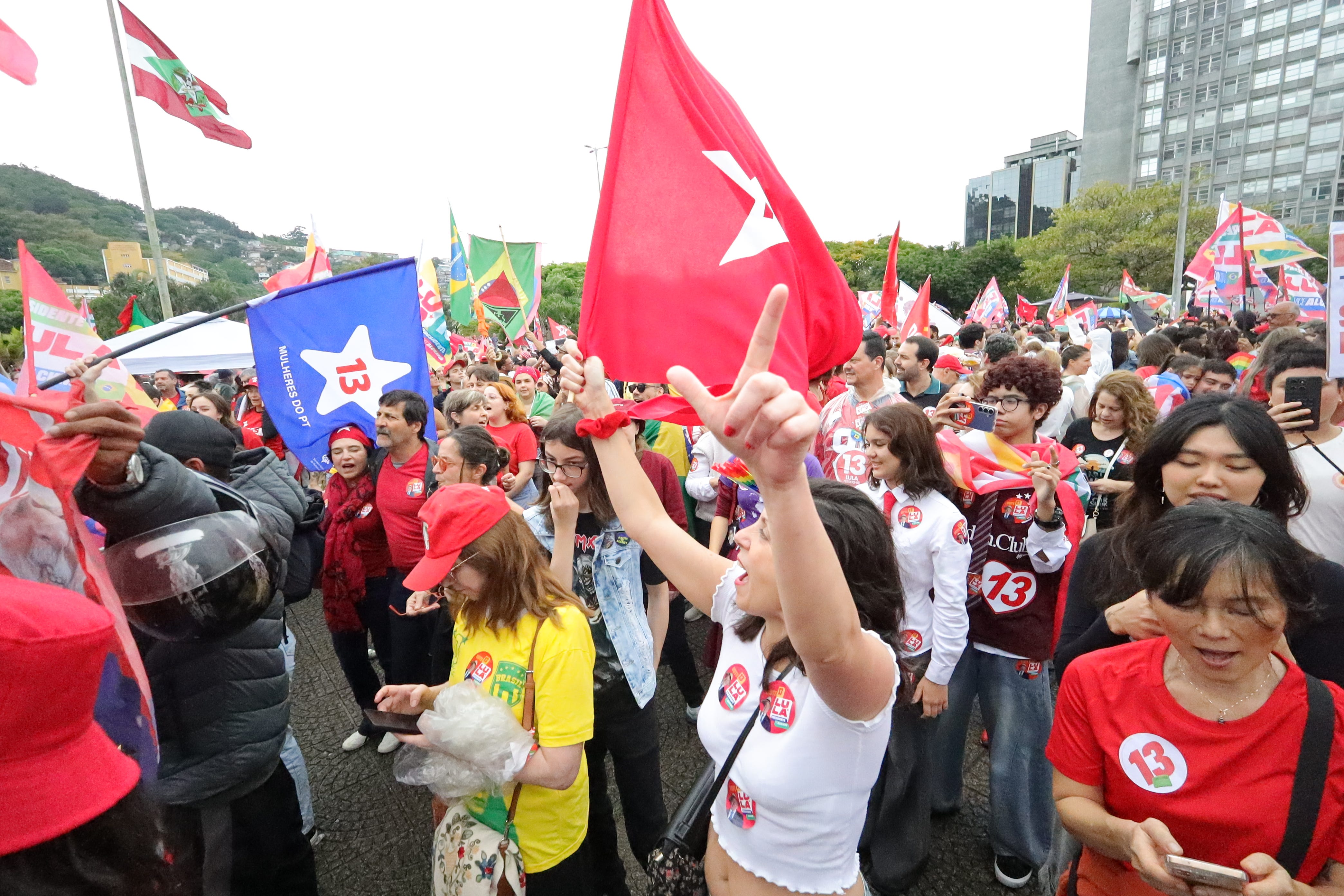
A woman holds up her hand in the shape of an "L”, during a rally for Lula in Florianopolis, Brazil, the day before the country's October 25, 2026 election (Michael Fox)
Lula’s historic win and defeat of the far right, represented by the Bolsonaro family, were celebrated by leftist parties and progressive media across the globe. Those of us living outside of Brazil even received congratulations from friends and colleagues.
For the moment, Brazil has emerged as a kind of global anti-fascist hero.
“Brasilien bleibt stabil” (“Brazil remains firm”), declared Taz, Germany’s leading leftist newspaper, invoking a slogan from the anti-fascist movement to honor this act of resistance.
“Brazil resists!” proclaimed the Catalan newspaper El Punt Avui on its front page.
There has been such an outpouring of positive sentiment from the press, politicians, and leftist activists that it would be impossible to list them all in this column.
The celebrations have also spilled into the public sphere. The “make an L” gesture, referencing Lula, has become a global symbol of progressive resistance. Among the first to adopt it was former Barcelona mayor Ada Colau, who encouraged a crowd at a rally in Madrid to form an “L” for Lula. The gesture has also been embraced by Mexican President Claudia Sheinbaum.
In a video shared on social media, French students, supporters of socialist Jean-Luc Mélenchon, a presidential candidate currently rising in the polls for next year’s election, can be seen forming an “L” with their hands, followed by an “M” for Mélenchon.
The demonstrations that brought thousands of people together across the country, the strength shown by students, and images of elderly individuals with mobility issues heading to the polls made headlines globally, leaving a lasting impression on everyone.
Yet, beyond Lula, another figure has generated quite a buzz: federal deputy André Janones.
As the creator of the “Lula’s Army” (Exército do Lula) WhatsApp group, he played a pivotal role in the left’s victory on social media, a space previously dominated, by a wide margin, by the far-right.
How did they pull it off? The press and various activists are now trying to uncover this formula, and WhatsApp groups modeled after “Lula’s Army” are beginning to emerge elsewhere in the world, with similar groups already appearing in Spain, France, Argentina, and Colombia.
Is this merely a fleeting burst of excitement? Perhaps. But it is undeniable that Brazil currently serves as a clear example that defeating the far-right is possible, a realization that prompts others to think: “If they can do it, so can I.”
International Solidarity on X
One of the most compelling developments, reflecting both the admiration of foreigners and the enthusiasm of Brazilians, is unfolding on X (formerly Twitter). There, ordinary young Brazilians are sharing the strategies they learned during the three-week interval between the first and second rounds of the election with progressive counterparts in France, Spain, Argentina, and even Japan.
Foreign observers are incredibly energized by the “Brazilian case study” and are eager to grasp the tips offered by their successful counterparts.
“Folks, let’s follow the Brazilians’ lead. We must stop engaging with far-right posts; let’s block these accounts and never interact with them,” wrote a young anti-fascist French activist on the platform.
Full of enthusiasm, some Brazilians are now reaching out to assist other nations. That includes Spain, where they are also working to counter the far-right.
“Folks, let’s help the Spaniards; they need to defeat the far-right,” wrote one young person. “They’ve set up a WhatsApp group, but for now, there are only 20,000 people in it. Let’s help out!”
“Hey, ‘Lula’s Army,’ are we supposed to be working for Mélenchon, Sánchez, or both?” asked another.
Spain’s Pedro Sánchez is seeking reelection in the country’s general elections this November. His campaign is feeling energized.
“We’re going to do what Lula did in Brazil,” Sánchez said at a rally following Lula’s election. “The world is watching us. If Brazil can do it, so can we.”
Will Brazilians, drawing on their own successful experience, be able to help the world break free from the far-right wave sweeping the planet? We don’t know. It’s an incredibly difficult task. But that’s not what matters most. What truly matters is that we’ve shown, through our own example, that it is possible when society organizes, works earnestly, sets aside political differences, and genuinely unites against the far-right.
Hopefully, this victory for civil society, and the success it has garnered around the world, will also help put an end to our”stray-dog complex”. Brazilians have long felt a deep-seated sense of national inferiority. For years, we’ve told ourselves that we are too complacent. That we “don’t take to the streets to fight for our rights.” Instead, we hold up the French, for instance, as the “cool” ones because they are always out there protesting.
Now, the exact opposite is happening, and we should, in fact, be proud. We have shown that it is possible to resist fascism in a distinctly “Brazilian” way. The world is applauding and calling for an encore.
Nina Lemos is a journalist and writer. She lives in Berlin. This article initially ran in ICL Notícias. It has been translated by Panamerican Dispatch. You can read it in its original Portuguese here.