


By Raony Salvador
Flávio Bolsonaro chose one of Rio de Janeiro’s most contested criminal territories to close out his campaign in the city. On Saturday, his motorcade traveled roughly 11 kilometers between Campo Grande and Bangu, an area where drug trafficking factions, militias and networks tied to the illegal gambling game known as jogo do bicho operate.
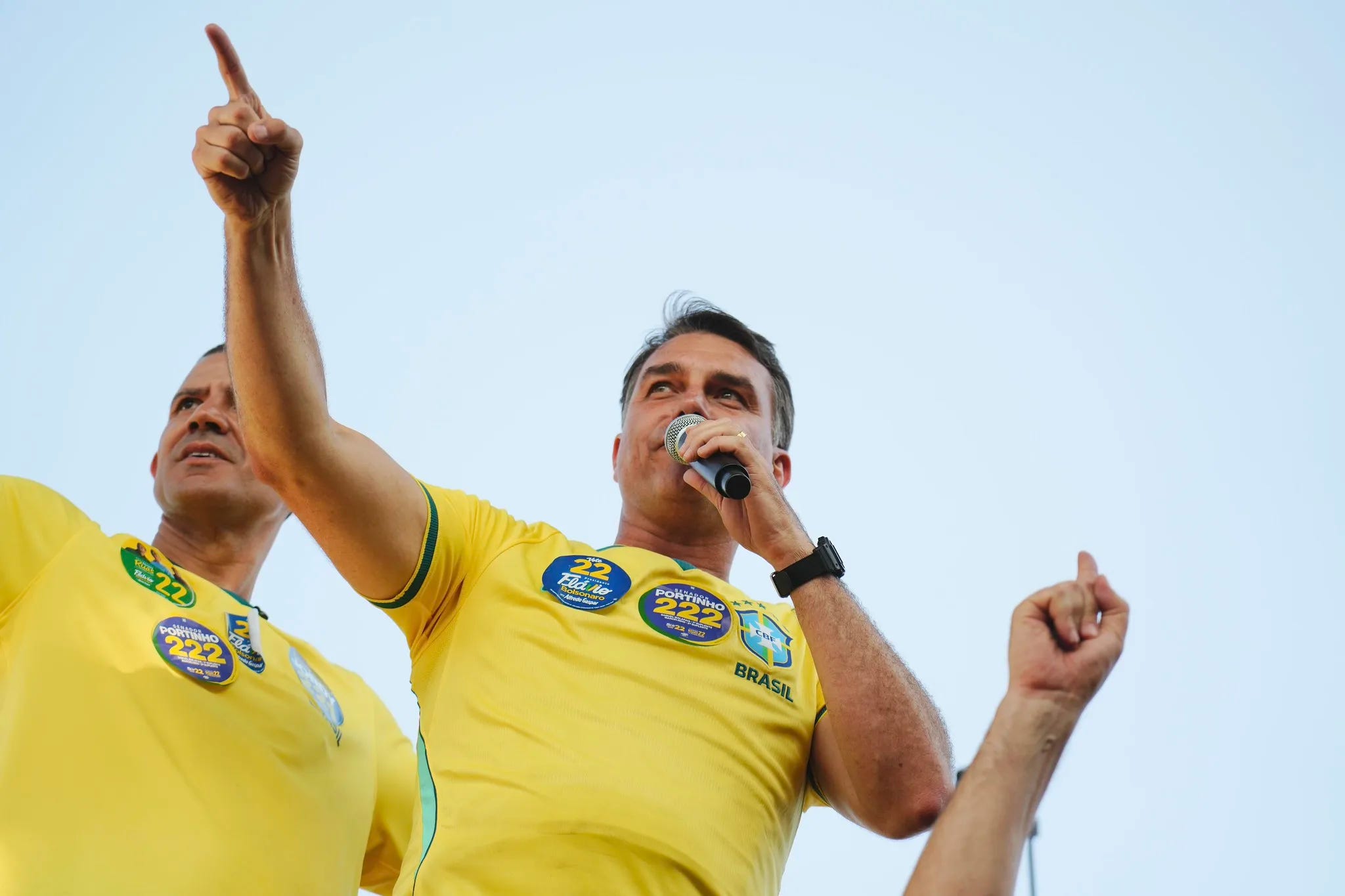
Flávio Bolsonaro on last day of campaigning (photo: Flávio Bolsonaro campaign)
Campo Grande has been at the center of a territorial war between militia groups and CV for years. According to investigations and researchers cited by the news outlet UOL, the CV has been trying to push into areas once controlled by paramilitary militias, while some militia have formed alliances with the TCP to hold off that expansion.
The area’s criminal map also includes the ADA, which has long operated in the neighborhood of Padre Miguel, along with a longstanding jogo do bicho (”animals game”/illegal gambling) operation.
Bangu is one of the main territories tied to the organization run by Rogério de Andrade, nephew of Castor de Andrade and one of the central figures in Rio’s illegal gambling world. In March, Rio’s State Prosecutor’s Office ordered the arrest of police officers accused of belonging to de Andrade’s security team and protecting illegal gambling spots in the area.
Another operation in May investigated money laundering linked to jogo do bicho and carried out warrants in Bangu and Campo Grande as well. De Andrade remains in a federal prison.
It was in this territory that Flávio held his final Rio de Janeiro campaign event before the vote. During the campaign, he promised to classify gangs and militias as terrorist organizations, following a policy adopted by the Trump administration in the United States.
The area also carries real electoral weight for the Bolsonaro movement. Jair Bolsonaro beat Lula in both Campo Grande and Bangu in the 2022 presidential election, and his son’s campaign is trying to hold onto those voters.
Flávio ended the route at Praça da Fé without giving a speech. After he left, the event continued with allies and supporters.
This article original ran in Revista Forum, was translated by Panamerican Dispatch, and can be read in its original Portuguese here.