


by Cleber Lourenço
The Bolsa Familia, or the “family purse” translated literally, is one of President Luiz Inacio Lula da Silva’s signature social welfare programs. It dates back to 2003, his first year in office, when low-income families began receiving cash transfers in exchange for ensuring their children were going to school and getting vaccinated, among other requirements. This has now become a story, because far-right candidate Flávio Bolsonaro has claimed to embrace the program ahead of the election. Meanwhile, old deleted posts by Flávio Bolsonaro show what he has really thought of the program in the past. -PD
Old posts by Senator Flávio Bolsonaro attacking the Bolsa Família program and other social welfare initiatives have been deleted from his social media accounts. The deletions were reported Monday, October 19, six days before the presidential runoff. In these posts, Bolsonaro tried to link the cash transfer program to vote-buying, accused the Workers’ Party of keeping families in poverty to secure electoral support, and advocated for a two-year limit on receiving state-level benefits.
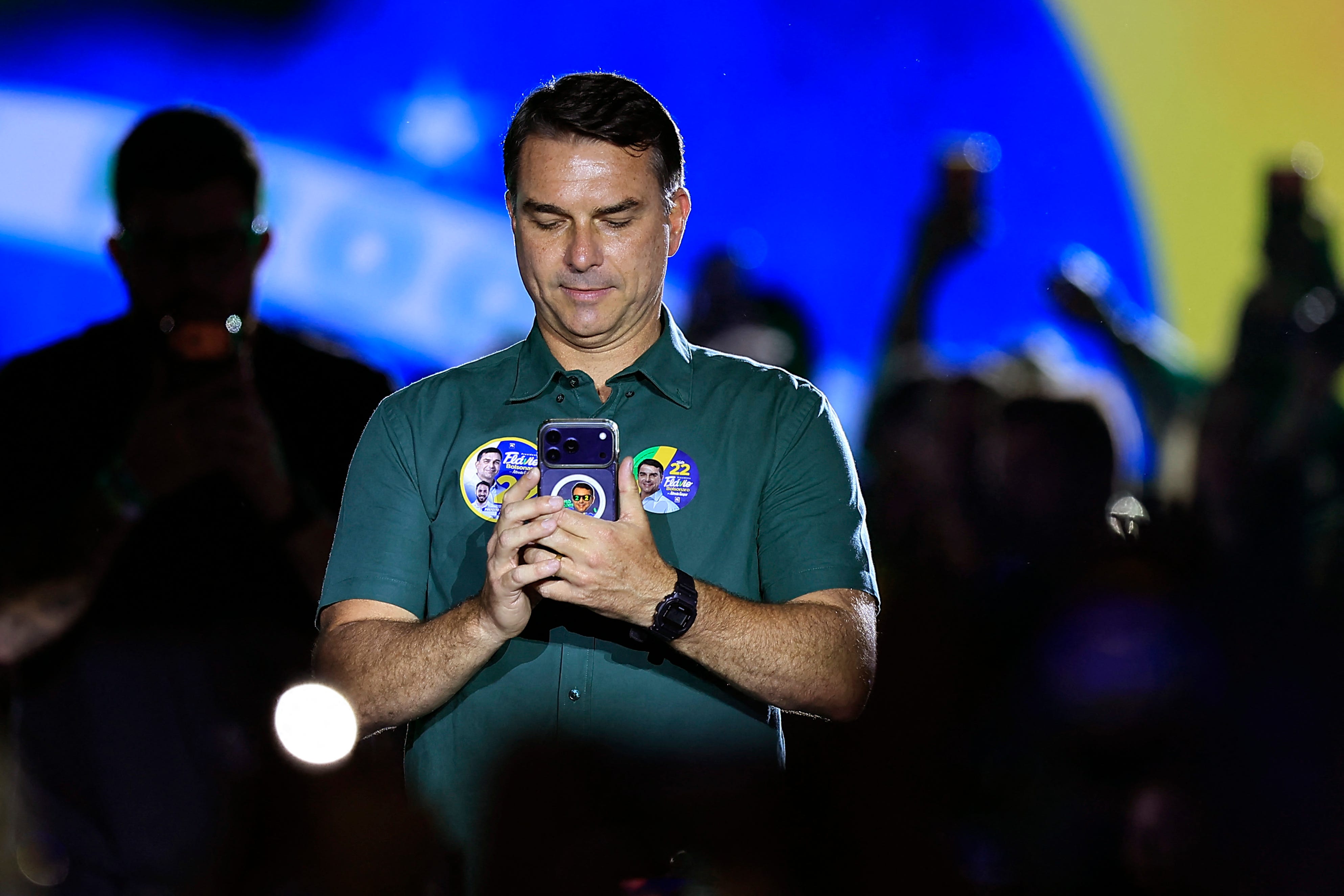
Brazil’s right-wing senator Flavio Bolsonaro looks at his phone during a campaign rally in Guarulhos, São Paulo, on October 21, 2026 (Photo by Miguel SCHINCARIOL / AFP via Getty Images)
News about the deleted posts emerged on the same day that Daniella Marques, the economic coordinator for his campaign, described reliance on social programs as a “welfare trap.”
One of the most pointed posts dates back to April 5, 2010, when Flávio Bolsonaro said the Bolsa Família was tantamount to buying votes.
“As long as votes are traded for basic food baskets, Bolsa Família [welfare payments], and handouts, Brazil will not move forward,” one of the posts read.
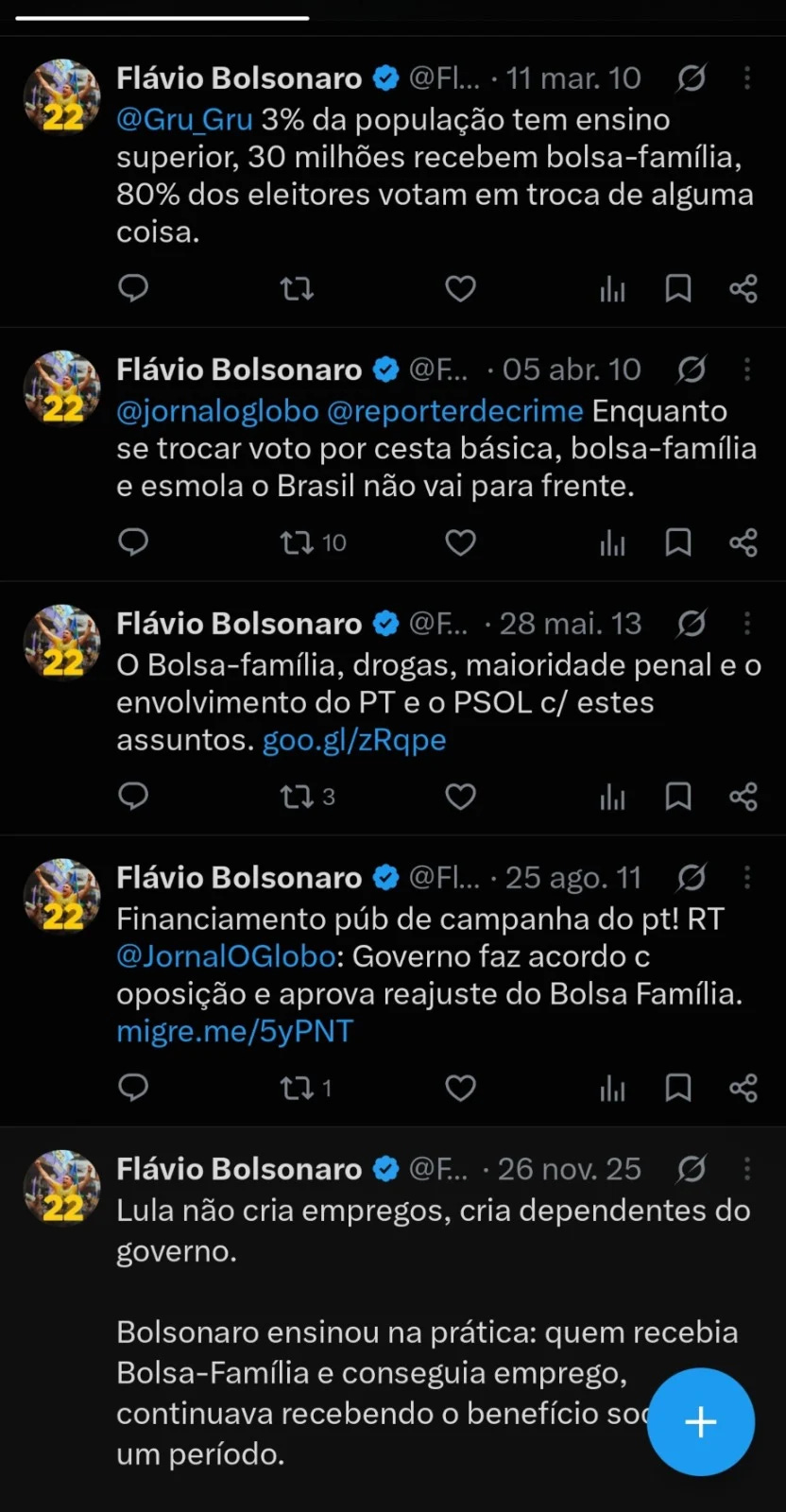
On June 24, 2013, the then-state lawmaker once again attacked social programs, accusing the PT of perpetuating poverty through what he termed bolsa-farelo, meaning “welfare crumbs” or “scraps.” In the message, he argued that maintaining families economically dependent served to preserve electoral support for the party.
On August 25, 2011, Flávio Bolsonaro also criticized an increase in the welfare payment, labeling the measure a form of public financing for Lula’s Workers’ Party campaign.
The posts demonstrate that his critique was not limited to the management of these programs. Bolsonaro linked cash transfers to political dependency and attributed electoral motives to the assistance provided to the poorest families.
Screenshots of these messages began circulating again Monday, October 19. While earlier records of some of these posts exist, it has not yet been possible to independently confirm when they were deleted from X (formerly Twitter).
Flávio Bolsonaro Sought to Limit Social Benefits to Two Years
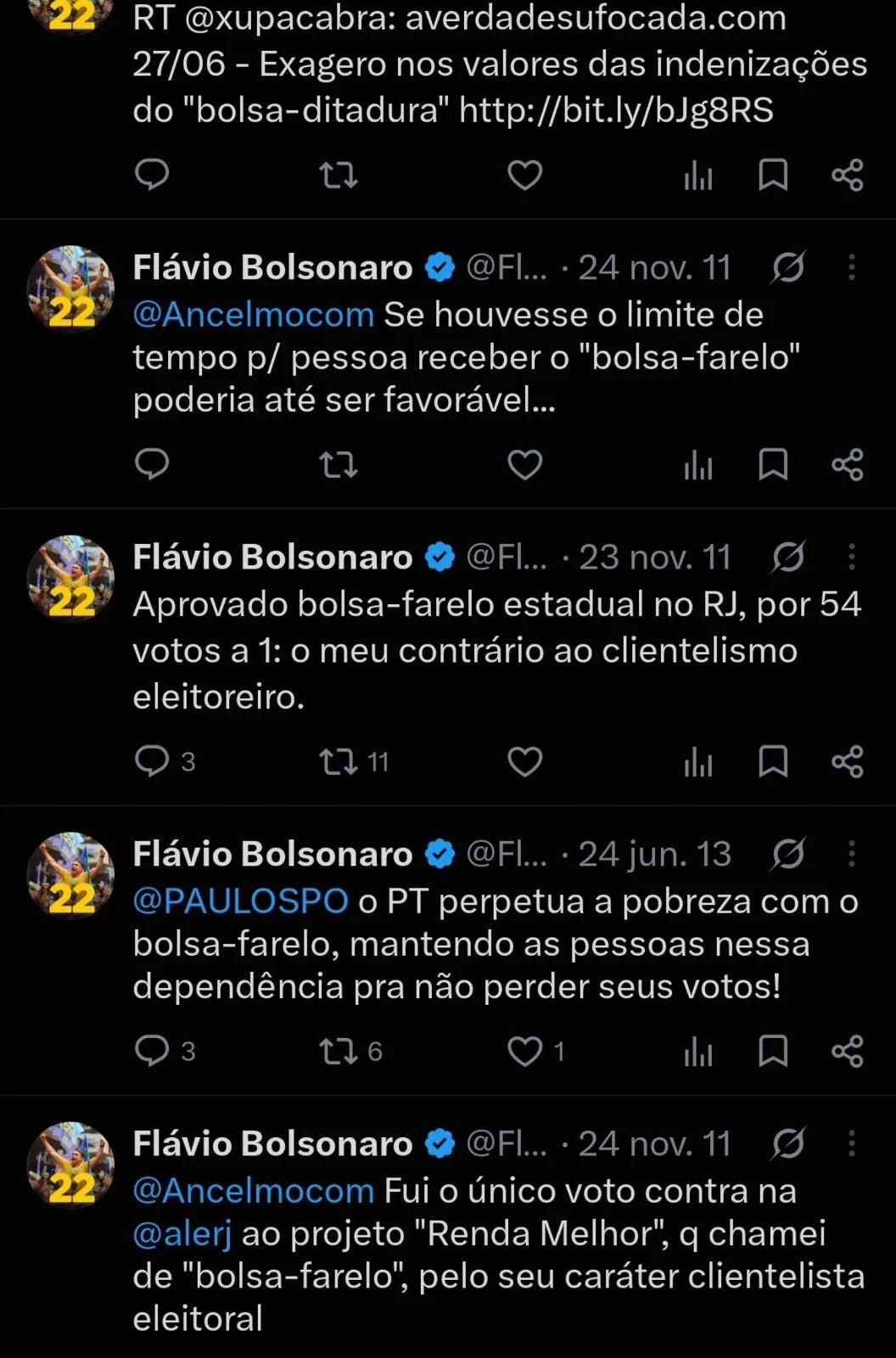
The critique also translated into parliamentary action. On November 23, 2011, Flávio Bolsonaro was the only state deputy to vote against the Renda Melhor (”Better Wage”) program, which was approved by the state legislative assembly of Rio de Janeiro by a margin of 54 votes to one.
At the time, he posted a message referring to the initiative as the state’s bolsa-farelo, or welfare scraps.
The Renda Melhor program supplemented the income of families living in poverty or extreme poverty in Rio de Janeiro.
The following day, November 24, 2011, Bolsonaro stated on social media that he had submitted amendments to the bill to restrict the duration of benefit payments: “I proposed amendments to the bill [...] to limit it to two years.”
In another post from the same day, he argued that the lack of a maximum time limit for receiving benefits could foster dependency on the state among the recipients.
The proposal advocated by then-State Deputy Bolsonaro sought to establish a time limit for a cash-transfer program, a position that’s distinct from the current debate regarding the rules of the federal Bolsa Família program.
Daniella Marques Calls Social Assistance a “Welfare Trap”
Monday, October 19, during an interview on the television program Pânico, Daniella Marques, economic coordinator for Flávio Bolsonaro’s campaign, revisited the discussion surrounding dependency on social programs.
While advocating for the creation of a federal Ministry of Prosperity, Marques said that the proposal’s goal would be, “To free Brazil from this welfare trap.”
Marques also said that social programs can create a “toxic and abusive” dynamic when they are used for political purposes to instill fear among beneficiaries.
On the same day, she presented a proposal for a two-year transition period for Bolsa Família recipients who secure formal employment or decide to start a business.
“People cannot remain trapped in the Bolsa Família program forever; it serves as a safety net, but it is merely the beginning of a journey. Everyone deserves to dream of greater opportunities and more dignity,” she stated.
According to Marques, the proposal would allow beneficiaries to pursue financial autonomy during a transition period. Should they lose their income or become unable to support themselves, they would be entitled to automatically return to the program.
Marques emphasized that she does not intend to cut social programs; instead, she advocates for measures such as professional training, access to credit, and promoting entrepreneurship.
The current proposal is not identical to the one championed by Flávio Bolsonaro in 2011. At that time, he sought to limit the duration of a state-level program. Marques’s current approach focuses on a transition rule for individuals who enter the labor market or start their own businesses, with the option to return to Bolsa Família if needed.
Nevertheless, both positions use a two-year timeframe as a benchmark for discussing how long families should remain in cash-transfer programs.
This article originally appeared in ICL Notícias, which has authorized Panamerican Dispatch to translate and publish it in English. It can be read in its original Portuguese, here.