


By Cleber Lourenço
On Tuesday, Brazilian Supreme Court Justice Flávio Dino ordered the Federal Police to investigate suspected foreign financing of Flávio Bolsonaro’s presidential campaign. Bolsonaro lost to Luiz Inácio Lula da Silva in the runoff. The investigation will also need to determine whether any connection exists between political support for the senator and foreign interests in Brazil’s rare earth and strategic mineral resources.
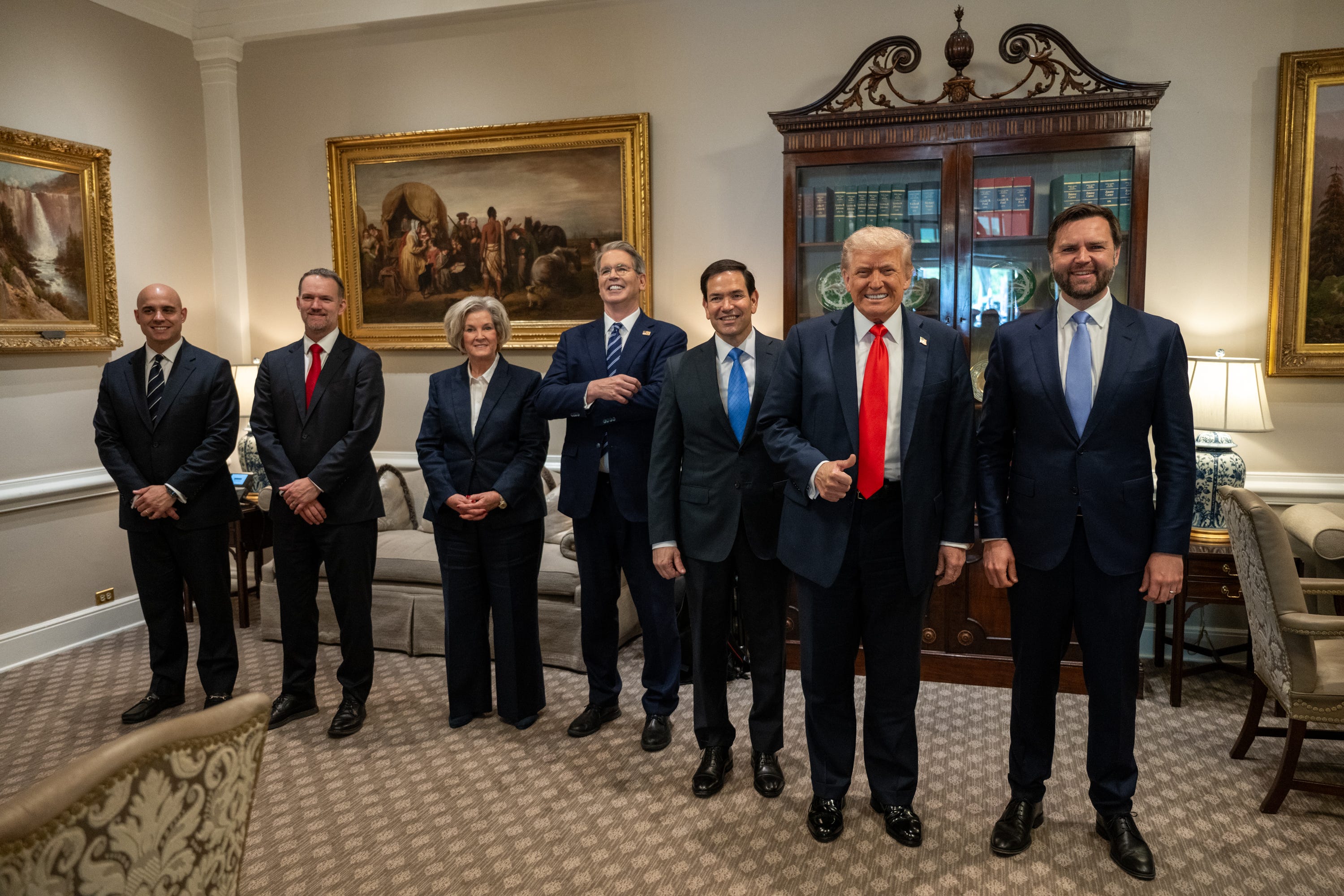
Trump cabinet members involved with the Rockbridge Network include James Blair, Scott Bessent, Marco Rubio e J. D. Vance. (Photo: White House)
Dino issued the 38 page ruling as part of ADPF 1178, a constitutional challenge originally filed by the Brazilian Mining Institute (Instituto Brasileiro de Mineração/Ibram). He ordered that an investigation be opened under the Supreme Court’s direct supervision, due to the possible involvement of members of Congress, whose parliamentary immunity can only be overridden in the nation’s highist court, in the alleged crimes under investigation.
The investigation’s main focus is on dealings involving Rockbridge Network, a U.S. organization founded with the involvement of Vice President J.D. Vance, along with Brazilian businessmen Tallis Gomes and Pedro Sang. The Federal Police must determine whether these dealings involved money, services or other economic benefits intended to help Bolsonaro’s campaign.
Investigators must also identify who was involved in the contacts between representatives of the American organization and Brazilian businessmen, and what purpose those contacts served.
Federal Police to Investigate Possible Link Between Campaign Support and Rare Earths
One of the most significant parts of the ruling is the suspicion that efforts to finance political activity may be tied to foreign economic interests in Brazilian mineral resources.
Dino explicitly ordered the Federal Police to investigate whether there is “concrete evidence linking the discussions over political financing to the reported economic interests in Brazilian rare earths and critical minerals.”
Dino also wants to determine who may have made any proposals, who they were directed to, and what might have been offered in return.
At stake are resources considered strategic for sectors including technology, energy and defense. In his ruling, Dino noted that these minerals belong to the federal government and that their extraction requires authorization or a concession from public authorities, as required by Brazil’s Constitution of 1988
If evidence emerges of negotiations involving rural land, the Federal Police must also determine whether there was an attempt to get around legal restrictions on foreign ownership of Brazilian land, including through the use of intermediaries.
Suspicions about Rockbridge first reached Brazil’s electoral courts through a complaint filed by Renan Santos, then a presidential candidate for the Missão party. The Workers’ Party later brought its own information about possible foreign financing operations to the Supreme Court.
Dino noted that the arguments presented by the two parties overlap.
Covert Advertising and Favoritism on Social Media
Another part of the investigation concerns paid promotion of content favorable to Bolsonaro by accounts based abroad, particularly posts that cited projections from Polymarket, a foreign prediction market platform barred from operating in Brazil.
According to the complaint filed by the Missão party, foreign accounts that normally didn’t cover Brazilian politics began running paid posts about Bolsonaro’s candidacy around the same time, citing estimates from that same platform.
The Federal Police must determine who paid for this content, where the money came from, and whether any Brazilian intermediaries were involved.
The ruling also addresses the role tech companies played during the campaign. Dino ordered an investigation into “intentional asymmetries and algorithmic manipulation” meant to help or hurt specific candidacies.
To support the order, Dino compiled documents from Meta’s Oversight Board, statements from United Nations experts, and a letter from U.S. lawmakers who pointed to possible inequalities in how Lula’s and Bolsonaro’s campaigns were treated.
Among the incidents cited were restrictions on boosting Lula’s posts on Instagram and improper recommendations of content linked to Bolsonaro.
Dino also cited an October 21 opinion from the Office of the Electoral Prosecutor General, which found that Meta had failed to comply with court orders, including requirements related to transparency around election ads and how its artificial intelligence tools function.
The ruling also references reporting from Intercept Brasil on payments from Bolsonaro’s campaign to Elytron, a company that offered an artificial intelligence system abroad for political influence operations. According to that reporting, the campaign recorded payments of $116,500 to the company, while the Liberal Party separately reported another $25,600.
Weighing all of this information together, Dino said the evidence points to “intensifying signs of foreign interference in the electoral process.”
Investigation Will Be Overseen by the Supreme Court
Along with ordering the investigation, Dino notified 10 federal agencies, including Abin, the Council for Financial Activities Control (Coaf), the Central Bank, the federal tax authority, the National Mining Agency and the Foreign Affairs Ministry, asking each to consider any action within its own authority.
Dino also drew on an Abin report identifying hidden financing of political groups, disinformation campaigns and cyberattacks as possible tools of foreign interference in Brazilian elections.
For Dino, the issue goes beyond foreign citizens expressing political opinions, which is protected as free speech. The problem arises when representatives of international organizations work to advance economic or institutional interests through actions meant to interfere in the election itself.
Under those circumstances, Dino said, there may be an “instrumentalization of political party activity in service of foreign interests.”
Although Dino denied the Workers’ Party’s request to join the case as a formal party, he acknowledged the relevance of the evidence presented and decided it would be more appropriate to investigate it through a separate proceeding.
The Federal Police must report the case number of the investigation to the Supreme Court. The investigation begins two days after Bolsonaro’s defeat and will aim to determine whether his contacts with foreign businessmen and organizations were limited to political and commercial exchanges, or whether they involved improper financing, covert advertising and economic interests in Brazil’s strategic resources.
So far, there is no confirmed evidence that Rockbridge illegally financed the campaign, or that any commitment was made to grant mineral rights in exchange for political support.
This article initially ran in ICL Notícias, has been translated by Panamerican Dispatch with express authorization of the editor, and can be read in its original Portuguese here.