


by Marcia Carmo
Democracies today find themselves at a crossroads. They must coexist with Big Tech companies that are deeply invested in shaping the public agenda of various nations, says Colombian analyst Juan David Gutiérrez.
“Not only are they highly interested in influencing the public agendas of many countries, but they also clearly have their own priorities. starting with nations on the scale of Brazil. Yet, they seek to influence the agendas of smaller countries as well,” he said during an interview with Brasil 247, speaking from Bogotá.
Gutiérrez holds a PhD in public policy from the University of Oxford and serves as an associate professor at the School of Government at the University of the Andes in Colombia.
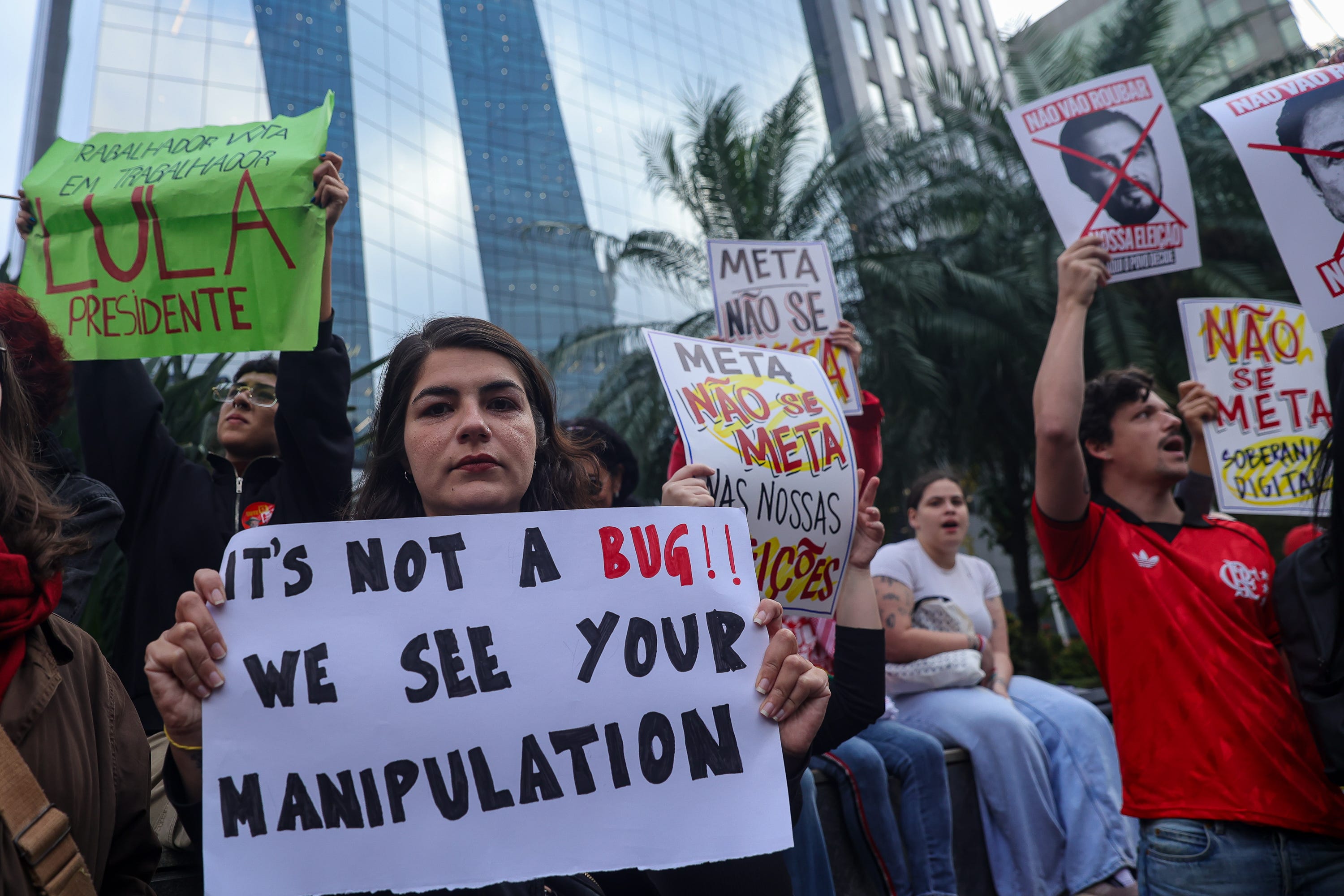
Demonstrators protest outside Meta’s headquarters in São Paulo, Brazil, on October 19, 2026, amid allegations that Instagram affected the campaign of Brazilian President Luiz Inacio Lula da Silva ahead of the presidential election. (Photo by Allison Sales/NurPhoto via Getty Images)
Trump’s Defeat
In Gutiérrez’s view, Donald Trump’s defeat in the recent U.S. legislative elections is unlikely to alter the current landscape for these companies. He suggests that the Democrats show no genuine interest in the debate around regulating Big Tech or digital platforms, whether at the national or global level.
“Many Democrats advocate for the regulation of Big Tech. That explains why the magnates behind these companies supported Trump,” he said. “Yet, at the same time, the Democrats have never seriously discussed national regulation on the matter, let alone spearheaded a global conversation. My expectations are very limited.”
“Sovereignty and Democracy”
Over the weekend in Rio de Janeiro, Gutiérrez participated in the 2nd Summit of the Latin American Dialogue 2026, Conlat, which brought together academics from the Institute of Social and Political Studies at the State University of Rio de Janeiro, Argentina’s Torcuato Di Tella University, Colombia’s Universidad de los Andes, and El Colegio de México.
The meeting included analysts, diplomats, and civil society representatives from various countries, and was titled “Sovereignty and Democracy in Latin America and the Caribbean in Times of Geopolitical Turmoil.”
Power
“We have seen here in Colombia how these companies seek to interfere in the public agenda, especially over the debate on the regulation of digital platforms [social media]. The discussion here centers on limiting children’s and adolescents’ access to social media. There has been intense lobbying by these ‘Big Tech’ companies against the proposal,” Gutiérrez’s said.
The Colombian Congress is currently debating bills that would set an age limit for social media access. One proposal sets the minimum age at 16. Others suggest 14.
Elections
Gutiérrez noted that in the most recent elections, every presidential candidate utilized social media, seeking to expand their voter base through the “use of algorithms” in their campaigns.
He said that political campaigns have had to adapt to achieve better results among the electorate. Gutiérrez recalled that the new Colombian President Abelardo de la Espriella, a far-right figure and ally of the Trump administration, appointed ‘influencers’ to government positions, despite their lack of experience or knowledge over the policy areas they were tasked with overseeing.
“Influencers who were very aggressive in their way of communicating, knowing full well that algorithms would amplify them based on the words they used,” he said. “In other words, even if indirectly, Big Tech exerts an influence on political trajectories and democracies. And here in Colombia, some of these influencers, who are now members of the government, claim that their previous style of speaking and acting was merely for the sake of the electoral contest.
“It’s a difficult situation, to say the least,” he said.
Regulating Big Tech?
Gutiérrez believes that digital platforms “have ended up degrading the quality of democratic processes.”
“Every country should have the sovereignty to define its own ‘rules of the game’ over any product or service offered within its borders,” he said. “The fact that Big Tech companies are based in another country shouldn’t mean that other nations are relegated to being mere users of their systems. Users need to be protected. But, as we can see, it’s not that simple.”
When asked what could be done given the current landscape, he answered, “Establishing new rules of the game for these platforms, social media, as an initiative by individual countries.”
But he acknowledged that this was no simple task.
He noted that, in the case of Colombia, for example, the legal entities representing these companies in the country argue that they merely manage the brand, and that any legal action must be pursued in California, in the United States, where the companies’ headquarters are located.
“It is not a simple question, as we can see,” he said. “But it is an important one for our democracies.”
Because these are transnational, borderless companies, competing with them is inherently difficult, the expert explained.
“Furthermore, there is the issue of scale and reach. Brazil is a large country, but there are few economies with sufficient scale to justify or sustain this reality,” he said. “Brazil and China are two such examples. To complicate matters further, all the ‘Big Tech’ firms are foreign companies.”
At the Conlat meeting in Rio de Janeiro, Gutiérrez presented research on the use of artificial intelligence by governments and how such tools could also facilitate surveillance. The study, he noted, involved analyzing dozens of forms of AI across more than twenty Latin American countries. The conclusion, he stated, is that over 40% of these tools are used for the surveillance of individuals or objects.
“The question is: what happens in countries with fragile democracies and authoritarian tendencies when AI is used in this way?” He asked.
“We are, without a doubt, in the midst of a major debate about the state of democracy in these new times,” he asserted.
In his view, it is essential to recognize that digital tools and social media have both positive and negative effects, yet some narratives overlook the real challenges they pose to democracies and to society as a whole.
Marcia Carmo is a journalist and correspondent for Brasil 247 in Argentina. She holds a Master’s Degree in Latin American Studies from La Universidad Nacional de San Martín in Buenos Aires. This article was originally published by Brasil 247. It was translated by Panamanian Dispatch. You can read the original, in Portuguese, here.