


By Brasil 247
President Luiz Inácio Lula da Silva’s campaign team is formally requesting the Superior Electoral Court (TSE) to disqualify the presidential ticket of Senator Flávio Bolsonaro, based on evidence that Meta of has been illegally favoring him through recommendation mechanisms and artificial intelligence tools.
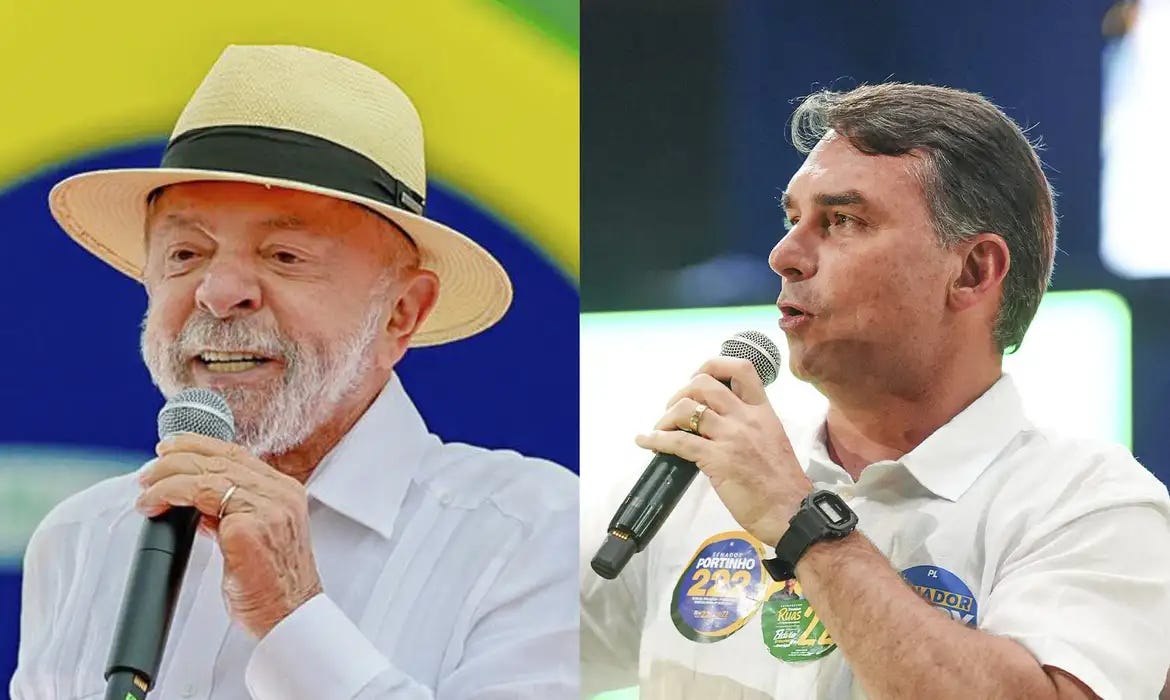
Folha de S.Paulo reported that the electoral judicial investigation action (known as an Aije) points to possible irregularities in how the systems of Instagram, Facebook and WhatsApp are working. Lawyers for the Lula campaign say recommendation mechanisms, generative AI features and ad review procedures have been operating in Flávio’s favor and to Lula’s detriment.
The complaint also cites episodes involving Meta’s AI tools and Grok, from X. It says the tools generated propaganda tied to the PL candidate. They refused to produce similar content for the president.
Lula’s campaign lawyers argue that the episodes could amount to abuse of economic power and improper use of the media. The request for an investigation rests on those grounds.
Complaint cites accusations about algorithms and ads
The complaint cites a Folha report that revealed internal messages from Meta employees saying that restrictions on Lula’s campaign ads damaged his campaign. The messages also suggest that Meta’s systems recommended the primary WhatsApp channel supporting the Bolsonaro campaign, as well as his Instagram profile. The complaint argues that those recommendations break Brazil’s election laws.
Another point is the atypical algorithmic amplification of the profile of Rep. Nikolas Ferreira, a Liberal Party ally of Flávio Bolsonaro from Minas Gerais who is Bolsonaro’s most popular supporter on social media.
The complaint mentions data showing that Ferreira’s campaign videos have reached tens of millions of views. That tops the numbers from profiles with much larger followings such as Kylie Jenner, Kim Kardashian, Neymar, Virginia Fonseca and Beyoncé.
The complaint also cites a test. The same video posted by Ferreira drew 396,400 views on TikTok and 56.1 million on Instagram.
Lula’s campaign points to gap in engagement between candidates
The complaint also says Lula’s and Bolsonaro’s Instagram profiles show sharp differences in engagement. According to data reproduced in the complaint, Bolsonaro has 13,606,146 followers, against 16,436,220 for Lula. However Bolsonaro posts record higher averages of likes, comments and views.
A passage in the complaint reads, “Although [Bolsonaro’s] profile has 17.2% fewer followers (13,606,146 versus 16,436,220), its average likes and comments per post are 2.96 times higher. On Reels, average views reach 15.64 million, against 5.91 million. Adjusted for follower base, the interaction rate is 10.23% versus 2.86%, or 3.58 times higher.”
Lula’s campaign presents the numbers as signs of a possibly unequal distribution of reach between the two candidates.
Meta says it does not favor any candidate
Meta denied the accusations of electoral interference and of favoring Bolsonaro. The episodes had different causes, Meta said, and some “had wide reach and affected different accounts and advertisers in different countries.” Meta also said it treats all candidates the same: “We do not give preferential treatment to any candidate, party or political position, and our systems are not designed or operated to do so.”
On its AI tool, Meta said it temporarily banned the generation of images of candidates “in compliance with Brazil’s electoral rules.” It also said it has adopted “additional measures so that prompts using only candidates’ first names and their ballot numbers also do not produce images.”
Lula’s campaign also objects in the complaint to a post critical of Lula that Paulo Skaf, president of the Federation of Industries of the State of São Paulo (Fiesp), published on Oct. 13. The complaint alleges that the post was boosted with Fiesp’s funds and reached more than 1 million Facebook and Instagram users.
Under the electoral laws cited in the complaint, only parties, coalitions and candidates may pay to boost electoral ads, and political ads cannot be negative.
Superior Electoral Court rulings increase pressure on Meta
Lula’s campaign had already gone to the Superior Electoral Court the week before. It asked for action against what it called “repeated and systematic” failures in the distribution of posts by Lula and his allies on Meta’s platforms.
In a preliminary ruling on Oct. 15, Justice Marco Aurélio Bellizze ordered Meta to guarantee equal treatment for Lula and Bolsonaro. He also ordered Meta to fix problems in Lula’s ad accounts. The ruling set further measures and information requests. Meta faces a daily fine of R$500,000 (about $99,000) if it does not comply..
On Sunday night, Oct. 18, Bellizze issued a new preliminary ruling. If Meta fails to meet the requirements within 24 hours, the daily fine could rise to R$1 million (about $198,000).
Lawyer Luiz Eduardo Peccinin, one of those responsible for the complaint, said the role of big tech companies in the electoral process must be investigated.
“The alignment of the big tech companies with Flávio Bolsonaro’s campaign was already clear when they took an active role in the Liberal Party’s communication forums. What we are seeing is not only an attempt to interfere in favor of one campaign, it is a direct attack on one of the largest democracies in the world,” Peccinin said.
Maíra Recchia, another author of the complaint, said the facts should be investigated and Meta held accountable if irregularities are confirmed.
“A private company cannot decide, through the opacity of its algorithms, who will be heard and who will be silenced in an election. The signs of Meta’s interference demand urgent investigation, transparency and accountability. If the platform improperly reduces the reach of a candidacy, it undermines equality and voters’ right to information,” Recchia said.
Internal messages describe restrictions on Lula
According to the Folha report cited in the complaint, Lula’s official profile was unable to boost posts in Instagram on Oct. 9. Meta first blamed a global technical failure.
However, internal messages obtained by Folha suggest the global problem occurred on Oct. 7 and lasted five hours. The restriction on Lula’s account was reportedly logged two days later and lasted almost 24 hours.
In the messages, Meta employees reportedly said Lula’s account was “limited” compared with Bolsonaro’s.
Another episode involves the WhatsApp channel “Tropa do Flávio” (Flávio’s Troops). It reportedly appeared among recommendations in searches for channels supporting Lula. Under the electoral laws cited in the complaint, candidates’ profiles and channels may not be recommended. They should appear in results only when a user searches the account’s exact name.
The messages suggest Meta employees knew that searches for “Exército de Lula” (Lula’s Army), the name of Lula’s WhatsApp channel, also showed recommendations for the channel supporting Bolsonaro.
The complaint adds that Bolsonaro’s profile appeared in recommendations in Instagram searches, while other candidates did not get the same treatment. The messages also suggest Lula’s account was not displayed even when a user searched the exact name of Lula’s profile.
Lula’s campaign is asking for information on how Meta’s algorithms work and for access to its internal messages. It wants the information to back up its accusations of abuse of economic power and improper use of the media.
This article originally ran in Brasil 247, was translated by Panamerican Dispatch with express authorization of the editor-in-chief, and can be read in its original Portuguese here.