


by Leda Paulani
I am not a political scientist, a field within the human sciences that I consider among the most complex, but I want to weigh in on the whirlwind we have been going through since October 4.1
Luiz Inácio Lula da Silva’s epic comeback over the candidate of the corrupt and criminal far right will be the subject of study by these experts for a very long time to come, and will surely generate much debate.2 For me, however, one thing is indisputable: there was an uprising of civil society that made this David-versus-Goliath victory possible. A David who, incredibly, is President of the Republic and who, if everything were normal, should have been the Goliath in this story. But that is not the case.
Luiz Inácio Lula da Silva’s victory was a triumph over the mighty and omnipresent Big Tech companies, over the Big Brother of the North, the United States, and its dreadful president, Donald Trump, and over the neofascists who, unfortunately, keep gaining ground around the world and here too.3 It was a triumph over the most powerful material interests, which openly rooted for his defeat, and over the big corporate media, which gave the criminal, coup-plotting candidate a free pass, treating him as a “normal” candidate.
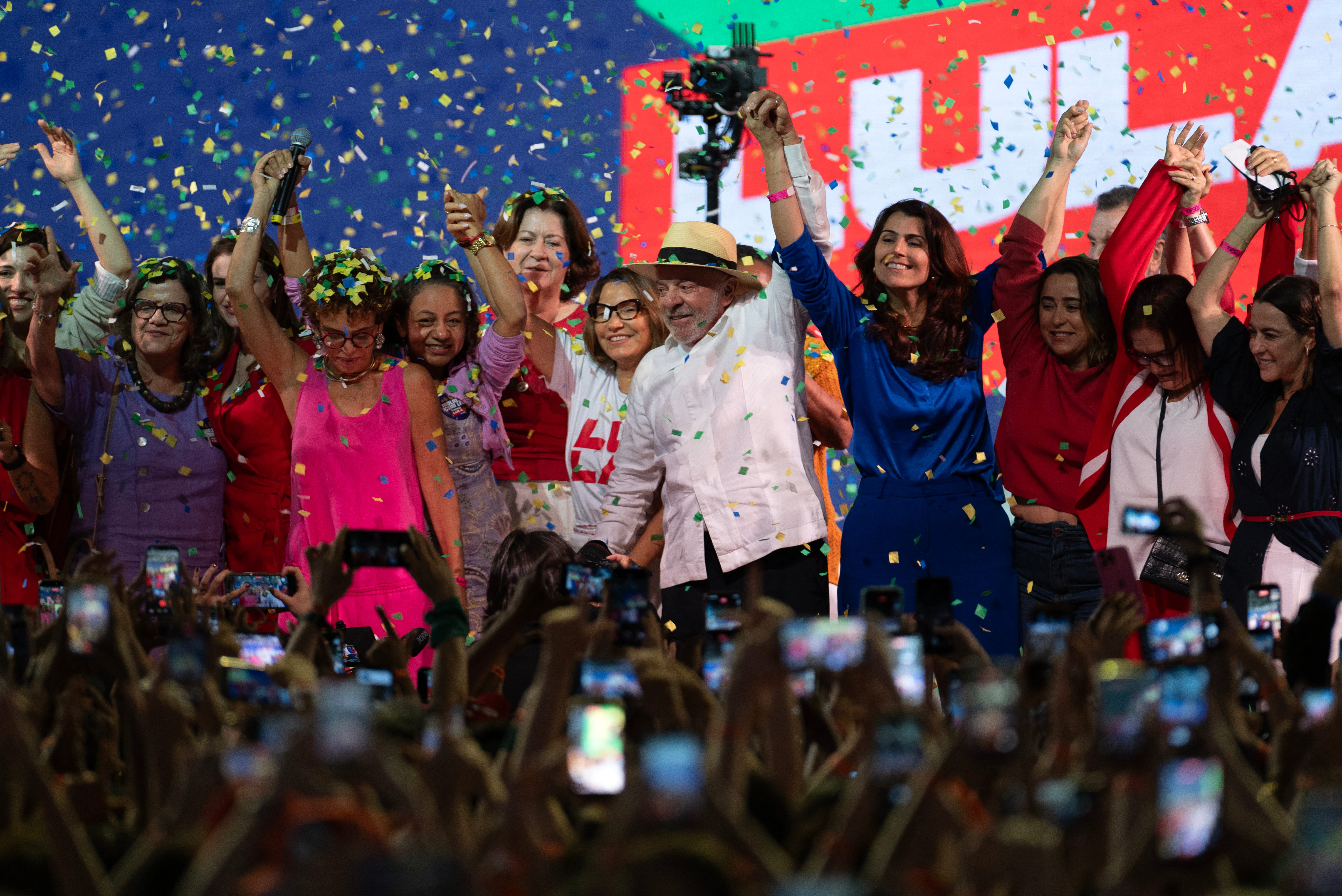
Brazil’s President Luiz Inacio Lula da Silva raises a hand on stage during a “Women with Lula” campaign rally in Belo Horizonte, Minas Gerais state, Brazil, on August 29, 2026. (Photo by Douglas MAGNO / AFP via Getty Images)
Lula’s victory was a triumph over the president of the Superior Electoral Court (TSE)4, who was an avowed partisan of the other candidate and shamelessly campaigned for him, usurping the power institutionally granted to him, and also over sections of the state apparatus5 that played dirty, trying to prevent his likely voters from voting.
In the flood of commentary now pouring out to make sense of this epic saga, the streets and social media have appeared as indispensable protagonists. But the massive street demonstrations across the country were not scheduled by the campaign. They were not instigated by the Workers’ Party (PT) or by the parties of the coalition supporting the president’s re-election.
No! It was civil society that took to the streets, that was shaken by the prospect of the country plunging over a precipice, and that decided to react. It all began with a demonstration by students at the Universidade Federal Fluminense (UFF) in Niterói, the day after the first round, when the nightmare began. It was those young people who pulled the thread that began to weave the unlikely victory.
Congressman André Janones’s great idea of creating what he called “Lula’s army”6 to dominate social media, outmaneuver the biased algorithms, and achieve what the left had never managed before would have come to nothing had nearly 11 million Brazilian citizens not thrown themselves headlong into it.
But beyond the streets and social media, a myriad of entirely individual initiatives, coordinated by no one, began to spring up from all sides.
People who paid out of their own pockets to print thousands of pamphlets to hand out in various places, some of them showing the social achievements of the Lula government, in contrast to its horrible predecessor. Others exposed the countless crimes and shady dealings of the opposition candidate. Still others recalled the terrible years of the dictatorship and the loss of freedom that a far-right victory would represent.7
People who campaigned online tirelessly, working to win over undecided voters and those who had abstained in the first round8. People who, on election day itself, organized carpools to take elderly voters and others who would have trouble getting to the polling stations, voters who otherwise would not have voted for re-election.
Given all this, I believe Luiz Inácio Lula da Silva’s victory represents much more than the four additional years that Brazilians have given him to govern the country. And I say it means much more, not only because it spared Latin America a perilous near-unanimity of far-right governments9, which would have further increased Donald Trump’s power over our wealth and over democracy. Nor is it only because it symbolized a heavy defeat for the seemingly unstoppable rise of the far right around the world.
All of this is true. But the greatest value of this incredible victory, in my view, is that it runs resolutely counter to the deepest ideological currents of our time, in a world increasingly dominated by the values of the self-made individual, meritocracy, and rational individual action, a world in which each person looks out only for themselves, their own gain, their particular advantage, their private interests. This ideology, it should be said, is indispensable to the commodity form, and the endless torrent of technological novelties in the digital world only reinforces it.
This bleak world is the product of decades of neoliberalism and of the inequalities, injustices, and affronts to human dignity it has generated.
Against the “neoliberal subject,” in Pierre Dardot and Christian Laval’s terms, Brazil showed the world the beauty of the collective, the common, and the group, of the sense of community and the building of solidarities. It showed the pleasure of a victory that belongs to everyone. It reminded everyone of the joy, almost absent today, of feeling part of something that transcends us.
May the victory of Luiz Inácio Lula da Silva and of Brazil serve to change, however slightly, the grim panorama of this first quarter of the twenty-first century!
Leda Paulani is Professor Emerita of Economics at the University of São Paulo (USP). She is the author of, among other books, Modernidade e discurso econômico [Modernity and Economic Discourse] (Boitempo). This essay was originally published in the Brazilian online magazine A Terra é Redonda shortly after the second round of the 2026 presidential election in Brazil. This text was translated by Lygia Sabbag Fares and Pedro Henrique Evangelista Duarte. You can read the original article, in Portuguese, here.
Translator’s note: In the first round, on October 4, President Lula (Workers’ Party, PT) finished second with 45.2% of the valid votes, behind Senator Flávio Bolsonaro (Liberal Party, PL), son of former president Jair Bolsonaro, with 47.0%. In the runoff on October 25, Lula won by about 51.8% to 48.2%. It was the first time since the two-round system was introduced in 1989 that a candidate who came second in the first round went on to win. Lula, who governed from 2003 to 2010 and again from 2023, thus secured an unprecedented fourth term (2027–2030).
Translator's note: Flávio Bolsonaro's father, Jair Bolsonaro, president from 2019 to 2022, had already been barred from running for office and, in 2025, was convicted by Brazil’s Supreme Federal Court (STF) of plotting a coup to stay in power after losing the 2022 election and sentenced to 27 years in prison. Paulani’s description of the candidate as “coup-plotting” should be read against this background.
In 2025, the Trump administration imposed 50% tariffs on many Brazilian exports and sanctioned Supreme Court justice Alexandre de Moraes, explicitly linking these measures to the prosecution of Jair Bolsonaro. During the 2026 campaign, Trump repeatedly said he was following the Brazilian election closely.
Translator’s note: The TSE organizes and adjudicates Brazilian elections; its presidency rotates among justices of the Supreme Federal Court. During the 2026 election, it was presided over by Kassio Nunes Marques, whom Jair Bolsonaro appointed to the Supreme Court in 2020. Several of his rulings during the campaign were criticized as favoring the Bolsonaro candidate, such as suspending the release of a poll showing Flávio Bolsonaro losing ground. He also twice suspended the “Lula’s Army” WhatsApp channel (see note 6) during the runoff campaign. Some of his rulings were overturned by the full court.
Translator’s note: On the day of the runoff, bus service was sharply reduced in several cities, including São Paulo. According to Lula’s campaign, these cities are governed by mayors allied with Flávio Bolsonaro. The campaign denounced this as an attempt to keep low-income voters, who lean toward Lula, from reaching the polls. Electoral authorities extended voting by two hours.
Translator’s note: André Janones, a federal deputy from Minas Gerais, launched the “Exército do Lula” (Lula’s Army), a WhatsApp channel. It had roughly 60,000 followers after the first round and nearly 11 million by the runoff. Followers received “missions,” such as recruiting friends or sharing campaign videos.
Translator’s note: Brazil was ruled by a military dictatorship from 1964 to 1985. Jair Bolsonaro, president from 2019 to 2022, has repeatedly praised that regime.
Translator’s note: Voting is compulsory in Brazil, but the penalty for not voting is a small fine, and abstention usually reaches around a fifth of the electorate. Mobilizing first-round abstainers was therefore a decisive part of the runoff campaign.
Translator’s note: At the time of writing, right-wing and far-right presidents governed several Latin American countries, among them Javier Milei in Argentina and José Antonio Kast in Chile.
References for the Translator’s Notes
A Gazeta. “Exército de Lula no WhatsApp: por que Nunes Marques suspendeu canal novamente.” October 2026. https://www.agazeta.com.br/mundo/exercito-de-lula-no-whatsapp-por-que-nunesmarques-suspendeu-canal-novamente-1026
Al Jazeera. “Brazil Supreme Court Sentences Bolsonaro to 27 Years over Coup Plot.” September 11, 2025. https://www.aljazeera.com/news/2025/9/11/brazils-bolsonaro-found-guilty-of-coup-plot-bytop-court
Al Jazeera. “The WhatsApp ‘General’ behind Lula’s Election Comeback in Brazil.” October 27, 2026. https://aljazeera.com/news/2026/10/27/the-whatsapp-general-behind-lulas-election-comebackin-brazil
Congresso em Foco. “Exército do Lula sai do ar por 48 horas por medida de Nunes Marques.” October 2026. https://www.congressoemfoco.com.br/noticia/123226/exercito-do-lula-sai-do-ar-por-48- horas-por-medida-de-nunes-marques
Euronews/Reuters. “Brazil Highway Police Blockades Fan Voter-Suppression Fears.” October 31, 2022. https://www.euronews.com/2022/10/31/brazil-election-prf
Itatiaia. “Quem é obrigado a votar nas eleições de 2026? Veja regras, prazos e penalidades.” 2026. https://www.itatiaia.com.br/politica/eleicoes/quem-e-obrigado-a-votar-nas-eleicoes-de-2026- veja-regras-prazos-e-penalidades/
Jornal do Brasil. “Plenário do TSE derruba decisão de Nunes Marques a favor de Flávio contra Lula.” August 2026. https://www.jb.com.br/brasil/justica/2026/08/amp/1060595-plenario-do-tsederruba-decisao-de-nunes-marques-a-favor-de-flavio-contra-lula.html.
NBC News. “Trump Hits Brazilian Products with 50% Tariffs over Bolsonaro.” July 2025. https://www.nbcnews.com/politics/trump-administration/trump-brazilian-products-tariffsbolsonaro-rcna222534.
O Liberal. “PF investiga redução de ônibus em 5 estados durante o 2º turno das eleições.” October 26, 2026. https://www.oliberal.com/eleicoes/pf-investiga-reducao-de-onibus-em-5-estados-duranteo-2-turno-das-eleicoes-1.1187164
O Popular. “Kassio manda tirar do ar pesquisa que mostrou recuo de Flávio Bolsonaro.” 2026. https://opopular.com.br/politica/kassio-manda-tirar-do-ar-pesquisa-que-mostrou-recuo-deflavio-bolsonaro-1.3419678
O Povo. “Trump volta a dizer que está acompanhando as eleições do Brasil de perto.” October 3, 2026. https://mais.opovo.com.br/jornal/politica/2026/10/03/trump-volta-a-dizer-que-estaacompanhando-as-eleicoes-do-brasil-de-perto.html
PBS NewsHour. “José Antonio Kast Sworn In as Chile’s President in Sharpest Shift to the Right since Pinochet.” March 11, 2026. https://www.pbs.org/newshour/world/jose-antonio-kast-sworn-inas-chiles-president-in-sharpest-shift-to-the-right-since-pinochet
Times Brasil. “Decisão 2026: em eleição conturbada e com Brasil dividido, Lula é reeleito para quarto mandato.” October 25, 2026. https://timesbrasil.com.br/brasil/decisao-2026-em-eleicaoconturbada-e-com-brasil-dividido-lula-e-reeleito-para-quarto-mandato/