


by Brasil 247
Ambassador Celso Amorim, special adviser to the presidency on international affairs, warned of the risk that the United States could interfere in Brazil’s election process. He said the October 25 presidential runoff carries consequences that reach far beyond Brazil’s borders. In an interview with Tutaméia on Friday, the former foreign and defense minister discussed pressure from the Trump administration on Latin America, the challenges facing Brazilian sovereignty, and the importance of the country’s technological and military independence.
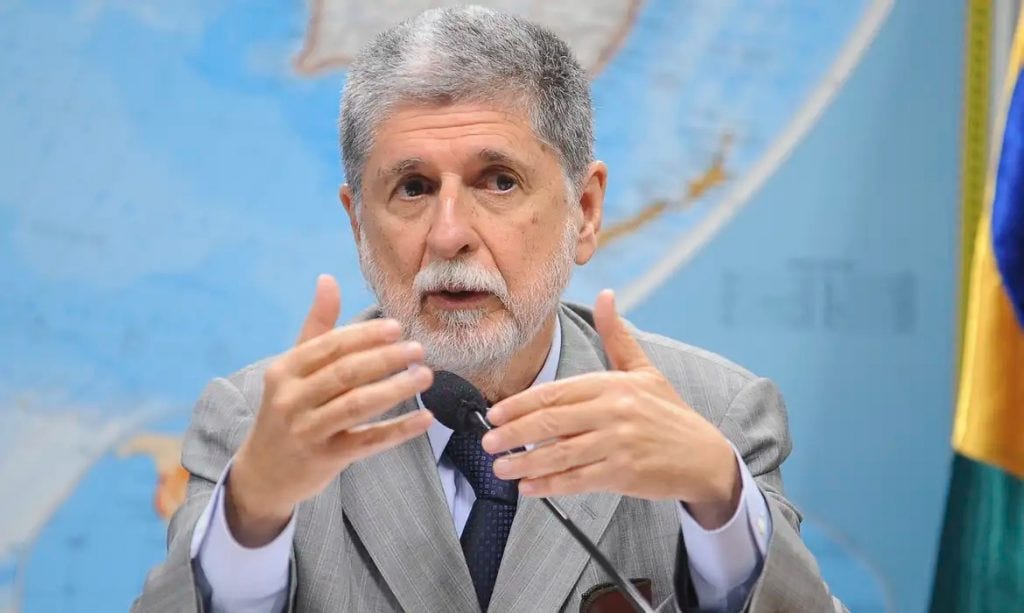
(Wilson Dias/Agência Brasil)
Amorim said Brazil holds a strategic position in the global balance of power, and that the country’s political decisions have ripple effects across the Global South and relations between major powers.
“What happens in Brazil will have an influence on the global balance itself,” he said.
The diplomat stressed that Brazilian sovereignty depends on maintaining diverse international relationships and avoiding dependence on any single power.
“In the complex world we live in today, sovereignty doesn’t mean isolation. It means having relationships with more than one country. It means diversifying your relationships. It means not depending on a single power in any sense, economically, socioculturally, or even militarily in terms of defense,” he said.
Amorim Calls Out Washington’s Pressure on Brazil
Asked about possible attempts by the Trump administration to interfere in Brazil’s election, Amorim said he believes the influence of certain U.S. political sectors on Brazil’s political landscape is real.
He said this interference doesn’t need to target voting mechanisms directly. It can take the form of diplomatic, economic and political pressure, along with support for Brazilian ideological movements.
The presidential adviser cited the tariffs imposed by the United States, diplomatic restrictions, and initiatives from sectors of the American far right as examples of actions that, in his view, go beyond the limits of a balanced bilateral relationship.
Amorim also referred to reports of attempts to send American representatives to Brazil to inspect the electoral system, calling the idea absurd.
In the diplomat’s assessment, strategic U.S. documents reveal an intention to reassert American dominance over the Western Hemisphere. He said these initiatives need to be analyzed together, not as isolated incidents.
Diplomat Sees Risk of Unprecedented Submission to the United States
Discussing the Bolsonaro family’s international positions, Amorim said that unrestricted access to Brazil’s strategic information by the United States would represent a profound break from the country’s diplomatic tradition.
The former foreign minister compared the current situation to U.S. interference in the 1964 military coup, recalling the role played by then Ambassador Lincoln Gordon and U.S. plans to provide military support to the coup plotters.
Amorim noted that even during the military dictatorship, Brazil at times took positions independent of Washington, including on nuclear policy, maritime issues, and recognizing Angola’s independence.
For Amorim, control over natural resources and strategic technologies sits at the center of today’s international disputes. He cited critical minerals and artificial intelligence as areas where Brazil needs to preserve its own decision making power.
He argued that sovereignty isn’t an abstract concept, but something directly tied to economic development and the population’s quality of life. As an example, he pointed to the creation of Petrobras and the importance of Brazil having its own oil production capacity, especially during periods of international instability.
China and Strategic Autonomy Take Center Stage
Amorim also discussed the growing rivalry between the United States and China and what it means for Brazil.
He said competition between major powers can create opportunities for countries that maintain autonomy in choosing their trade and technology partners. The diplomat noted that the expansion of economic ties between Brazil and China stems partly from China’s ability to offer competitive trade and investment terms.
He argued that Brazil should maintain relationships with multiple partners, without subordinating its decisions to the interests of either Washington or Beijing.
On technology, Amorim stressed the importance of solutions that let Brazil maintain control over the systems it acquires and make independent modifications. As an example, he cited the choice of the Gripen fighter jets during his time at the Defense Ministry, highlighting the access to technology and the ability to integrate Brazilian made weapons systems that decision provided.
The former minister also advocated for artificial intelligence systems built on open standards and subject to governance rules.
Critical Minerals Compared to Oil’s Historic Importance
One of the interview’s central points was the need for Brazil to establish a national strategy for critical minerals.
Amorim highlighted the Lula government’s creation of the National Council on Critical Minerals, comparing its historical importance to the creation of the National Petroleum Council decades earlier.
In the diplomat’s view, the ability to control the extraction and use of these resources will be decisive for Brazil’s industrial and technological development. He stressed that defending mineral sovereignty doesn’t mean halting exports or rejecting foreign investment. It means ensuring that national needs are treated as a priority.
The presidential adviser connected this strategy to the growing importance of minerals in producing electronics, artificial intelligence systems and defense technologies.
Amorim Calls for Investment in the Armed Forces and National Industry
Discussing the state of Brazil’s armed forces, Amorim said he sees growing concern about defending Brazilian territory and developing the country’s own military capabilities.
He pointed to the nuclear powered submarine program, the development of the Gripen fighter jets, and the need to expand the use of drones and other modern equipment.
He acknowledged these projects require substantial investment, but emphasized their effects on skilled job creation and technological development. According to Amorim, many technologies used in society today originated in military research and projects.
He argued that defense spending should be understood as part of a broader national development strategy, not simply as military expenditure. The goal, he said, should be ensuring Brazil can protect its autonomy and prevent any form of foreign intervention.
Concern Over Global Military Escalation
Amorim also voiced concern about rising international conflict and the potential for broader confrontation between major powers.
He described the war in Ukraine as a conflict with wider implications, involving Russia and European members of NATO. He reiterated his opposition to the use of force, including Russia’s invasion, but argued that conflicts need to be understood within their broader geopolitical context.
He also recalled Brazil’s role in negotiations over Iran’s nuclear program during the Obama administration, citing it as an example of the importance of diplomacy and dialogue.
Amorim expressed concern about diplomatic language being replaced by threats of destruction and military action. On Latin America, he criticized U.S. initiatives that, in his assessment, risk turning the fight against organized crime into a justification for military intervention.
The diplomat advocated for international cooperation against drug trafficking, including intelligence sharing and financial support, as long as the sovereignty of the countries involved is respected.
Summing up the relationship between sovereignty and material living conditions, Amorim said: “You can’t eat sovereignty. But without it, you’ll end up eating much worse things.”
Youth, Universities and Humanism
During the interview, Amorim also emphasized the importance of student participation in political debate and in shaping Brazil’s future.
The presidential adviser said younger generations need to live in a society that guarantees cultural freedom, access to knowledge and opportunities for development. He argued that Brazilian universities should be centers of scientific and technological excellence, but also spaces for humanistic education.
For the diplomat, economic and technological development cannot be separated from solidarity and respect for diversity. Amorim also stressed that strengthening democracy depends on citizen participation and the ability to preserve coexistence among different social groups.
Brazil Should Maintain Independent International Relations
Asked about the possibility that the United States might not recognize the outcome of Brazil’s election, Amorim said that isn’t his main concern.
He said Brazil’s economic, territorial, demographic and environmental scale makes it difficult for any U.S. administration to disregard the importance of bilateral relations. The diplomat said Trump has a pragmatic streak in his political conduct, even though some sectors of his administration remain more committed to an ideological vision of dominance over Latin America.
Amorim said his greatest concern involves possible indirect interference in Brazil’s public debate, including through the spread of false information.
Throughout the interview, he reiterated that Brazilian autonomy requires diversified international relationships, independent technological development and defense capability. The former foreign minister reiterated that Brazil should pursue cooperation with a range of countries while preserving its freedom to decide on its own resources, institutions and future.
This article first appeared in Brasil 247, was translated by Panamerican Dispatch with its consent, and can be read in its original Portuguese here.