


By Igor Ojeda
Le Monde Diplomatique Brasil
Never before in the history of this country has the climate crisis been as relevant to a presidential election as it, very likely, will be in the 2026 vote. Once again deeply polarized, this year’s electoral contest between President Luiz Inácio Lula da Silva of the Workers’ Party and Flávio Bolsonaro of the Liberal Party is taking place against a decisive climatic and geopolitical backdrop.
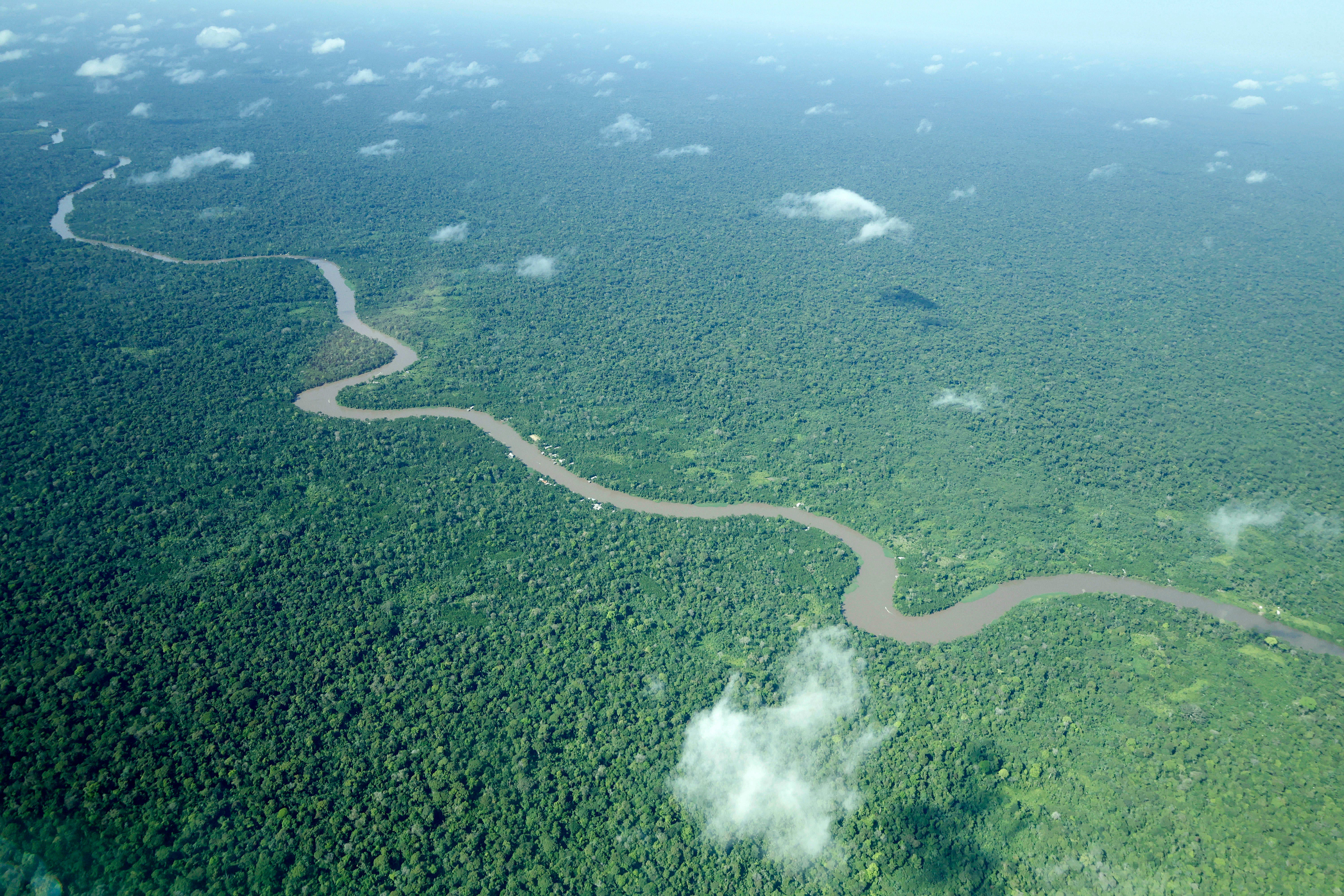
The Amazon rainforest seen from above near the mouth of the Amazon River. (Ricardo Lima/Getty)
Less than a year ago, in November 2025, Brazil hosted the United Nations’ annual climate summit, COP, that restored the country’s status as a key player in the global climate debate. This was a particularly important development given that Brazil currently ranks among the top five contributors to greenhouse gas emissions, primarily due to agriculture, cattle ranching, and deforestation.
Four years after the last Brazilian presidential election, in which Lula defeated Jair Bolsonaro by a razor-thin margin, the effects of the climate crisis have intensified. As scientists and environmental, social, and civil society organizations have been warning for years, the planet is increasingly suffering the severe consequences of this reality, with a rise in the frequency and intensity of extreme natural events, in addition to the increase in average global temperatures. In Brazil, the historic drought in the Amazon in 2023 and the unprecedented floods in Rio Grande do Sul in 2024 were just a few examples.
The arrival of the El Niño weather phenomenon, forecast to last until early 2027 and once again cause severe droughts and above-average rainfall, alongside rising food prices, contributes to the growing importance of the climate debate in the electoral landscape.
In the geopolitical arena, the Brazilian presidential election will serve as yet another stage for the struggle for global hegemony between the United States and China—a contest currently focused largely on the race to control reserves of so-called critical minerals and rare earth elements. Beyond their strategic value for a clean energy transition, these resources are essential inputs for the defense industry.
“The election will reflect this struggle for hegemony,” says geographer Bruno Malheiro, a professor at the Federal University of Pará.
“One side, Flávio Bolsonaro’s, will be clearly structured around a policy of alliance and total alignment with the United States over critical minerals and rare earth elements,” Malheiro says. “On the other side, President Lula’s, we see a more open, multifaceted diplomatic policy, yet one clearly tethered to China in terms of economic strategy.”
Continuity on Environmental Policy vs. Return to Environmental Disregard
An analysis of both candidates’ platforms, as well as their speeches, stances, and track records, including Lula’s third term and Jair Bolsonaro’s administrations alongside Flávio’s tenure in the Senate, reveals two different paths. While the incumbent president signals a continuation of policies, with equally significant advances and limitations, his rival envisions a return to his father’s administration, grounded in the dismantling of environmental policies and a disregard for the climate agenda.
Political scientist Maureen Santos is a climate justice activist and international relations professor. In terms of the Paris Agreement negotiations, she believes that the fight against deforestation and illegal mining, and other issues, President Lula’s platform for the 2026 elections “doesn’t change much” compared to the proposals from the previous election or his current administration’s policies.
“However, it seems to me there is an attempt to forge a stronger connection with other areas of the government,” she notes.
To her, however, the platform does introduce some new elements. In particular, Lula places greater emphasis on policies concerning critical minerals and rare earth elements. Yet, Santos criticizes the lack of measures ensuring greater state control over the exploitation of these resources.
“Rhetoric about sovereignty obviously matters, but how can Brazil exercise sovereignty, for instance, given the new environmental licensing law, which relaxes licensing requirements, or the absence of a state-owned company for this sector?” she warns. “It is very difficult to envision sovereignty if the country continues to merely sell commodities.”
According to Santos, although Lula’s platform mentions technology transfer, processing, and value addition, there are doubts about whether this will actually materialize, given the negotiations the government has been conducting on this topic.
“But this is obviously not a sell-out like the one proposed by Flávio Bolsonaro on the subject. There is a stark difference,” notes Santos. She refers to a statement made by Flávio Bolsonaro in the United States this past March, that Brazil could be the solution for the U.S. to reduce its dependence on minerals from China.
Positive Results
For Suely Araújo, public policy coordinator at the Climate Observatory, a network of Brazilian environmental organizations, the content of the Lula government’s platform aligns with the actions taken during his current administration on the environment and climate. In her assessment overall, the president’s third term has yielded good results in this area.
“The Lula administration rebuilt environmental and climate governance, which had been severely dismantled by the end of the Bolsonaro administration,” she said.
Other positive aspects, according to Araújo, include the drop in deforestation rates, which account for a significant share of Brazil’s greenhouse gas emissions, and the increase in resources for the Climate Fund, the primary financing tool for climate change policy.
Brazil’s National Institute for Space Research monitors Amazon deforestation by satellite. According to the agency’s figures in August, this year, the Amazon recorded the smallest area under deforestation alerts in history, a 36% drop compared to 2025. According to the Climate Observatory, the total area under deforestation alerts in the Amazon region dropped 41% over the past four years during the Lula administration, compared to the four years prior under the Bolsonaro administration.
Meanwhile, Climate Fund resources have increased by more than 300 times since 2020, according to the figures presented in July by the Ministry of Finance. For 2026, the budget forecast is $5.3 billion, compared to $17.4 million six years earlier.
Complete Chaos
Flávio Bolsonaro’s government platform, meanwhile, is “a non-plan in this area,” observes Araújo, the Public Policy coordinator at the Climate Observatory.
“There are scattered references throughout the text making it clear that we would face very serious climate and environmental problems in general if everything he proposes were implemented. The possibility of this plan becoming reality is truly alarming,” she warns.
In Bruno Malheiro’s assessment, a Flávio Bolsonaro administration would lead us “to complete chaos, because he represents a project of violence and the total destruction of the state, of agreements, and of universities, which would become more directly tied to agribusiness, losing their autonomy.”
Malheiro also says, “we would see the destruction of the very logic of politics, turning it into an engine of destruction. We saw this clearly with the Jair Bolsonaro administration.”
While climate and environmental agendas appear repeatedly throughout Lula’s platform, Bolsonaro’s platform contains no mentions, for instance, of terms such as climate change, greenhouse gas emissions, the Paris Agreement, Nationally Determined Contributions—each country’s official plan to reduce greenhouse gas emissions, mitigation, or adaptation.
Suely Araújo points out that Flávio Bolsonaro’s stance as a senator already offered a preview of what a potential administration of his might look like.
“He signed bills attempting to eliminate the legal preservation of native vegetation on rural properties, and supported the law that dismantled environmental licensing, among other measures,” she says. “As for the climate, it is a non-issue for him; his approach to the subject would likely follow along the lines of his father Jair Bolsonaro, who, in some statements, bordered on denialism.”
“At the very least, a denial of the subject’s relevance,” she adds.
Although he backed away from the promise to withdraw Brazil from the Paris Agreement, Jair Bolsonaro’s administration cut climate research funding, stalled the Amazon Fund, and took a confrontational stance on international demands for deforestation and emissions reduction targets, among other issues.
According to UFPA professor Bruno Malheiro, a potential Flávio Bolsonaro administration would follow the denialist logic of his father’s tenure, but with certain nuances shaped by the current context.
“For instance, regarding critical minerals, he already envisions handing them over entirely [to the United States], but he will logically leverage the energy transition narrative to make this somewhat more palatable. Flávio Bolsonaro might be a bit more adept than his father in this regard,” Malheiro says.
However, on international climate agreements, Malheiro believes that Flávio Bolsonaro—if elected—would indeed adopt a denialist policy.
“He might engage in opportunistic behavior during a specific climate event, should a particular sector pressure him to accept an agreement that works to his advantage,” he says.
Environmental activist Maureen Santos suggests that the fact that Brazil attracts investment by playing a key role in the climate agenda might prevent a potential Flávio Bolsonaro administration from breaking away from it entirely.
“It will depend heavily on the dialogue with the United States, which withdrew not only from the Paris Agreement but also from the Climate Convention,” she points out.
Zero Deforestation
In his campaign platform, President Lula pledges to work toward “achieving net-zero deforestation by 2030.”
“To this end,” the document states, “all levels of government will continue to act in an integrated manner to implement deforestation control and prevention plans and to fully implement the National Integrated Fire Management Plan.”
According to the text, a fourth Lula administration would seek to ensure the effectiveness of the Forest Code and the Atlantic Forest Law, “advance the allocation of public lands for conservation units, Indigenous and quilombola territories (communities descended from Africans and Afro-Brazilians who escaped slavery), and strengthen land tenure regularization.”
“It is crucial to truly eliminate deforestation by 2030. The policy in this area is positive, but it also needs to be reinforced by economic policies that empower the relevant stakeholders,” says Maureen Santos. However, she finds that one of the current administration’s major “bottlenecks” is the weakness of policies aimed at strengthening family and peasant farming, local food systems, the demarcation and titling of Indigenous lands, and agrarian reform.
“It falls short on these points,” she adds.
Meanwhile, Flávio Bolsonaro announces a goal of eliminating “illegal deforestation” by 2029.
“We will combat illegal burning by strengthening prevention, monitoring, enforcement, and the fight against environmental crimes, using tools enhanced by artificial intelligence, real-time databases, satellite imagery, and coordinated action among state agencies,” the text reads.
Suely Araújo notes, however, that legalized deforestation must also be reduced, or at the very least, offset by carbon sequestration measures, such as reforestation and the restoration of degraded areas.
“None of this is in Flávio Bolsonaro’s plan,” she says.
While acknowledging that the third Lula administration has achieved positive results for the environment and climate, Araújo says those results are limited or contradicted by the low number of non-reimbursable grants from the Climate Fund, and the decision to expand fossil fuel exploration.
“Lula’s plan states that he will continue to expand climate finance. However, there are challenges, because the bulk of the funding consists of loans, meaning the government can lend the money but cannot provide it as grants,” she says. “This poses a limitation, particularly for municipalities that lack borrowing capacity. We need to increase the resources available as non-repayable grants, especially for climate change adaptation.”
Geographer Bruno Malheiro, however, criticizes the logic behind the climate finance model that he believes dominated the third Lula administration’s climate and environmental policy.
“It represents the state abdicating its responsibility and outsourcing this policy to international funds controlled by major corporations,” he argues.
“You can no longer think in terms of public policy, at least in the area of climate finance, as if the problem were merely a lack of money. The real challenge is building a structured policy to combat climate change—something we fail to do because we are held hostage by the logic of the funds,” he says.
Energy Sources
Regarding energy generation, among other points, Flávio Bolsonaro’s government program promises to “integrate” new renewable sources, “transform our oil and gas wealth into energy and jobs,” stimulate the modernization of oil refining, encourage transport to Brazil’s center-west region via “modes cheaper than trucking,” and favor domestic fertilizer production using gas “to reduce the foreign dependency that weakens agribusiness and our food security.”
Lula’s program, in turn, states that a new Workers’ Party administration will continue to increase the use of renewable energy and accelerate “the progressive replacement of fossil fuels with biofuels and low-carbon fuels, including hydrogen-based ones.”
It also says it will continue participating in international conversations to create a global roadmap away from fossil fuels. On the other hand, the text celebrates the resumption of investments in oil and gas and the successive production records broken by Petrobras.
For Andrea Camurça, coordinator of the Terramar Institute, an NGO defending the rights of traditional peoples and communities in Ceará’s coastal zone, the energy plan presented by the incumbent president’s campaign reflects the policies adopted during his administration.
“At the same time that we see the advance of renewable energy, we see the continuation and expansion of fossil fuel exploration, as is the case in the basin of the mouth of the Amazon River.” she says. “There is even a dispute over the area, whether it should be used for oil exploration, the installation of offshore wind turbines, or even mining.”
Camurça sees a significant contradiction between the expansion and diversification of renewable energy in Brazil, and the fact that it is largely allocated to major industrial projects. She points out that while low-income families spend a significant portion of their budgets on energy, the state subsidizes it for the implementation of projects such as data centers, facilities essential for technologies like artificial intelligence.
“When we talk about the need to consider the energy transition, it cannot focus solely on replacing fossil fuels with renewable energy. We have to rethink this capitalist, consumerist society. If we continue on this path, who will actually suffer the most?” she asks.
Igor Ojeda is a journalist.
This article first appeared in Le Monde Diplomatique Brasil and can be read in its original Portuguese here.