


by Leonardo Fernandes
Brasil de Fato
The results of the first round of Brazil’s presidential election, which sent ultra-conservative Senator Flávio Bolsonaro of the Liberal Party and incumbent President Luiz Inácio Lula da Silva of the Workers’ Party to a runoff scheduled for October 25, had immediate repercussions across Latin America.
The Brazilian election, in which Flávio Bolsonaro secured 47.03% of valid votes against Lula’s 45.16%, has become the epicenter of a regional geopolitical struggle that exposes the alignment of far-right leaders with Washington’s agenda versus the progressive governments defending continental sovereignty.
Leaders from Latin America’s progressive camp reacted with both caution and resolution, denouncing the risks of social regression and submission to U.S. interests.
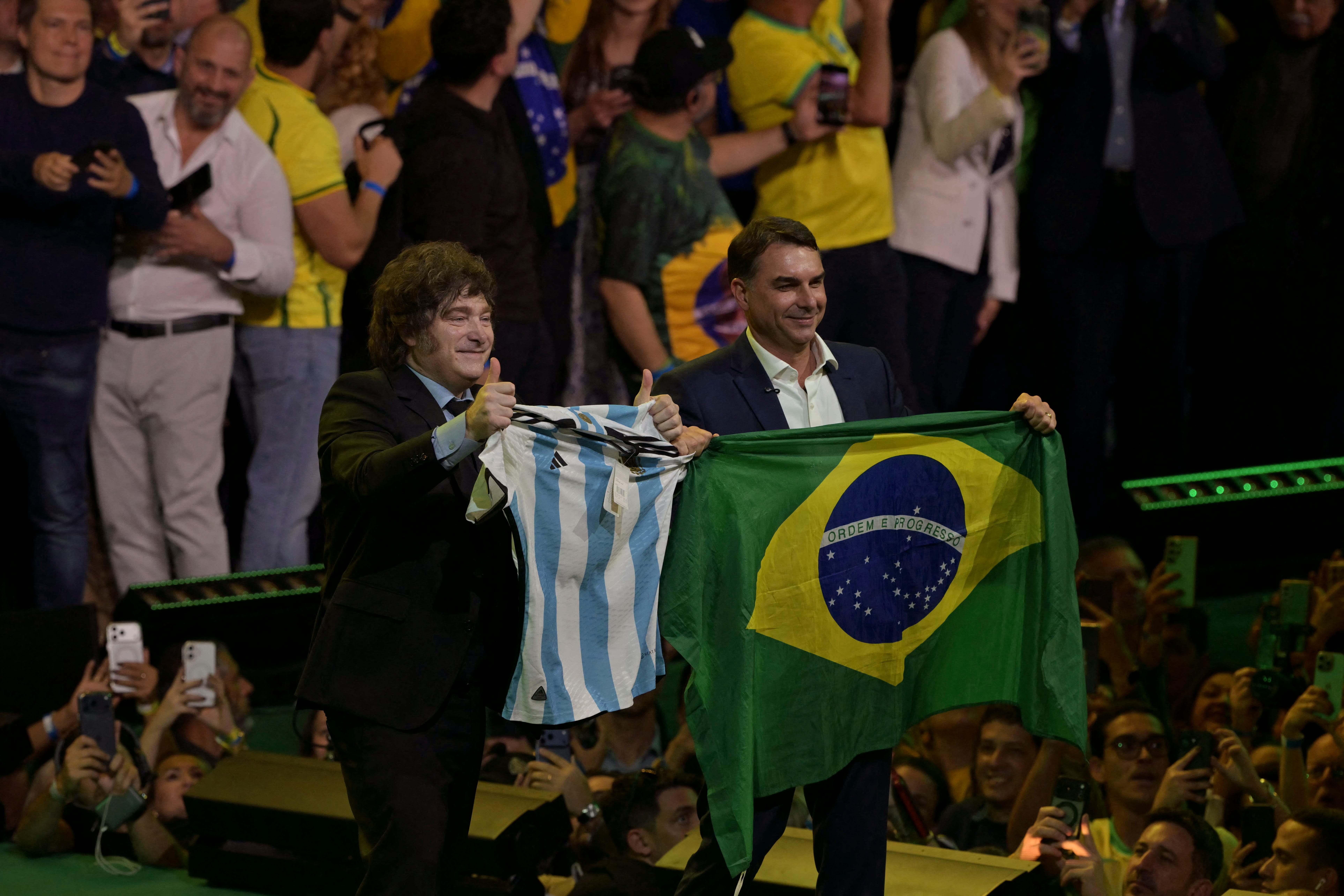
Argentine President Javier Milei holds a soccer jersey next to Brazil’s right-wing presidential candidate Flavio Bolsonaro during the launch of Bolsonaro’s candidacy, in São Paulo, Brazil, on July 25, 2026. (Nelson ALMEIDA / AFP via Getty Images)
Mexican President Claudia Sheinbaum emphasized the need to wait for the final runoff results before offering any definitive assessment of regional geopolitics. When asked if a potential victory for Flávio Bolsonaro would leave the Mexican government without allies in Latin America, Sheinbaum downplayed the potential friction with the ultraconservative figure.
“Our main ally is the people of Mexico; as long as we remain close to the people, representing them and governing by and for the people, there will be no problem whatsoever,” Sheinbaum said during her daily press conference.
Meanwhile, former Colombian president Gustavo Petro criticized the rhetoric of local right-wing factions and denounced interference by the Trump administration in Latin America. Petro emphasized that the brief periods of progressive and humanist governments reduced the region’s historic social inequality. He said that Washington’s strategy seeks to destroy sovereignty and foster political instability.
“President Donald Trump decided to accept [Secretary of State] Marco Rubio’s proposal and prioritize an agenda of destroying progressivism over the agenda of combating drug trafficking; it is worth remembering that progressive ideas lie at the origin of all American republics, including that of the U.S.A.,” Petro wrote.
“The consequence of Donald Trump’s policy will be increased social and economic inequality, as well as a rise in drug trafficking, violence, and northward migration. For the people of Latin America whose elections have been rigged by the direct interference of a foreign government, there is no alternative but rebellion,” Petro argued.


Trump and Rubio’s Allies
Among conservative and far-right leaders, the vote was met with an atmosphere of euphoria and celebration.
Argentine President Javier Milei took to social media to celebrate the results in Brazil, describing the election as historic and calling Lula a “communist leftist.” Milei once again championed the U.S. ultraconservative movement by citing the acronym MAGA, shorthand for Trump’s slogan “Make America Great Again.”
“A communist leftist loses to a right-winger, and the markets celebrate with sharp gains… Impoverishing leftists, get out of the way, for we are trying to make the continent shine,” Milei wrote on X.


In another post, the Argentine president stated that “freedom is advancing in Brazil.”
“Congratulations, dear friend Flávio Bolsonaro, on this historic election against the communist Lula,” posted Milei, who is facing a severe crisis of popularity amid the skyrocketing poverty rate among the Argentine population.

In the same vein, Colombian President Abelardo de la Espriella stated that the true meaning of change lies in defeating the left, publicly expressing his support for the pro-Bolsonaro candidate.
“Today my heart is with Brazil; may God have mercy on this sister nation, just as He did with Colombia. True change is defeating the left,” wrote Espriella. “A big hug, my friend Flávio Bolsonaro. Stand firm for the Fatherland!” posted the Colombian president, concluding his message with a salute to Cristo Rey.

Venezuelan opposition leader María Corina Machado also celebrated the election results, linking Flávio Bolsonaro’s performance to the effort to defeat communism in the region. Israeli Prime Minister Benjamin Netanyahu joined in the congratulations and expressed a desire to restore priority diplomatic ties with Brazil under a potential right-wing government.
“My respect and affection go to the people of Brazil for an exemplary democratic process, in which they were able to proudly exercise popular sovereignty through the vote. My recognition goes to Flávio Bolsonaro, the winner of this first round,” the Venezuelan far-right leader posted.
“We Latin Americans want to live in freedom, democracy, prosperity, and justice, and Brazil plays a decisive role in our region’s future,” Machado said. In the post, the Venezuelan politician stated that “very soon, Venezuela, too, will advance along the path to freedom.”

Overt Intervention
The reactions from both blocs are unfolding against a backdrop of growing interference by Washington in Latin America, a trend solidified by the Donald Trump administration’s strategy known as the “Shield of the Americas.” The region’s recent history is marked by episodes of economic pressure, sanctions, and disinformation campaigns.
In Colombia, the election of Abelardo de la Espriella was marred by allegations regarding the massive use of artificial intelligence and digital bot farms, as well as explicit support from the White House and Secretary of State Marco Rubio. In Argentina, a $20 billion currency swap agreement was openly made conditional upon Javier Milei’s electoral success. In Honduras, the scandal known as “Hondurasgate” exposed negotiations and a pardon granted by Trump to former President Juan Orlando Hernández, aimed at reorganizing local conservative forces.
Brazil in the Empire’s Crosshairs
In Brazil’s case, warnings of foreign intervention have moved beyond mere suspicion and have become the subject of formal investigations. The Federal Police have opened a preliminary inquiry into potential U.S. interference in the 2026 election.
The probe was initiated following a formal request from the Office of the Attorney General, prompted by revelations that a U.S. State Department fund had allocated $1 million to finance groups dedicated to attacking Brazil’s Supreme Court and undermining democratic institutions.
Concurrently, Lula’s campaign petitioned the Superior Electoral Court to investigate the U.S. Embassy’s unilateral decision to suspend consular services in Brazil just before the vote, citing security threats that were not substantiated by Federal Police inquiries. Intelligence reports indicate that Washington’s actions seek to create an environment of chaos and instability, viewing Lula’s leadership as an obstacle to plans for neocolonial domination and control over strategic resources in the Western Hemisphere.
This article first ran in Brasil de Fato, was translated by Panamerican Dispatch, and can be read in its original Portuguese here.